Question
Explain the construction and working of Ferry’s black body.

Answer

i. Ferry's perfectly blackbody consists of a double-walled hollow sphere having a tiny hole or aperture, through which radiant heat can enter.
ii. The space between the walls is evacuated and the outer surface of the sphere is silvered.
iii. The inner surface of a sphere is coated with lampblack.
iv. There is a conical projection on the inner surface of the sphere opposite the aperture. The projection ensures that a ray travelling along the axis of the aperture is not incident normally on the surface and is therefore not reflected back along the same path.
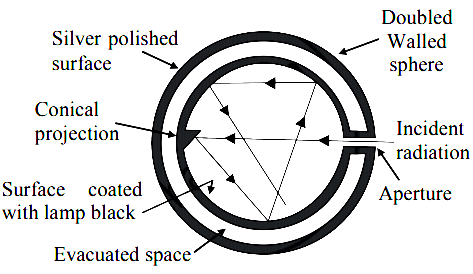
Ferry's blackbody
v. A heat ray entering the sphere through the aperture suffers multiple reflections and is almost completely absorbed inside.
vi. Thus, the aperture behaves like a perfect blackbody.
vii. The effective area of a perfect blackbody is equal to the area of the aperture.

Need a full question paper?

Generate a complete, print-ready paper with questions like this in minutes — across 16+ boards, with answer keys.

Start Generating Free

Similar questions

'If $\mathrm{r}=1$, then it is a white body'. Is this true ? Explain.
Calculate the rms speed of hydrogen molecules at 373.2K. [Molar mass of hydrogen, $M_0=2$ $\left.\times 10^{-3} \mathrm{~kg} / \mathrm{mol}, \mathrm{R}=8.314 \mathrm{~J} / \mathrm{mol} . \mathrm{K}\right]$
A current of equal magnitude flows through two long parallel wires separated by \(0.2 cm\). If force per unit length of \(4 \times 10^{-2} N / m\) acts on both the wires respectively, calculate the current through each wire.
A body cools from \(80^{\circ} C\) to \(70^{\circ} C\) in 5 minutes and to \(62^{\circ} C\) in the next $5$ minutes. Calculate the temperature the surroundings.
A cylinder containing one gram molecule of the gas was compressed adiabatically until its temperature rose from 27°C to 97°C. Calculate the work done and heat produced in the gas (? = 1.5).
Distinguish between harmonics and overtones.
The equation of motion of a particle executing SHM is $x = a \sin \left(\frac{\pi}{6} t\right)+ b \cos \left(\frac{\pi}{6} t\right)$, where a $=3 cm$ and $b =4 cm$. Express this equation in the form $x = A \sin \left(\frac{\pi}{6} t+\phi\right)$. Hence, find $A$ and $\varphi$.
Show that the frequency of the first line in Lyman series is equal to the difference between the limiting frequencies of Lyman and Balmer series.
If the refractive index of glass is $3 / 2$ and that of water is $4 / 3$ respectively, find the speed of light in glass and in water.
The total energy of free surface of a liquid drop is \(2 \pi\) times the surface tension of the liquid. What is the diameter of the drop? (Assume all terms in SI unit).