Question
Explain the Construction and working of gold leaf electroscope.
Answer

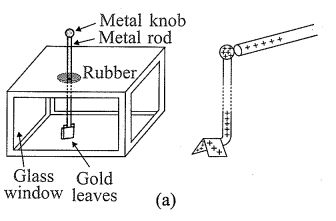
►A gold leaf electroscope is shown in figure.
►Its a simple apparatus to detect charge on a body [Fig. (a)].
►It consists of a vertical metal rod housed in a box, with two thin gold leaves attached to its bottom end.
►When a charged object touches the metal knob at the top of the rod, charge flows on to the leaves and they diverge.
►The degree of divergance is an indicator of the amount of charge.
Image

Need a full question paper?

Generate a complete, print-ready paper with questions like this in minutes — across 16+ boards, with answer keys.

Start Generating Free

Similar questions

Spring fitted doors close by themselves when released. You want to keep the door open for a long time, say for an hour. If you put a half kg stone in front of the open door, it does not help. The stone slides with the door and the door gets closed. However, if you sandwitch a 20g piece of wood in the small gap between the door and the floor, the door stays open. Explain why a much lighter piece of wood is able to keep the door open while the heavy stone fails.
An iron needle is attracted to the ends of a bar magnet but not to the middle region of the magnet. Is the material making up the ends of a bar magnet different from that of the middle region?
$a$. State Ampere's circuital law connecting the line integral of $B$ over a closed path to the net current crossing the area bounded by the path.
$b$. Use Ampere's law to derive the formula for the magnetic field due to an infinitely long straight current carrying wire.
$c$. Explain carefully why the derivation as in $(b)$ is not valid for magnetic field in a plane normal to a currentcarrying straight wire of finite length and passing through the midpoint of the axis.
Answer the following questions:
An applied voltage signal consists of a superposition of a dc voltage and an ac voltage of high frequency. The circuit consists of an inductor and a capacitor in series. Show that the dc signal will appear across C and the ac signal across L.
Draw a graph from the following data. Draw tangents at $x = 2, 4, 6$ and $8.$ Find the slopes of these tangents. Verify that the curve drawn is $y = 2x^2$ and the slope of dy tangent is $\tan\theta=\frac{\text{dy}}{\text{dx}}=4\text{x}.$
$x$ $1$ $2$ $3$ $4$ $5$ $6$ $7$ $8$ $9$ $10$
$y$ $2$ $8$ $18$ $32$ $50$ $72$ $98$ $128$ $162$ $200$
A man stands before a large wall at a distance of 50.0m and claps his hands at regular intervals. Initially, the interval is large. He gradually reduces the interval and fixes it at a value when the echo of a clap merges with the next clap. If he has to clap 10 times during every 3 seconds, find the velocity of sound in air.
Two point charges are placed at a distance d from each other. Due to these, the electric field intensity at any point is zero. But the point is not in the middle of these charges although on the line connecting them, write two necessary conditions for this to happen.
Find the area bounded under the curve $y = 3x^2 + 6x + 7$ and the $X-$ axis with the ordinates at $x = 5$ and $x = 10.$
What is light-emitting diode (LED)? Write down its one application.
Explain the dependence of the electric potential generated at a great distance due to a small electric dipole, when the point of observation is (i) in the axial position, and (ii) in the equatorial position.