Question
Explain the construction and working of solar cell.
Answer

Construction :
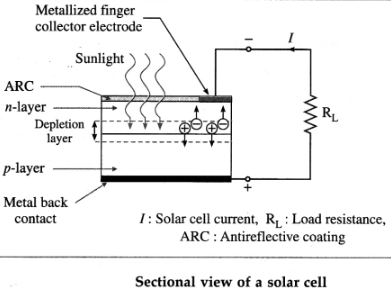
A simple pn-junction solar cell con-sists of a p-type semiconductor substrate backed with a metal electrode back contact. A thin n-layer (less than 2.5 pm, for silicon) is grown over the p-type substrate by doping with suitable donor impurity. Metal finger electrodes are prepared on top of the n-layer so that there is enough space between the fingers for sunlight to reach the n-layer and, subsequently, the underlying pn-junction.

Image

Working : When exposed to sunlight, the absorption of incident radiation (in the range near-UV to infrared) creates electron-hole pairs in and near the depletion layer.

Consider light of frequency v incident on the pn-junction such that the incident photon energy hv is greater than the band gap energy EG of the semiconductor. The photons excite electrons from the valence band to the conduction band, leaving vacancies or holes in the valence band, thus generating electron-hole pairs.

The photogenerated electrons and holes move towards the n side and p side, respectively. If no external load is connected, these photogenerated charges get collected at the two sides of the junction and give rise to a forward photovoltage. In a closed- circuit, a current I passes through the external load as long as the solar cell is exposed to sunlight.

A solar cell module consists of several solar cells connected in series for a higher voltage output. For outdoor use with higher power output, these modules are connected in different series and parallel combinations to form a solar cell array.

[Note : Currently most of the crystalline solar cells are p-type as described above. This is because of a lower cost of production of p-type. But performance wise, n-type solar cells (a thin p-layer over an n-type substrate by doping with suitable acceptor impurity) can give much better efficiency compared to p-type solar cells.]

Need a full question paper?

Generate a complete, print-ready paper with questions like this in minutes — across 16+ boards, with answer keys.

Start Generating Free

Similar questions

How are polarized light and unpolarized light represented in a ray diagram ?
OR
How will you distinguish between polarized and unpolarized light in a ray diagram?
On passing light of wavelength $5000 A$ through two pinholes $2\ mm$ apart, an interference pattern is formed on a screen kept parallel to the plane of the pinholes and $100 \ cm$ from them. Find the distance between the fifth bright band on one side of the central bright band and the sixth dark band on the other side.
Express the equation of a simple harmonic progressive wave in different forms.
A rectangular coil of length $0.5 m$ and breadth $0.4 m$ has resistance of $5 \Omega$. The coil is placed in a magnetic field of induction $0.05 T$ and its direction is perpendicular to the plane of the coil. If the magnetic induction is uniformly reduced to zero in 5 milliseconds, find the emf and current induced in the coil.
Define ideal simple pendulum and obtain an expression for its periodic time.

Define mass flow rate or mass flux. Explain how it is related to the velocity of fluid.
Find the capacitance of a parallel plate capacitor with a dielectric slab between the plates.
An $\text{LCR}$ series combination has $R=10 \Omega_r L =1 mH$ and $C =2 \mu F$. Determine $(i)$ the resonant frequency $(ii)$ the current in the circuit $(iii)$ voltages across $L$ and $C$, when an alternating voltage of rms value $10 mV$ operating at the resonant frequency is applied to the series combination.
State the conditions for constructive and destructive interference of light.
Obtain the expression for the period of a simple pendulum performing S.H.M.