Question
Explain the deviation in ionisation enthalpy of some elements from the general trend by using.

Answer

Ionisation enthalpy increases in a period with increase in atomic number. The graph shows few exceptions and not the linear relationship. Ionisation enthalpy of Be is greater than that of B due to filled s-orbital in Be $\left(\mathrm{Be}-\mathrm{I} . \mathrm{s}^2 1 \mathrm{~s}^2, \mathrm{~B}-1 \mathrm{~s}^2 2 \mathrm{~s}^2 2 \mathrm{p}^1\right)$
Ionisation enthalpy of N is greater than that of O due to half-filled p-orbitals in nitrogen. $\left(N-1 s^2 2 s^2 2 p^3, O-1 s^2 2 s^2 2 p^4\right)$.

Need a full question paper?

Generate a complete, print-ready paper with questions like this in minutes — across 16+ boards, with answer keys.
Start Generating Free

Similar questions

i. Account for the following:
a. Boron trihalides $\left( BX _3\right)$ act as Lewis acids.
b. $PbCl _4$ is a powerful oxidising agent.
c. Graphite acts as a good lubricant.
ii. Complete the following reactions:
  1. $\text{NA}_2\text{B}_4\text{O}_7+2\text{HCl}+5\text{H}_2\text{O}\xrightarrow{\ \ \ \ \ \ \ }$
  2. $\text{B}_2\text{H}_6+6\text{NH}_3\xrightarrow{\Delta\ \ }$
  1. How can you say that sugar is solid and water is liquid?
  2. Oxygen is prepared by catalytic decomposition of potassium chlorate ($KClO_3$​​​​​​​). Decomposition of potassium chlorate gives potassium chloride (KCl) and oxygen ($O_2​​​​​​​$​​​​​​​)· If 2.4mol of oxygen is needed for an experiment, how many grams of potassium chlorate must be decomposed?
(At. mass of K = 39, Cl = 35.5, O = 16)
Write a relation between $\Delta\text{G}$ and Q and define the meaning of each term and answer the following:
  1. Why a reaction proceeds forward when Q < K and no net reaction occurs when Q = K.
  2. Explain the effect of increase in pressure in terms of reaction quotient Q. for the reaction: $\text{CO(g)}+\text{3H}_2\text{(g)}\rightleftharpoons\text{CH}_4\text{(g)}+\text{H}_2\text{O(g)}$
  1. What is the shape of orbital with l = 2 and l = 3?
  2. Account for the following:
  • Chromium has configuration $3d^5 4s^1$ and not $3d^4 4s^2$.
  • Bohr's orbits are called stationary orbits or states.
What happens when
  1. Chlorine gas is passed through a cold and dilute solution of NaOH?
  2. Yellow phosphorus is heated with NaOH solution?
  3. Carbon dioxide is passed through ammonical brine solution?
  4. Sodium hydrogen carbonate is heated?
Carbon monoxide gas is more dangerous than carbon dioxide gas. Why?
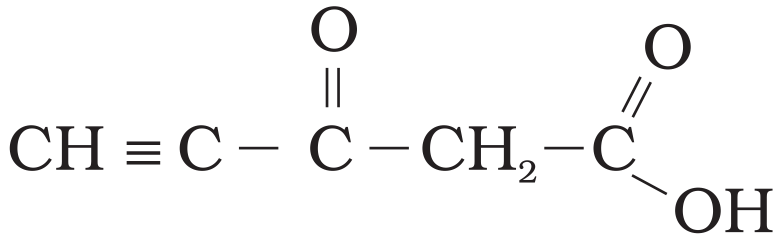
Predict the hybridization of each carbon in the molecule of organic compound given below. Also indicate the total number of sigma and pi bonds in this molecule.
The enthalpy of vaporisation of liquid diethyl ether $\left(\mathrm{C}_2 \mathrm{H}_5\right)_2 \mathrm{O}$ is $26.0 \mathrm{~kJ} \mathrm{~mol}^{-1}$ at its boiling point (35.0°C). Calculate $\Delta\text{S}^\circ$ for the conversion of:
  1. Liquid to vapour.
  2. Vapour to liquid at 35°C.
Calculate the total number of electrons present in $1.6g$ of methane.
Write down the quantum numbers n, and I for the following orbitals.
i. $3 d_{x^2-y^2}$
ii. $4 \mathrm{~d}_{\mathrm{z}^2}$
iii. $3 \mathrm{~d}_{\mathrm{xy}}$
iv. $4 d_{x z}$
v. $2 p_z$
vi. $3 p_x$