Question
Explain the difference between static friction, kinetic friction and rolling friction.

Answer

self

Need a full question paper?

Generate a complete, print-ready paper with questions like this in minutes — across 16+ boards, with answer keys.
Start Generating Free

Similar questions

State and explain three different modes of transference of heat. Explain how the loss of heat due to these three modes are minimised in a thermos flask.
$\hat{i}$ and $\hat{j}$ are unit vectors along $x$ and $y$ axis respectively. What is the magnitude and direction of the vectors $\hat{i}+\hat{j}$ and $\hat{i}-\hat{j}$ ? What are the component of a vector $\overrightarrow{ A }=2 \hat{ i }+3 \hat{ j }$ along the direction of $\hat{i}+\hat{j}$ and $\hat{i}-\hat{j}$ ? (You can use the graphical method).
The wavelength of sodium light in air is 589nm.
  1. Find its frequency in air.
  2. Find its wavelength in water (refractive index = 1.33).
  3. Find its frequency in water.
  4. Find its speed in water.
Prove that when a particle suffers an oblique elastic collision with another particle of equal mass and initially at rest, the two particles would move in mutually perpendicular directions after collisions.
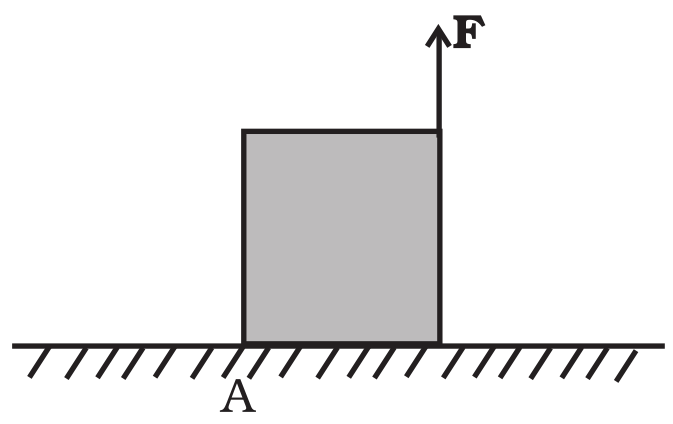
A uniform cube of mass m and side a is placed on a frictionless horizontal surface. A vertical force F is applied to the edge as shown in match the following (most appropriate choice):

a. $\frac{\text{mg}}{4}<\text{F}<\frac{\text{mg}}{2}$ i. Cube will move up.
b. $\text{F}>\frac{\text{mg}}{2}$ ii. Cube will not exhibit motion.
c. $\text{F}>\text{mg}$ iii. Cube will begin to rotate and slip at A.
d. $\text{F}=\frac{\text{mg}}{4}$ iv. Normal reaction effectively at $\frac{\text{a}}{3}$


Consider a rectangular block of wood moving with a velocity v0 in a gas at temperature T and mass density ρ. Assume the velocity is along x-axis and the area of cross-section of the block perpendicular to v0 is A. Show that the drag force on the block is $4\rho\text{ Av}_0\sqrt{\frac{\text{KT}}{\text{m}}}$ where m is the mass of the gas molecule.
0.1 gm molecule of diatomic gas is isothermally expanded at 293 K to twice its initial volume. After that its adiabatic expansion is done until the final volume becomes four times the initial volume. Find the final temperature of the gas and also calculate the work done for both the expansion ( $R = 8 . 3$ joule $m o l ^{ l } K ^{-1}$, $\gamma=1.4)$
A stone of mass 0.25kg tied to the end of a string is whirled round in a circle of radius 1.5m with a speed of 40 rev./min in a horizontal plane. What is the tension in the string? What is the maximum speed with which the stone can be whirled around if the string can withstand a maximum tension of 200N?
The edge of an aluminium cube is 10 cm long. One face of the cube is firmly fixed to a vertical wall. A mass of 100 kg is then attached to the opposite face of the cube. The shear modulus of aluminium is 25 GPa. What is the vertical deflection of this face?
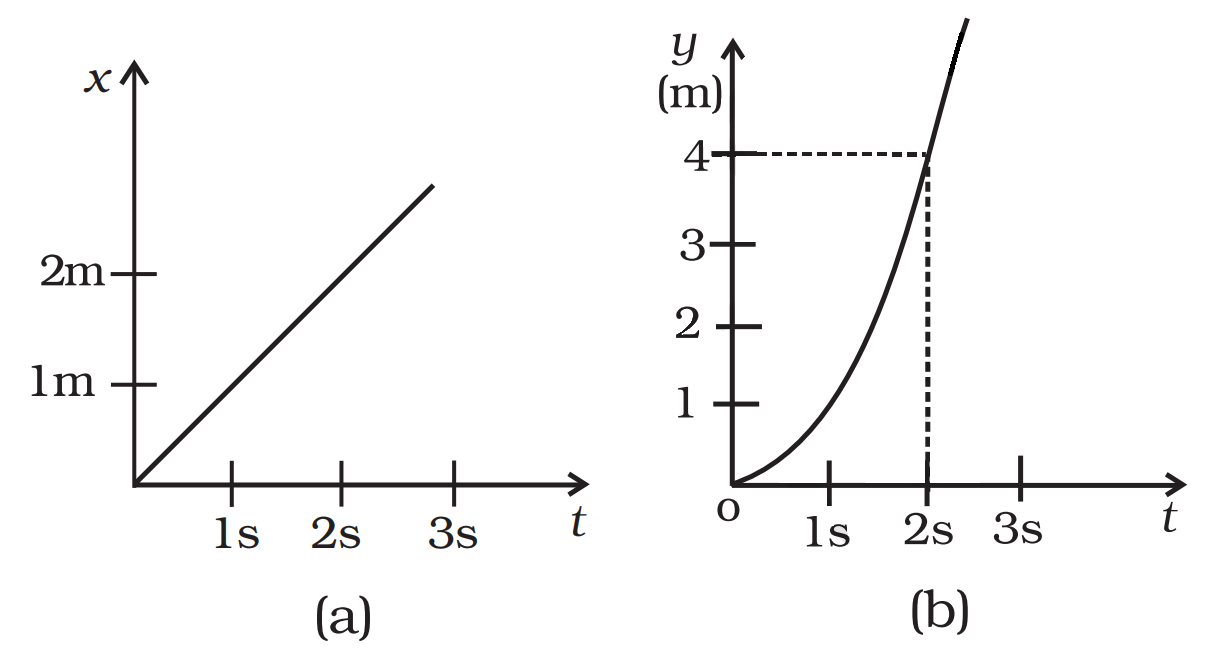
shows (x, t), (y, t) diagram of a particle moving in 2-dimensions.

If the particle has a mass of 500g, find the force (direction and magnitude) acting on the particle.