Question
Explain the effect of electric potential (potential difference) on photoelectric current and derive the definition and formula of stopping potential.
Answer

Initially, plate C is illuminated with light keeping plate A at positive potential with respect to plate C and keeping the frequency (v) and intensity (I) of incident light constant. Due to the positive potential of $A$, some of the emitted photo electrons are attracted towards, plate A and form a photocurrent.
Now if the magnitude (value) of the positive potential of A is increased then more and more emitted electrons are attracted to A and form more photocurrent. Thus, photocurrent increases with voltage.
After some time, all the electrons emitted from plate C are collected by plate A and form the maximum photocurrent in the circuit. This value of current is saturated (maximum), meaning that on increasing the potential no longer increase the photocurrent. This maximum value of the photocurrent is called saturation current.
• Stopping Potential :
Now apply a negative potential to the plate A with respect to the plate $C$.
By doing this the electrons emitted from C will be repelled by A , so the electrons that have enough energy to overcome the repulsion of A will reach A and form a current in the circuit, so the photocurrent will decrease.
Now if the negative potential of A is increased i.e. made more negative, more and more electrons will be repelled and the number of electrons falling on A will decrease, so the photocurrent will also decrease rapidly.
For some minimum value of the negative potential of A , all electrons arriving at A will be stopped. i.e. the photocurrent in the circuit will be zero. This minimum value of negative potential of A is called the stopping potential or cut-off voltage.
Each electron emitted from C has a different energy (kinetic energy), so if the electron with the maximum kinetic energy is stopped by the repulsion of the plate A , all the electrons are stopped and the photocurrent in the circuit is stopped.
Suppose, maximum kinetic energy of electron is $K _{\max }$.
The energy provided by the repulsion of A to stop this electron $=e V_0$
Thus, photocurrent stops if $K _{\max }=e V_0$.
Here the voltage $V _0$ will be the stopping potential or cut-off voltage.
Image
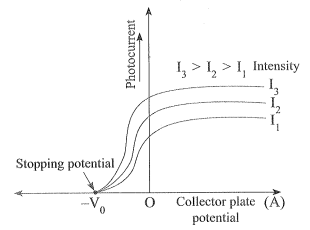
Now keeping the frequency of the incident light constant and increasing its intensity (i.e. intensity $I_2$ then $I _3$, where $I _3> I _2> I _1$ ) a graph of photocurrent versus collector plate can be drawn.
It is clear from this graph that by increasing the intensity of light the value of the maximum saturated photocurrent increases, So $I =\frac{q}{t}=$ $\frac{n e}{t}$ as the number of electrons emitted in 1 sec increases by $\left(\frac{n}{t}\right)$, but the value of the stopping potential does not change, so it can be said from
$K _{\max }=e V_0$, the maximum kinetic energy of emitted photoelectrons does not depend on the intensity of incident light.
$K _{\max }$ does not depend on the intensity of incident radiation.

Need a full question paper?

Generate a complete, print-ready paper with questions like this in minutes — across 16+ boards, with answer keys.
Start Generating Free

Similar questions

A particle of mass ‘m’, with charge ‘q’ moving with a uniform speed ‘v’, normal to a uniform magnetic field ‘B’, describes a circular path of radius ‘r’. Derive expressions for the:
  1. Time period of revolution.
  2. Kinetic energy of the particle.
  1. State the law of radioactive decay. Write the SI unit of ‘activity’.
  2. There are $4\sqrt{2}\times10^6$ radioactive nuclei in a given radioactive sample. If the half life of the sample is 20 s, how many nuclei will decay in 10 s?
Calculate the number of photons emitted per second by a 10W sodium vapour lamp. Assume that 60% of the consumed energy is converted into light. Wavelength of sodium light = 590nm.
Draw the circuit diagram showing how a p-n junction diode is
i. forward biased
ii. reverse biased
How is the width of depletion layer affected in the two cases?
A wire AB is carrying a steady current of 12 A and is lying on the table. Another wire CD carrying 5A is held directly above AB at a height of 1 mm. Find the mass per unit length of the wire CD so that it remains suspended at its position when left free. Give the direction of the current flowing in CD with respect to that in AB. $[$Take the value of $g = 10 ms^{–2}]$
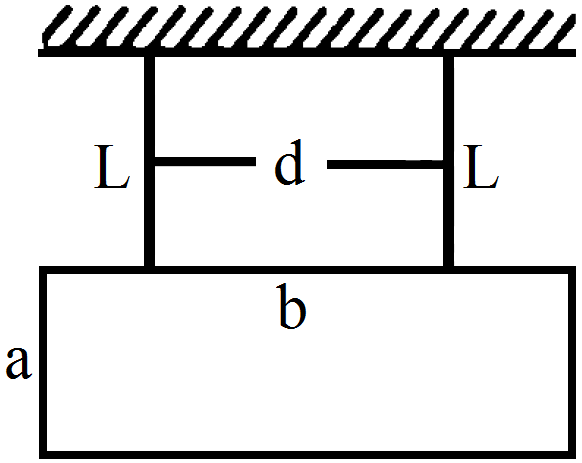
A rectangular plate of sides a and b is suspended from a ceiling by two parallel strings of length L each figure The separation between the strings is d. The plate is displaced slightly in its plane keeping the strings tight. Show that it will execute simple harmonic motion. Find the time period.
A wire of length 1m and radius 0.1mm has a resistance of $100\Omega.$ Find the resistivity of the material.
Find the range of frequency of light that is visible to an average human being $(400\text{nm} < \lambda < 700\text{nm}).$
A bulb rated 60W at 220V is connected across a household supply of alternating voltage of 220V. Calculate the maximum instantaneous current through the filament.
A thin spherical shell lying on a rough horizontal surface is hit by a cue in such a way that the line of action passes through the centre of the shell. As a result, the shell starts moving with a linear speed v without any initial angular velocity. Find the linear speed of the shell after it starts pure rolling on the surface.