Question
Explain the effect of electric potential (potential difference) on photoelectric current and derive the definition and formula of stopping potential.
Answer

Initially, plate C is illuminated with light keeping plate A at positive potential with respect to plate C and keeping the frequency (v) and intensity (I) of incident light constant. Due to the positive potential of $A$, some of the emitted photo electrons are attracted towards, plate A and form a photocurrent.
Now if the magnitude (value) of the positive potential of A is increased then more and more emitted electrons are attracted to A and form more photocurrent. Thus, photocurrent increases with voltage.
After some time, all the electrons emitted from plate C are collected by plate A and form the maximum photocurrent in the circuit. This value of current is saturated (maximum), meaning that on increasing the potential no longer increase the photocurrent. This maximum value of the photocurrent is called saturation current.
• Stopping Potential :
Now apply a negative potential to the plate A with respect to the plate $C$.
By doing this the electrons emitted from C will be repelled by A , so the electrons that have enough energy to overcome the repulsion of A will reach A and form a current in the circuit, so the photocurrent will decrease.
Now if the negative potential of A is increased i.e. made more negative, more and more electrons will be repelled and the number of electrons falling on A will decrease, so the photocurrent will also decrease rapidly.
For some minimum value of the negative potential of A , all electrons arriving at A will be stopped. i.e. the photocurrent in the circuit will be zero. This minimum value of negative potential of A is called the stopping potential or cut-off voltage.
Each electron emitted from C has a different energy (kinetic energy), so if the electron with the maximum kinetic energy is stopped by the repulsion of the plate A , all the electrons are stopped and the photocurrent in the circuit is stopped.
Suppose, maximum kinetic energy of electron is $K _{\max }$.
The energy provided by the repulsion of A to stop this electron $=e V_0$
Thus, photocurrent stops if $K _{\max }=e V_0$.
Here the voltage $V _0$ will be the stopping potential or cut-off voltage.
Image
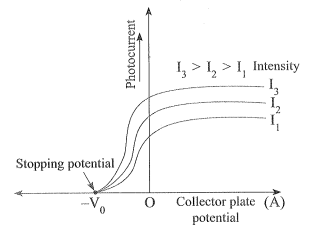
Now keeping the frequency of the incident light constant and increasing its intensity (i.e. intensity $I_2$ then $I _3$, where $I _3> I _2> I _1$ ) a graph of photocurrent versus collector plate can be drawn.
It is clear from this graph that by increasing the intensity of light the value of the maximum saturated photocurrent increases, So $I =\frac{q}{t}=$ $\frac{n e}{t}$ as the number of electrons emitted in 1 sec increases by $\left(\frac{n}{t}\right)$, but the value of the stopping potential does not change, so it can be said from
$K _{\max }=e V_0$, the maximum kinetic energy of emitted photoelectrons does not depend on the intensity of incident light.
$K _{\max }$ does not depend on the intensity of incident radiation.

Need a full question paper?

Generate a complete, print-ready paper with questions like this in minutes — across 16+ boards, with answer keys.

Start Generating Free

Similar questions

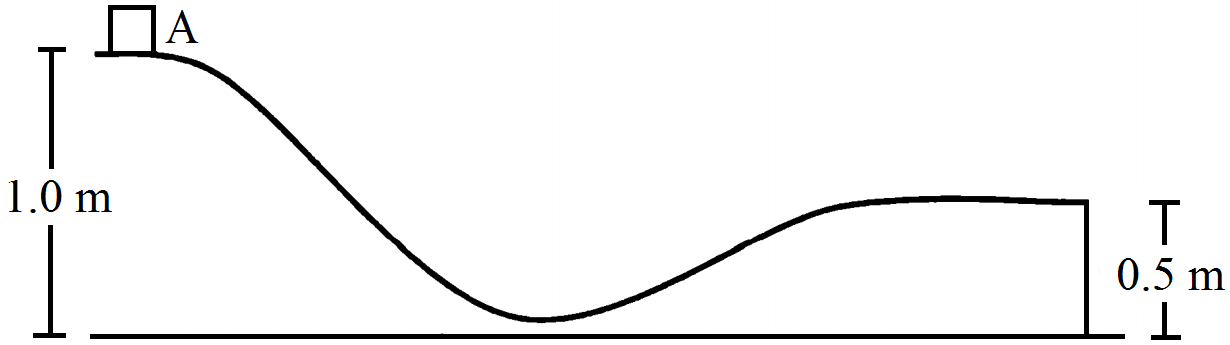
Figure shows a particle sliding on a frictionless track which terminates in a straight horizontal section. If the particle starts slipping from the point A, how far away from the track will the particle hit the ground?

A block is projected along a rough horizontal road with a speed of 10m/s. If the coefficient of kinetic friction is 0.10, how far will it travel before coming to rest?
Light in certain cases may be considered as a stream of particles called photons. Each photon has a linear momentum $\frac{\text{h}}{\lambda}$ where h is the Planck's constant and $\lambda$ is the wavelength of the light. A beam of light of wavelength $\lambda$ is incident on a plane mirror at an angle of incidence $\theta.$ Calculate the change in the linear momentum of a photon as the beam is reflected by the mirror.
Consider a simple harmonic motion of time period T. Calculate the time taken for the displacement to change value from half the amplitude to the amplitude.
A conducting sphere of radius 10 cm has an unknown charge. If the electric field 20 cm from the centre of the sphere is $1.5 \times 10^3 N / C$ and directed radially inward, what is the net charge on the sphere?
Can an electromagnetic wave be deflected by an electric field or a magnetic field?
Double - convex lenses are to be manufactured from a glass of refractive index 1.55, with both faces of the same radius of curvature. What is the radius of curvature required if the focal length is to be 20cm?
An ac genrator is made from area of cross section $3 m^2$ and a coil of 100 turns which is rotated by a constant angular velocity of $60 rad / s$ in a magnetic field of 0.04 T . Resistance of the coil is $500 \Omega$ Calculate: (i) maxumum current obtained from the generator and (ii) maximum power dissipated in the coil.
What are the advantages of the null-point method in a Wheatstone bridge? What additional measurements would be required to calculate Runknown by any other method?