Question
Explain the effect of intersity of light on photocurrent.

Answer

In an experimental arrangement of the photoelectric effect the collector A is maintained at a positive potential with respect to photosensitive plate C .
The potential difference between A and C and the frequency of the incident light is kept constant.
The intensity of incident light is changed.
When light is incident on plate C , electrons are emitted from it and these are attracted by plate A to form a photocurrent.
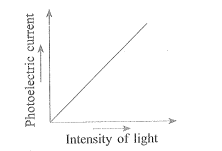
The magnitude of photocurrent obtained for different light intensities is measured with a microammeter and a graph of photocurrent versus intensity is drawn.
Image
The straight line of graph suggests that the photocurrent is directly proportional to the intensity of incident light.
Now, current $I =\frac{q}{t}$
$\therefore I =\frac{n e}{t} \quad(\because q=n e)$
BDkt, $n=$ Number of electrons
$e=$ Charge of electron
$\therefore \quad I \propto \frac{n}{t} \quad(\because e$ is constant $)$
Thus, the current (photocurrent) is directly proportional to the number of photoelectrons emitted per unit time.
From this it can be said that the number of photoelectrons emitted per unit time (one second) is directly proportional to the intensity of incident radiation.
Photocurrent $\propto$ Intensity
Photocurrent $\propto$ number of electrons per unit time. (Number of electrons emitted per unit time) $\propto$ (Intensity)

Need a full question paper?

Generate a complete, print-ready paper with questions like this in minutes — across 16+ boards, with answer keys.
Start Generating Free

Similar questions

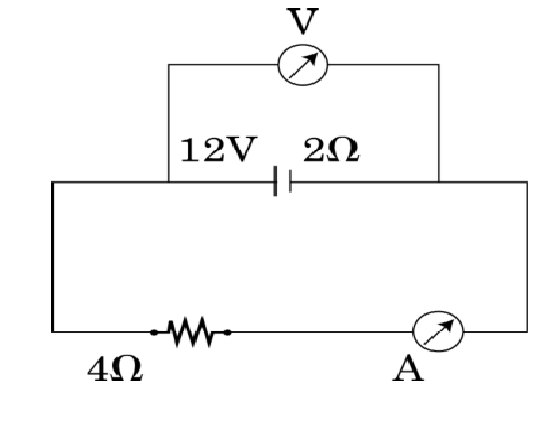
A battery of emf 12V and internal resistance 2 $\Omega$ is connected to a 4 $\Omega$ resistor as shown in the figure.
  1. Show that a voltmeter when placed across the cell and across the resistor, in turn, given the same reading.
  2. To record the voltage and the current in the circuit, why is voltmeter placed in parallel and ammeter in series in the circuit?
A beam of light consisting of two wavelengths, $4000 \mathring A$ and $6000 \mathring A ,$ is used to obtain interference fringes in a Young’s double$-$slit experiment. What is the least distance from the central maximum where the dark fringe is obtained?
A free neutron beta-decays to a proton with a half-life of 14 minutes.
  1. What is the decay constant?
  2. Find the energy liberated in the process.
Two spherical balls of mass 10kg each are placed 10cm apart. Find the gravitational force of attraction between them.
Two identical phase connected waves, each of intensity $I _0$, are producing interference patterns. Write the value of the resultant intensity at the places of (i) constructive interference, (ii) destructive interference
Explain threshold frequency.
  1. An em wave is travelling in a medium with a velocity $\overrightarrow{\text{v}} = \text{v}\hat{\text{i}}.$ Draw a sketch showing the propagation of the em wave, indicating the direction of the oscillating electric and magnetic fields.
  2. How are the magnitudes of the electric and magnetic fields related to the velocity of the em wave?
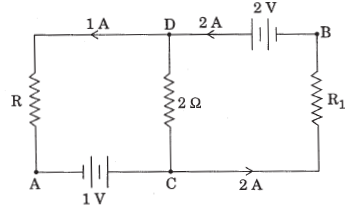
In the given circuit, assuming point A to be at zero potential, use Kirchhoff's rules to determine the potential at point B.
Answer the following questions:
In any ac circuit, is the applied instantaneous voltage equal to the algebraic sum of the instantaneous voltages across the series elements of the circuit? Is the same true for rms voltage?
From what electric dipole of electric field is found and for which two cases is the result simple?