Question
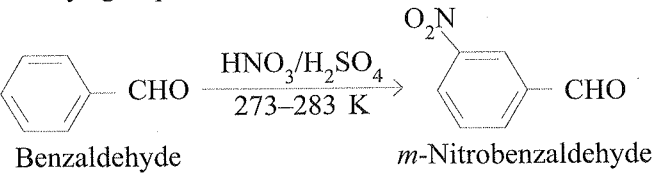
Explain the electrophilic substitution reaction of benzaldehyde with suitable example.

Answer

→ Electrophilic substitution reaction: Aromatic aldehydes and ketones undergo electrophilic substitution at the ring in which the carbonyl group acts as a deactivating and meta-directing group.
Image

Need a full question paper?

Generate a complete, print-ready paper with questions like this in minutes — across 16+ boards, with answer keys.
Start Generating Free

Similar questions

Note: In the following questions a statement of assertion followed by a statement of reason is given. Choose the correct answer out of the following choices.
  1. Assertion and reason both are correct statements and reason is correct explanation for assertion.
  2. Assertion and reason both are correct statements but reason is not correct explanation for assertion.
  3. Assertion is correct statement but reason is wrong statement.
  4. Assertion and reason both are incorrect statements.
  5. Assertion is wrong statement but reason is correct statement.
Assertion: When methyl alcohol is added to water, boiling point of water increases.
Reason: When a volatile solute is added to a volatile solvent elevation in boiling point is observed.
State the limitations of Valence bond theory
Give plausible explanation of :
Why are aliphatic amines stronger bases than aromatic amines?
(a) Write the structural formula of isobutyl alcohol.
(b) Draw the resonance structure of phenol.
When mixed ethers in which primary or secondary alkyl group is present is treated with one mole of HI , the iodide ion $\left( I ^{-}\right)$goes to which alkyl group and why?
p-Dichlorobenzene has higher m.p. than those of $o$-and $m$-isomers. Discuss.
Write the $IUPAC$ name and draw the structure of coordination entities of $[PtCl(NH_3)_5]Cl_3.$
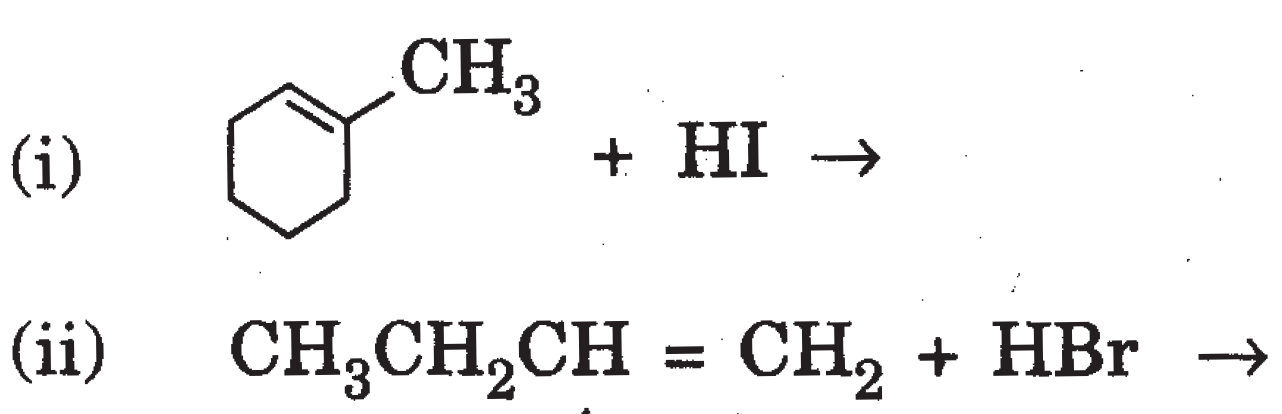
Complete the following reaction equations:
Give plausible explanation :
There are two - $NH _2$ groups in semi carbazide. However, only one is involved in the formation of semi-carbazones.
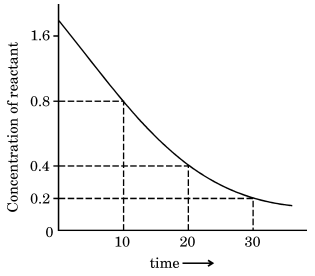
Analyse the given graph, drawn between concentration of reactant vs. time.
Image
(a) Predict the order of reaction.
(b) Theoretically, can the concentration of the reactant reduce to zero after infinite time? Explain.