Question
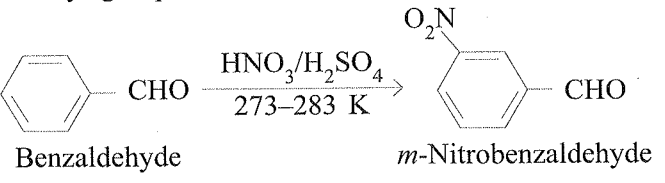
Explain the electrophilic substitution reaction of benzaldehyde with suitable example.
Answer

→ Electrophilic substitution reaction: Aromatic aldehydes and ketones undergo electrophilic substitution at the ring in which the carbonyl group acts as a deactivating and meta-directing group.
Image

Need a full question paper?

Generate a complete, print-ready paper with questions like this in minutes — across 16+ boards, with answer keys.

Start Generating Free

Similar questions

Define the following terms:
  1. Mole fraction.
  2. Isotonic solutions.
  3. Van't Hoff factor.
  4. Ideal solution.
If the value of rate constants are same for three reactions whose orders are 1,2 , and 3 , then what will be the order of the rates of these reactions if the value of concentration is 1 M , less than 1 M and more than 1 M ?
A graph between ln k and $\frac{1}{\text{t}}$ for a reaction is given. Here k is rate constant and T is temperature in Kelvin.

If OA = a and OB = b, answer the following:
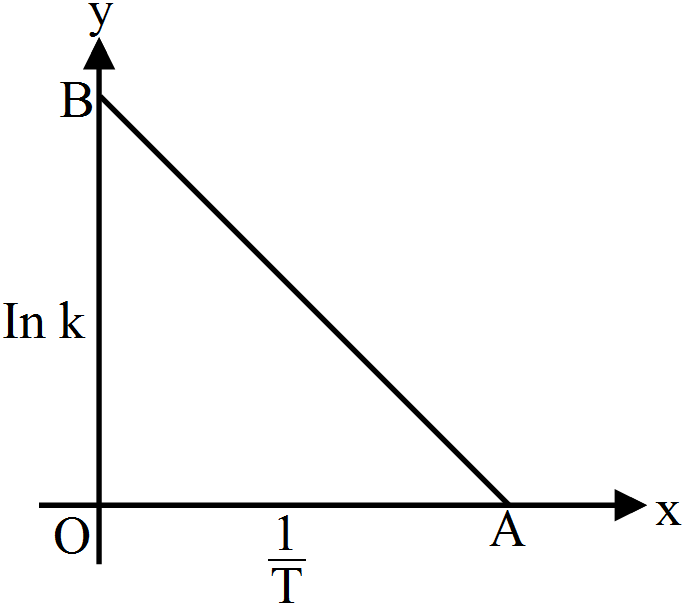
  1. What is the activation energy (Ea) of the reaction?
  2. What is the frequency factor (A) for the reaction?

Write steps to carry out the conversion of phenol to aspirin.
Use Hund's rule to derive the electronic configuration of Ce3+ ion, and calculate its magnetic moment on the basis of 'spin-only' formula.
The reaction between A and B is first order with respect to A and zero order with respect to B. Fill in the blanks in the following table:
Experiment [A]/mol L-1 [B]/mol L-1 Initial rate/mol L-1 min-1
I 0.1 0.1 2.0 × 10-2
II - 0.2 4.0 × 10-2
III 0.4 0.4 -
IV - 0.2 2.0 × 10-2
Answer the following:
(a) Define rate of reaction?
(b) For a reaction the rate law expression is represented as follows:
Rate $=k[A][B]^{\frac{1}{2}}$
   i. Interpret whether the reaction is elementary or complex. Give reason to support your answer.
  ii. Write the unit of rate constant for this reaction if concentration of A and B is expressed in moles/L
State Raoult’s law for solutions of volatile liquid components. Taking a suitable example, explain the meaning of positive deviation from Raoult’s law.
Chlorobenzene is extremely less reactive towards a nucleophilic substitution reaction. Give two reasons for the same.
For a first order reaction, show that time required for 99% completion is twice the time required for the completion of 90% of reaction.