Question
Explain the embryonic development upto blastula formation in human ?###Draw a labelled diagram of blastocyst formation.###Define Cleavage ? Explain the development of the zygote upto blastocyst formation.

Answer

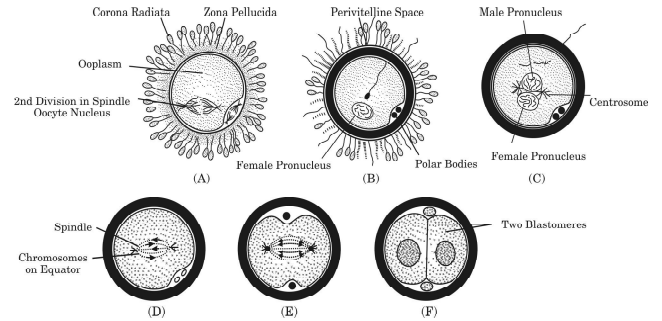
Fertilization : The fusion of male and female gametes produces diploid zygote. This process is called  fertilization.
Image
Cleavage : Structures and events proceed anticlockwise. At ovulation, the secondary oocyte leaves the ovary. A single sperm penetrates the zona pellucida, and fertilization occurs in the oviduct. As the zygote moves along the
oviduct, it undergoes cleavage to produce a morula (Fig.). The blastocyst forms and implants itself in the uterine lining.
Image
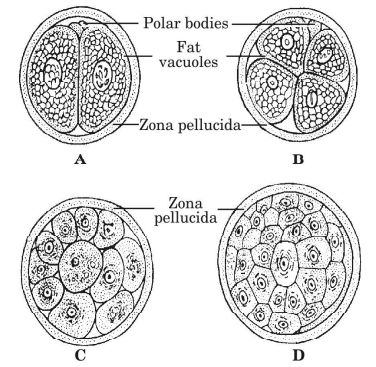
Fig. : Cleavage : In mammals, the cleavage is holoblastic or complete. First cleavage is vertical, second is also vertical but at right angle to the first cleavage. Third cleavage is horizontal. After this, the divisions are quick and irregular. As a result of this a solid ball of cells-morula is formed.
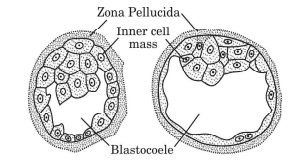
After fertilization the zygote passes down the fallopian tube. The cleavage takes place which is holoblastic in man and a many celled morula (Fig.) is formed having a cavity, the blastocoel (Fig.). It takes about 3 days. The morula is of the size of the zygote because even though the cleavage has taken place but there has not been growth of these newly formed cells. The cleaved cells are termed blastomeres. The outer layer of blastomere is called the trophoblast. (Gk. Troph = nourish and blast = bud).
Image
Fig. : Blastulation-formation of blastula from morula is called blastulation. Morula is changed to blastocyst. Its outer layer is called trophoblast. A group of cells are to the inner surface of trophoblasts. This is called inner mass of cells. As a result of cleavage a cavity is produced which is called blastocoel. From the inner cell mass ectoderm and endoderm are produced. Trophoblast is extra embryonic membrane, which helps in nutrition of embryo.
The trophoblasts at one point differentiate into thickened mass of cells, the inner cell mass. The inner cells mass eventually becomes the foetus. This stage having an inner cell mass is called blastocyst. Blastocyst is formed on the 5th day.
The blastocyst on reaching the uterus remains in the lumen for about two days. Its zona pellucida is dissolved and blastocyst comes in contact with the wall of the uterus, the endometrium. The trophoblasts derive nourishment from endometrium, divide repeatedly and within 6-7 days the balstocyst sinks down in the endometrium, and is embedded in it. This whole process is termed implantation.
Now trophoblasts form finger-like projections, the trophoblastic villi which liberate enzyme and dissolve the wall of arterial and venous blood vessels in the endometrium. At this stage, the exchange of nourishment, oxygen and excretory materials between the trophoblasts and maternal blood of the uterus wall is accomplished through the trophoblastic villi. Later on this function is performed by placenta which is formed by the fusion of allantois and chorion

Need a full question paper?

Generate a complete, print-ready paper with questions like this in minutes — across 16+ boards, with answer keys.
Start Generating Free

Similar questions

"It is often said that the pyramid of energy is always upright. On the other hand, the pyramid of biomass can be both upright and inverted." Explain with the help of examples and sketches.
List the attributes that populations possess but not individuals.
Which type of food would have lactic acid bacteria. Discuss their useful application.
Why do some adolescents start taking drugs? How can the situation be avoided?
In a biology class, teacher was telling the students that the structures/components and their functions in a watch can be compared with various levels of organisation we find in nature. Radhika was surprised and asked teacher to explain it. Teacher got impressed with Radhika's interest and explained that there is a systematic arrangement of smaller and simpler components into larger one in a hierarchy or pyramid having different levels where each level is formed of components of lower level and itself becomes part of higher level for achieving a common goal.
(i) What are the four levels of biological organisation found in nature?
(ii) What is the basic unit of ecological organisation?
(iii) Define community.
(iv) What values are shown by Radhika?
Describe the main ideas behind the biological control of pests and diseases.
(A)What is immunity and how many types are there?
(B) Write a brief note :-
(1) Auto immune disease$\quad$$\quad$(2) Allergy
a. Where is microsporangium located in an angiosperm? State the functions of tapetum and the other three layers of microsporangium.
b. Describe the structure of the male gametophyte produced as a result of microsporogenesis.
c. State the functions of each part of the male gametophyte.
What are the characteristics of DNA?
  1. In humans, males are heterogametic and females are homogametic. Explain. Are there any examples where males are homogametic and females heterogametic?
  2. Also describe as to, who determines the sex of an unborn child? Mention whether temperature has a role in sex determination.