Question
Explain the following briefly with appropriate example:
Revenue Recognition (Realisation) Concept.

Answer

Revenue Recognition (Realisation) Concept: According to the Revenue Recognition Concept, revenue is considered to have been realised when a transaction has been entered into and the obligation to receive the amount is established. It is to be noted that recognising revenue and receipt of an amount are two separate aspects.
Example: An enterprise sells goods in February, 2018 and receives the amount in April, 2018. Revenue of this sales should be recognised in February, 2018, i.e., when the goods are sold because the legal obligation to receive the amount is established (upon sales) in February, 2018. Let us take another example. Suppose, an enterprise has received an advance in February, 2018 for the sales to be made in May, 2018, revenue shall be recognised in May, 2018, upon sales having been made because the legal obligation to receive the amount is established in May, 2018.

Need a full question paper?

Generate a complete, print-ready paper with questions like this in minutes — across 16+ boards, with answer keys.

Start Generating Free

Similar questions

Prepare the purchase book of M/s Shiv Stationers from the following:
2010
 
June 1


Purchased from Gagan Stationery Mart on credit
70 dozens pencils @ ₹ 25 per dozen.
10 dozens registers @ ₹ 15 per register.
June 10
 
 
Purchased from Amrit Furniture.
2 Tables @ ₹ 1,500 per table.
June 15
Purchased 3 dozens ink pots @ ₹ 80 per dozen from Mehar Paper Co. And received cash discount of ₹ 50.
June 18


Purchased from Rehman Bros. on credit.
5 reams of white paper @ ₹ 50 per ream
120 pens @ ₹ 60 per dozen
Less: trade discount of 10%.
Pass Journal entry for purchase of goods by Amrit, Delhi from Add Gel Pens, Delhi for ₹ 15,000 less Trade Discount 10% and Cash Discount 3%. CGST and SGST is levied @ 6% each. Assume payment is made at the time of purchase.
On Jan 01, 2016, Shankar purchased goods from Parvati for ₹ 8,000 and immediately drew a promissory note in favour of Parvati payable after 3 months. On the date of maturity of the promissory note, the Government of India declared holiday under the Negotiable Instrument Act 1881. Since, Parvati was unaware about the provision of the law regarding the date of maturity of the bill, she handed over the bill to her lawyer, who duly presented the bill and received the payment. The amount of the bill was handed over by the lawyer to Parvati immediately. Recore the necessary Journal entries in the books of Parvati and Shankar.
On checking the Bank Pass Book it was found that it showed an overdraft of ₹ 5,220 as on 31.12.2014, while as per Ledger it was different to Bank Debit. The following differences were noted:
  1. Cheques deposited but not yet credited by bank ₹ 6,000.
  2. Cheques dishonoured and debited by bank but not given effect to it in the Ledger ₹ 800.
  3. Bank charges debited by bank but Debit Memo not received from bank ₹ 50.
  4. Interest on overdraft excess credited in the Ledger ₹ 200.
  5. Wrongly credited by bank to account, deposit of some other party ₹ 900.
  6. Cheques issued but not presented for payment ₹ 400.
Rectify the following errors:
  1. Credit sales to Mridula ₹ 5,000 were recorded as ₹ 5,400.
  2. Credit purchases from Nayna ₹ 8,000 were recorded as ₹ 8,800.
  3. Goods returned to Priya ₹ 12,000 were recorded as ₹ 12,200.
  4. Goods returned from Rashi ₹ 10,000 were recorded as ₹ 11,000.
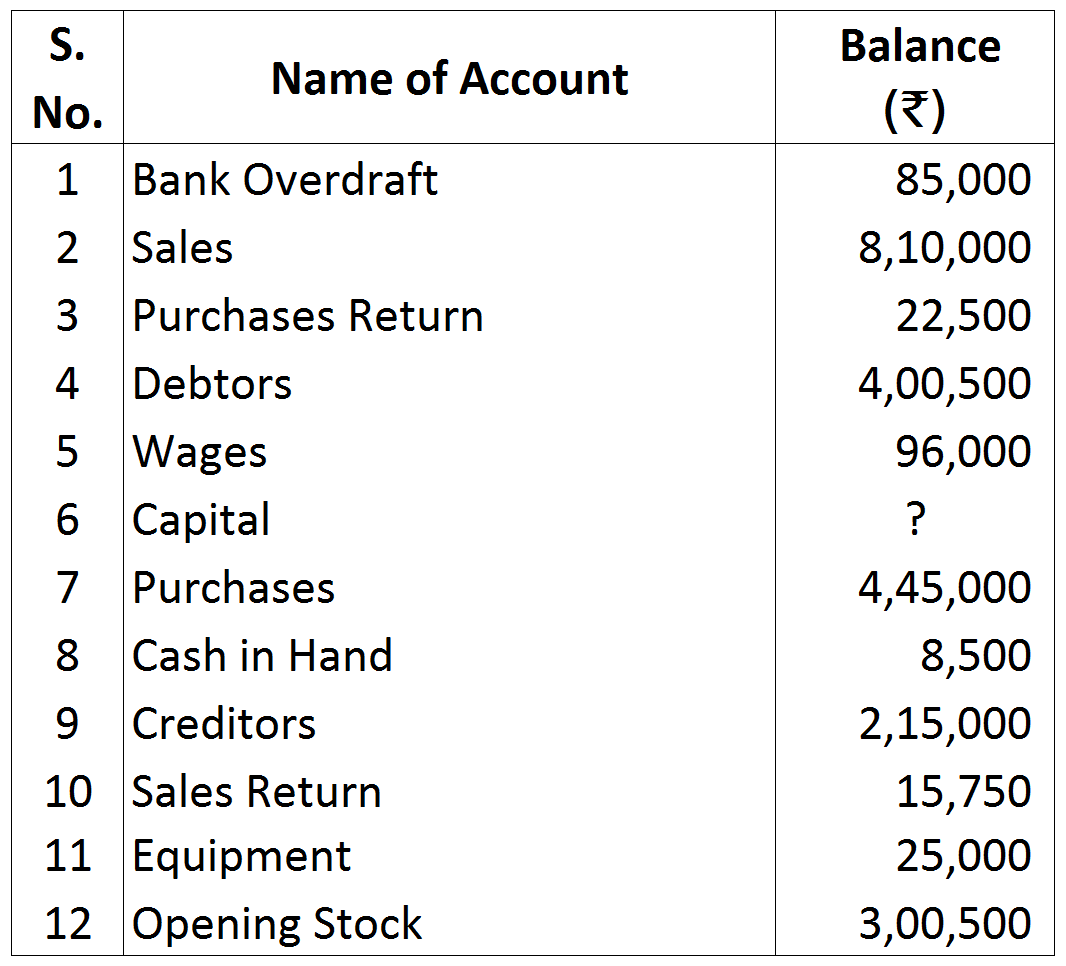
Prepare the Trial Balance of Ankit as on$31^{st}$​​​​​​​ March,$ 2019:$ He has omitted to open a Capital Account:
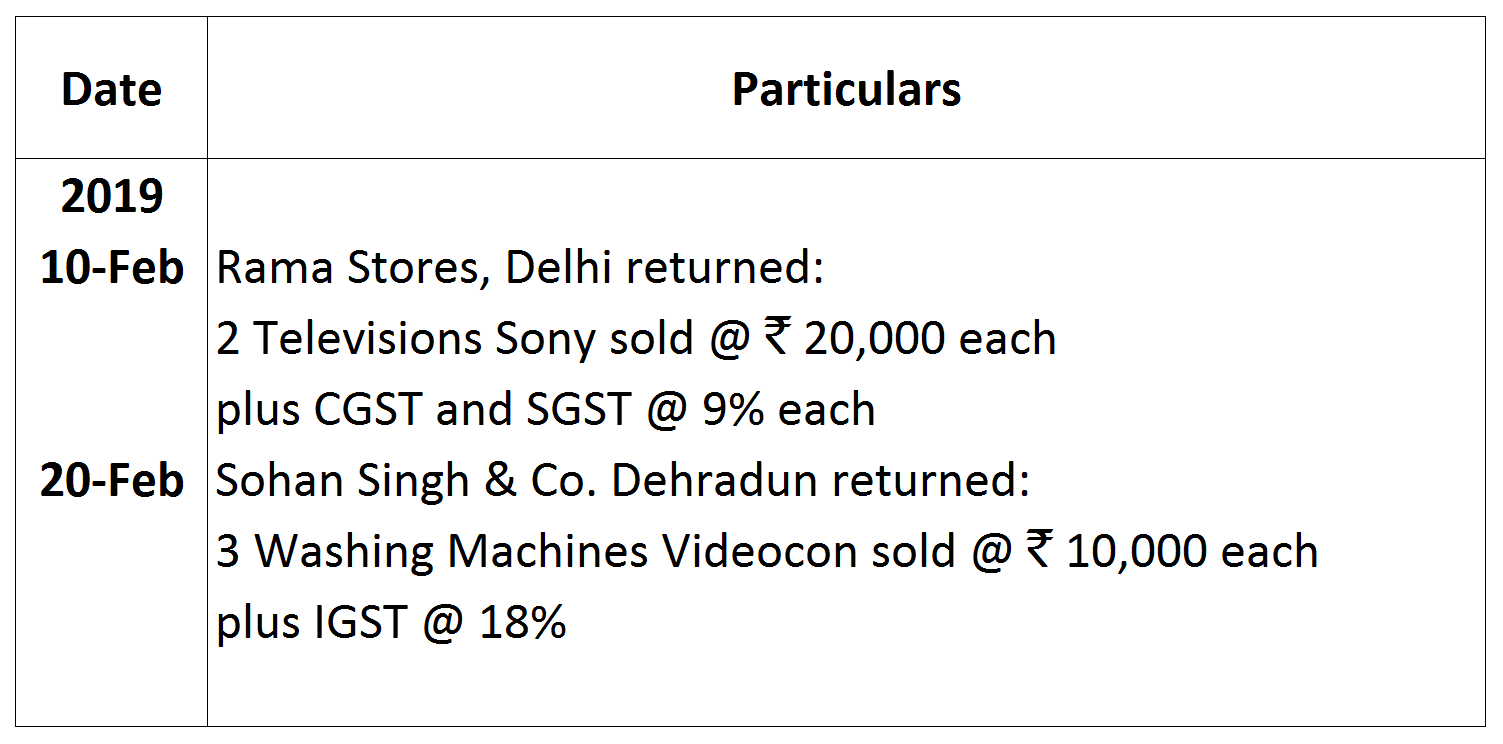
Prepare Sales Return Book of Shiv Shankar, Delhi from the following transactions and post them into Ledger:
On 30th June, 2014 the Pass Book of Sh. Mahabir Prashad showed a balance of ₹ 22,000. On comparing the Pass Book with Cash Book the following differences were found:-
  1. Mahabir Prashad had paid into the Bank on 26th June four cheques for ₹ 3,000; ₹ 6,000; ₹ 8,000 and ₹ 10,000. Of these, the cheque for ₹ 6,000 was credited by the bank in July 2014.
  2. On 23rd June three cheques were drawn for ₹ 12,000; ₹ 13,000 and ₹ 16,000. The first two cheques were presented to the bank for payment in June and the third in July 2014.
  3. Cheques amounting to ₹ 3,600 were deposited in the bank but no entry was passed in the Cash Book.
  4. Bank charges entered in Cash Book twice ₹ 50.
  5. Cheque received entered twice in the Cash Book ₹ 3,200.
Prepare a Bank Reconciliation Statement as on 30th June 2014.
Why is it important to adopt a consistent basis for the preparation of financial statements? Explain.
Darshan sold goods for ₹ 40,000 to Varun on 8.1.2017 and drew upon him a bill of exchange payable after two months. Varun accepted the bill and returned the same to Darshan. On the due date the bill was met by Varun. Record the necessary Journal entries in the books of Darshan and Varun in the following circumstances:
When the bill was retained by Darshan till the date of its maturity.
When Darshan immediately discounted the bill @6% p.a. with his bank.
When the bill was endorsed immediately by Darshan in favour of his creditor Suresh.
When three days before its maturity, the bill was sent by Darshan to his bank for collection.