Question
Explain the following:
Going Concern Concept.

Answer

Going Concern Concept: The going concern concept of accounting implies that the business entity will continue its operations in the future and will not liquidate or be forced to discontinue operations due to any reason. A company is a going concern if no evidence is available to believe that it will or will have to cease its operations in foreseeable future.
Example: The application of going concern concept of accounting is the computation of depreciation on the basis of expected economic life of fixed assets rather than their current market value. Companies assume that their business will continue for an indefinite period of time and the assets will be used in the business until fully depreciated. Another example of the going concern assumption is the prepayment and accrual of expenses. Companies prepay and accrue expenses because they believe that they will continue operations in future.

Need a full question paper?

Generate a complete, print-ready paper with questions like this in minutes — across 16+ boards, with answer keys.
Start Generating Free

Similar questions

Land and Buildings are shown at ₹ 10 Lac in the Balance Sheet of the business owned by Mr. Yuvraj. However, as per the certificate of Govt. approved valuer the realisable value of Land and Building is ₹ 200 Lac. Mr. Yuvraj wants to show the Land and Building at this value in his books. Can he do so?
What are the advantages of allowing Cash Discount? (Two points)
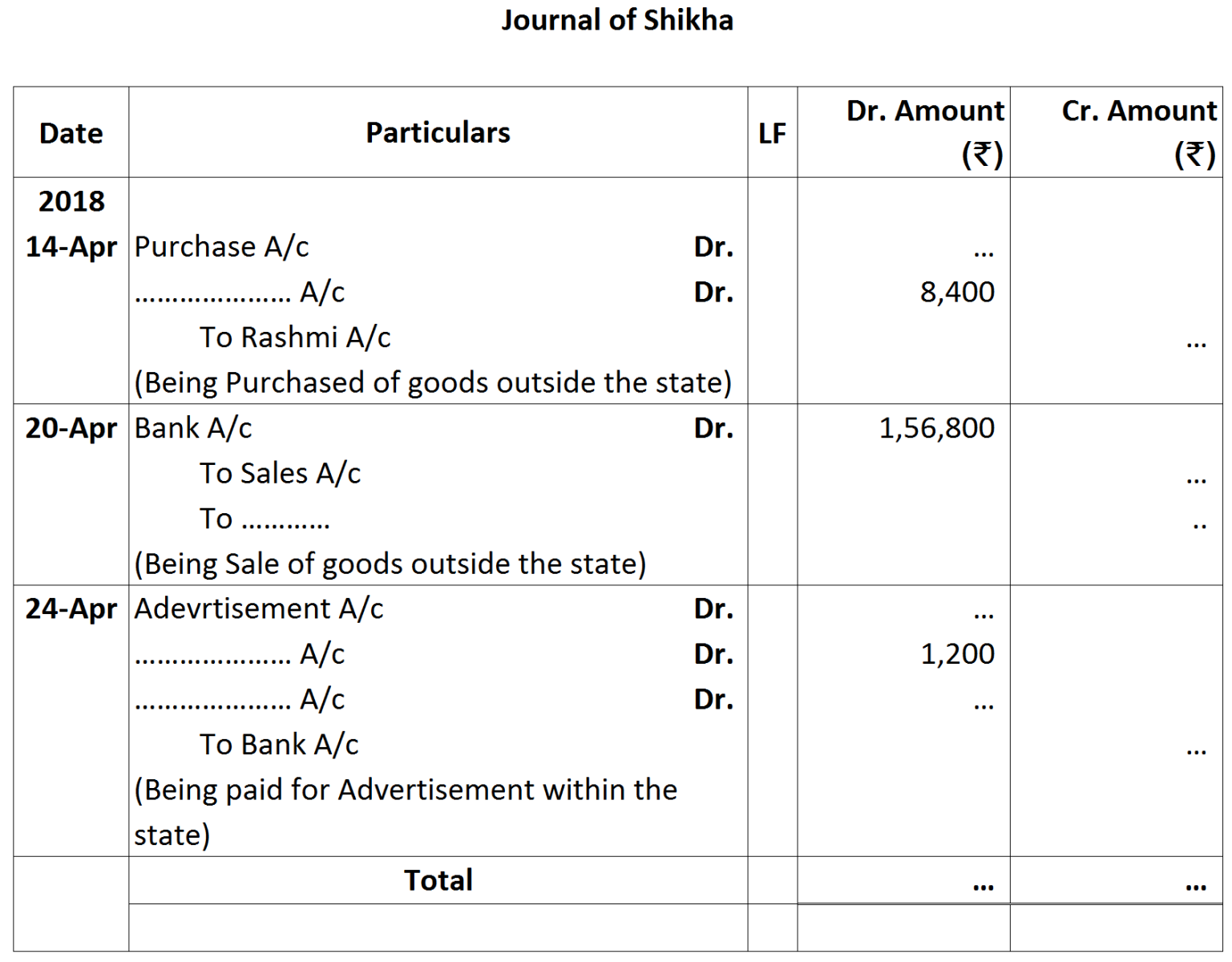
Fill in the missing assuming CGST @ 6% and SGST @ 6%:
Name the various entries which have to be passed through a Journal even though we might have kept all the subsidiary books in the business.
What is the reason that the capital expenditure is shown in the Balance Sheet?
After balancing of accounts, these always show Debit Balance. Is it Correct?
What do you understand by balancing of account?
Journalise the following transactions in the books of Shri Manoj, Kolkata and prepare Ledger Accounts.
Opening Debit Balances:
Cash in Hand ₹ 15,000; Cash at Bank ₹ 55,000; Stock ₹ 28,000; Debtors ₹ 25,000 (Sunil ₹ 5,000; Abhay ₹ 10,000 and Alok ​₹ 10,000); Fixed Assets: Computer and Printer ₹ 50,000; Furniture ₹ 10,000; Delivery Van ₹ 25,000.
Opening Credit Balances:
Bank Loan ₹ 90,000; Salaries Outstanding ₹ 15,000; Creditors ₹ 20,000; Bills Payable ₹ 10,000; Capital ₹ 73,000.
Transactions for the month of April, 2019 were:
  1. Purchased goods from M/s Prabhat Electricals, Delhi ₹ 10,000 less 10% Trade Discount.
Cheque was issued immediately and availed 2% Cash Discount on purchase price.
  1. Cheque was received from Abhay for the balance allowing him discount of 2%*.
  2. Cheque was received from Alok for the balance due*.
  3. Sunil was unable to pay the full dues and offered to pay 75%, which was accepted. Cheque was duly received*.
  4. Gave goods costing ₹ 1,000 as charity. These goods were purchased in Kolkata.
  5. In a competition held by the RWA where the shop is located an electric iron costing ₹ 500 was given as an award. It had been purchased from Prabhat Electricals, Delhi.
  6. A debt of ₹ 10,000 that was written off as bad debt in the past was received*.
  7. Salaries amounting to ₹ 15,000 provided in the books for the month of March, 2019 were paid through cheque*.
  8. Sales for the month were: Cash Sales ₹ 15,00,000 (Intra-state) and Credit Sales ₹ 3,00,000 (Inter-state).
  9. Purchases for the month were: Cash Purchases ₹ 1,00,000 (Intra-state) and Credit
Purchases (Inter-state) ₹ 9,00,000.

Cheques Received from Debtors ₹ 2,00,000; Deposited Cash ₹ 15,00,000.
  1. Paid to creditors through cheques ₹ 8,90,000*.
  2. Bank Loan repaid during the month ₹ 20,000*.
Inter-state transactions are subject to levy of IGST @ 12% and Intra-state transactions are subject to levy of CGST and SGST @ 6% each. GST is not levied on transactions marked with (*).
Journalise the following transactions:
  1. Purchased a Motor Car for 3,00,000 and paid 25,000 for its repair and renewal. Entire payment is made by cheque.
  2. Received Rent 5,000.
  3. Goods worth 20,000 were distributed as free samples.
  4. Charge depreciation on Motor Car 32,500.
  5. Rent due to Landlord 10,000 and Salary due to Clerks 80,000.
  6. Charge interest on Capital 20,000.
  7. 5,000 due from Sanjay Gupta are bad-debts.
  8. Goods worth 50,000 were destroyed by fire.
  9. ash 5,000 and goods worth 20,000 were stolen by an employee.
Journalise the following transaction in the Book of M/s. Beauti traders Also post them in the ledger.
Dec. 2017
 
1
Started business with cash
2,00,000
2
Bought office furniture
30,000
3
Paid into bank to open an current account
1,00,000
5
Purchased a computer and paid by cheque
2,50,000
6
Bought goods on credit from Ritika
60,000
8
Cash sales
30,000
9
Sold goods to Karishna on credit
25,000
12
Cash paid to Mansi on account
30,000
14
Goods returned to Ritika
2,000
15
Stationery purchased for cash
3,000
16
Paid wages
1,000
18
Goods returned by Karishna
2,000
20
Cheque given to Ritika
28,000
22
Cash received from Karishna on account
15,000
24
Insurance premium paid by cheque
4,000
26
Cheque received from Karishna
8,000
28
Rent paid by cheque
3,000
29
Purchased goods on credit from Meena Traders
20,000
30
Cash sales
14,000