Question
Explain the following items:
Avitaminosis.

Answer

Avitaminosis: Lack of more than one vitamin causes multiple deficiency diseases called avitaminosis.

Need a full question paper?

Generate a complete, print-ready paper with questions like this in minutes — across 16+ boards, with answer keys.

Start Generating Free

Similar questions

Using IUPAC norms write the formulae of the following:
(a) Tetrahydroxozincate(II)
(b) Potassium tetrachloridopadauate(II)
(c) Diaminedichloridoplatinum(II)
(d) Hexaammineplatinum (IV)
(e) Potassium tetracyanonickelate(II)
(f) Tetrabromidocuprate(II)
(g) Pentaamminenitrito-o-cobalt(III)
(h) Pentaamminenitrito-N-cobalt (III)
The ratio of amount of $Al , Cu$ and Na obtained at the cathode by passing 3 Faraday electric current in different electrolytic cell filled with aqueous solution of molten $AlCl _3, CuSO _4$ and molten NaCl . What be the ratio of amounts of $Al , Cu$ and Na ?
Classify the following into monosaccharides and disaccharides. Ribose, 2-deoxyribose, maltose, galactose, fructose and lactose.
Compound $'A\ ’$ with molecular formula $\ce{C_4H_9Br}$ is treated with aq. $\text{KOH}$ solution. The rate of this reaction depends upon the concentration of the compound $'A\ ’$ only. When another optically active isomer $'B’$ of this compound was treated with aq. $\text{KOH}$ solution, the rate of reaction was found to be dependent on concentration of compound and $\text{KOH}$ both.
  1. Write down the structural formula of both compounds $'A\ ’$ and $'B\ ’$.
  2. Out of these two compounds, which one will be converted to the product with inverted configuration.
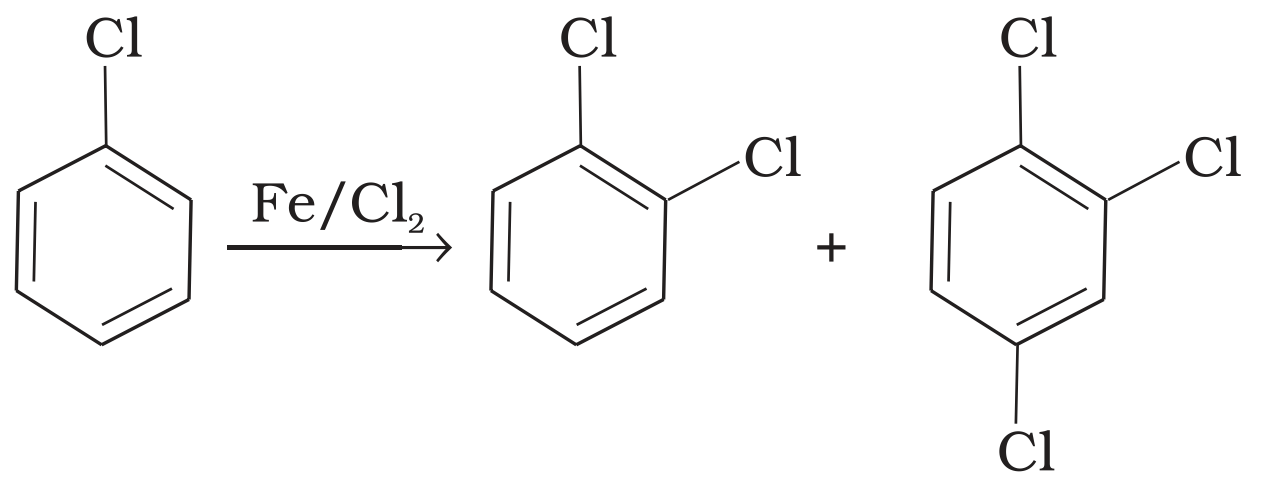
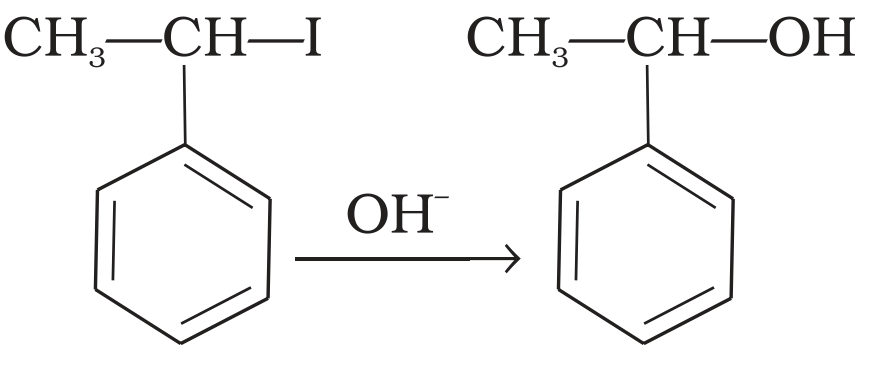
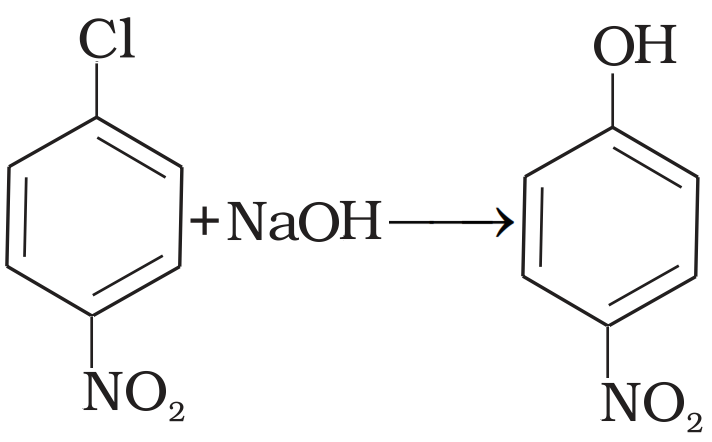
Match the reactions given in Column $I$ with the names given in Column $II.$
  Column $I$   Column $II$
$(i)$ $(a)$ Nucleophilic aromatic substitution
$(ii)$ $\text{CH}_3-\text{CH}==\text{CH}_2+\text{HBr}\xrightarrow{ \ \ \ \ \ }\text{CH}_3-\text{CH}-\text{CH}_3\ \ \ \ \ \ \ \ \ \ \ \ \ \ \ \ \ \ \ \ \ \ \ \ \ \ \ \ \ \ \ \ \ \ \ \ | \ \ \ \ \ \ \ \ \ \ \ \text{Br}$ $(b)$ Electrophilic aromatic substitution
$(iii)$ $(c)$ Saytzeff elimination
$(iv)$ $(d)$ Electrophilic addition
$(v)$ $\text{CH}_3\text{CH}_2\text{CH}\text{CH}_3\xrightarrow{\text{alc.KOH}}\text{CH}_3\text{CH}==\text{CH}\text{CH}_3\ \ \ \ \ \ \ |\ \ \ \ \ \ \ \ \ \ \ \ \ \ \ \ \text{Br}$ $(e)$ Nucleophilic substitution $(S_N1)$
 
The reaction of alkyl chloride with aquons KOH produces an alcohol, while the reaction with alcoholic КОН produces an alkene. Explain why and write the chemical equations for both reactions
Explain boiling point and melting point of dihalo-benzene. ### Give reason why melting point of P-Dichloro benzene is more than ortho and meta isomers.
Compare the stability of +2 oxidation state for the elements of the first transition series.
Using $\text{IUPAC}$ norms write the formulae for the following $:$
  1. Potassium trioxalatoaluminate$(III)$
  2. Dichloridobis$($ethane$-1,2-$diamine$)$cobalt$(III)$
Why do transition elements form coloured compounds explain?