Question
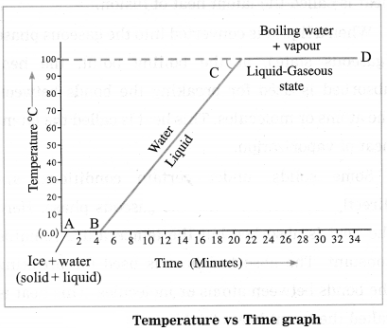
Explain the following temperature vs time graph:
Image

Answer

The graph shows what happens when a mixture of ice and water is heated continuously. The temperature of the mixture remains constant (0 °C) till all the ice melts as shown by the line AB. This temperature is the melting point of ice. On further heating, the temperature rises steadily from 0 °C to 100 °C as shown by the line BC, At 100 °C water starts converting into steam. This temperature is the boiling point of water. Further heating does not change the temperature and the conversion waters steam continues as shown by the line CD.

Need a full question paper?

Generate a complete, print-ready paper with questions like this in minutes — across 16+ boards, with answer keys.
Start Generating Free

Similar questions

What are the environmental consequences of the increasing demand for energy?
  1. An object 3cm high is placed $24\ cm$ away from a convex lens of focal length $8\ cm$. Find by calculations, the position, height and nature of the image.
  2. If the object is moved to a point only $3\ cm$ away from the lens, what is the new position, height and nature of the image?
  3. Which of the above two cases illustrates the working of a magnifying glass?
Find the power of a convex lens of focal length 12.5 cm.
Define absolute refractive index.
The shiny outer surface of a hollow sphere of aluminium of radius 50cm is to be used as a mirror:
  1. What will be the focal length of this mirror?
  2. Which type of spherical mirror will it provide?
  3. State whether this spherical mirror will diverge or converge light rays.
Observe the figure and write the answers to the following questions.
  1. Write the name of the reaction shown in the following figure.
  2. Write the above chemical reaction in the form of a balanced equation.
  3. Write the name of the product produced in the above reaction, write a use.
  4. Write the name of the catalyst used in the above reaction.
Reactants products Type of chemical reaction
BaCl_(2(aq))+ZnSO_(4(aq)) H_(2)CO_(3(aq)) Displacement
2AgCl_((s)) FeSO_(4(aq))+Cu_((s)) Combination
CuSO_(4(aq))+Fe_((s)) BaSO_(4)darr+ZnCl_(2(aq)) Decomposition
H_(2)O_((1))+CO_(2(g)) 2Ag_((s))+Cl_(2(g)) Double displacement
Read the given passage and answer the following questions:
The home electrical connection consists of 'live', 'neutral' and 'earth' wires. The 'live' and the 'neutral' wires have potential difference of 220 V . The 'earth' is connected to ground. Due to a fault in the equipment or if the plastic coating on the 'live' and the 'neutral' wires gives a way the two wires come in contact with each other and a large current flows through it producing heat. If any inflammable material (such as wood, cloth, plastic, etc.) exists around that place it can catch fire. Therefore a fuse wire is used as a precautionary measure.

i. Name the two wires having potential difference of 220 V .
ii. What is short circuit?
iii. Write the function of a fuse.
What happens when aluminium ore is heated with caustic soda? Write the balanced chemical equation for the same.
(A) Anil cannot see the blackboard writing clearly, but he can see nearby objects clearly.
(i) What is the eye defect he is suffering from?
(ii) How is it corrected?
(B) Anil’s uncle cannot see nearby objects clearly, but he can see distant objects clearly.
(i) What is the eye defect he is suffering from?
(ii) How is it corrected?