Question
Explain the following:
Electrovalent compounds have a high melting point and boiling point while covalent compounds have low melting and boiling points.
Answer

Electrovalent compounds have a strong force of attraction between the oppositely charged ions, so a large amount of energy is required to break the strong bonding force between ions. So, they have high boiling and melting points.
Covalent compounds have weak forces of attraction between the binding molecules, thus less energy is required to break the force of binding. So, they have low boiling and melting points.

Need a full question paper?

Generate a complete, print-ready paper with questions like this in minutes — across 16+ boards, with answer keys.

Start Generating Free

Similar questions

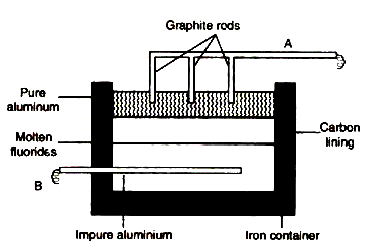
The sketch below illustrates the refin ing of aluminium by Hoopes process

(a) Which of A and B is th e cathode and which one is the anode?
(b) What is the electroly te in the tank?
( c) What material is used for th e cathode?
Give four examples of preparation of acids by synthesis.
A chemist has a 1.00 gram sample of water (H2O).
(i) Determine the number of moles of water in the sample.
(ii) Calculate the number of water molecules in the sample.
(iii) Discuss the significance of Avogadro's number in understanding the scale of chemical reactions.
Some of the fertilizers are sodium nitrate $NaNO _3$, ammonium sulphate $\left( NH _4\right)_2 SO _4$ and urea $CO \left( NH _2\right)_2$. Which of these contains the highest percentage of nitrogen?
Write the observation, and balanced equation for the following reaction:
A paper dipped in potassium permanganate solution is placed at the mouth of a test tube, containing sulphur dioxide gas.
Write the observation, and balanced equation for the following reaction:
Sodium hydroxide is added dropwise to a solution of zinc sulphate, till it is in excess.
Metal X is found in nature as its sulphides XS. It is used in the galvanization of iron articles. Identify the metal X. How will you convert this sulphide ore into the metal? Explain with equations.
Copy and complete the following table which relates to three homologous series of hydrocarbons:
General FormulaCnH2nCnH2n-2CnH2n+2
IUPAC name of the homologous series
Characteristic bond type Single bonds
IUPAC name of the first member of the series
Type of reaction with chlorine Addition
How much calcium oxide is formed when $82g$ of calcium nitrate is heated? Also find the volume of nitrogen dioxide evolved:
$2Ca(NO_3)_2\rightarrow 2CaO + 4NO_2 + O_2 (Ca = 40,N = 14, O = 16)$
A solid is crystalline, has a high melting point and is water soluble. Describe the nature of the solid.