Question
Explain the formation of ionic bonds in calcium chloride $(CaCl_2).$
Answer

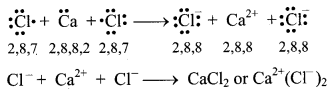
Formation of calcium chloride $(CaCl_2):$
$i.$ The electronic configurations of calcium and chlorine are:
$Na (Z = 11): 1s^2 \ 2s^2 \ 2p^6 \ 3s^2 \ 3p^6 \ 4s^2 \ or  \ (2, 8, 8, 2)$
$Cl (Z = 17): 1s^2 \ 2s^2 \ 2p^6 \ 3s^2 \ 3p^5 \ or \ (2, 8, 7)$
$ii.$ Calcium has two electrons in its valence shell. It has tendency to lose two electrons to acquire the electronic configuration of the nearest inert gas, argon $(2, 8, 8).$
$iii.$ Chlorine has seven electrons in its valence shell. It has tendency to gain one electron and thereby acquire the electronic configuration of the nearest inert gas, argon $(2, 8, 8).$
$iv.$ During the combination of calcium and chlorine atoms, the calcium atom transfers its valence electrons to two chlorine atoms.
$v.$ Calcium atom changes into $Ca^{2+}$ ion while the two chlorine atoms change into two $Cl^–$ ions. These ions are held together by strong electrostatic force of attraction.
$vi.$ The formation of ionic bond$(s)$ between $Ca$ and $Cl$ can be shown as follows:
Image

Need a full question paper?

Generate a complete, print-ready paper with questions like this in minutes — across 16+ boards, with answer keys.

Start Generating Free

Similar questions

Justify: Lead chamber process is an example of homogeneous catalysis.
Identify whether the following reaction is redox or NOT. State oxidant and reductant therein.$3 H _3 AsO _{3( aq )}+ BrO _{5( qq )}^{-} \longrightarrow Br _{\text {(aq) }}^{-}+3 H _3 AsO _{4( aq )}$
Explain: Ozonolysis
Show that carbon monoxide and carbon dioxide satisfy the law of multiple proportions.
Write note on ‘Principal Quantum number.
The need of the term average atomic mass.
Match the pairs :
 Column A Column B
i.Castner-Kellner cella.Na2CO
ii.Slaked limeb.CaCO3
iii.Solvay processc.NaOH
iv.Limestoned.Ca(OH)2
Explain dehydration reaction of alcohols.
Due to contamination by viruses, the hospital authorities had asked Ranjan, the ward boy, to keep cleaning the hospital lobby using some antiseptic. Ranjan would wipe the floor by adding Dettol to water and would always keep the premises clean. One of the active ingredients in Dettol is chloroxylenol $(4-$chloro$-3,5-$dimethylphenol$)$. Ranjan was also actively associated with an NGO, which was involved in Swachh Bharat campaign. Based on this passage, answer the following questions.
$i.$ Which functional groups are present in chloroxylenol?
$ii.$ Write the bond line and molecular formula of chloroxylenol.
$iii.$ Identify one group each in chloroxylenol which show $+I$ and $-I$ effect, respectively.
But$-1-$ene and $2-$methylpropene are separately treated with following reagents. Predict the product/products. Indicate major/minor product,
$i. HBr$
$ii. H_2SO_4 / H_2O$