Question
Explain the forward bias characteristics of $p-n$ junction diode with necessary graph.

Answer

Image

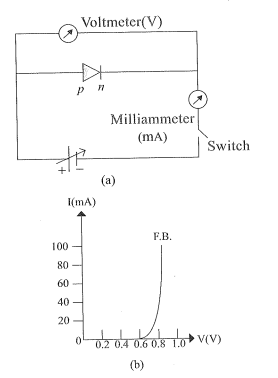
The circuit arrangement for studying the V-I characteristics of a diode, (i.e. Variation of current I as a function of applied voltage V ) is shown in fig. (a).
As shown in Fig., the battery is connected to the diode through a potentiometer (or rheostat) so that the applied voltage to the diode can be changed.
For different values of voltages, the value of current is noted. A graph between V and I is obtained as shown in fig. (b). For the forward bias, the current is of the order of $m A$.
As it is seen in the fig., in forward bias, the current first increases very slowly, almost negligibly till the voltage across the diode crosses a certain value.
After the characteristic voltage, the diode current increases significantly (exponentially) even for a very small increase in the diode bias voltage. This voltage is called the threshold voltage or cut-in voltage ( $\sim 0.2 V$ for germanium diode and $\sim 0.7 V$ for silicon diode).
For diodes, the ratio of small change in voltage $\Delta V$ to a small change in current $\Delta I$ is called dynamic resistance.
$r_d=\frac{\Delta V }{\Delta I }$
Its unit is ohm $(\Omega)$.
The resistance of the diode in forward bias mode is approximately between $10 \Omega$ to $100 \Omega$.

Need a full question paper?

Generate a complete, print-ready paper with questions like this in minutes — across 16+ boards, with answer keys.
Start Generating Free

Similar questions

The electric field intensity at a point at a distance of 20 cm from the centre of a sphere is 10 Volt/meter. Find the intensity of the electric field at a point located at a distance 8 cm from the centre of that circle. The radius of the sphere is 5 cm.
Consider a coin of Example 1.20. It is electrically neutral and contains equal amounts of positive and negative charge of magnitude 34.8kC. Suppose that these equal charges were concentrated in two point charges seperated by,
  1. 1cm $\Big(\sim\frac{1}{2}\times\text{diagonalof theone paisa coin}\Big)$,
  2. 100m (~ length of a long building), and
  3. 106m (radius of the earth). Find the force on each such point charge in each of the three cases. What do you conclude from these results?
Point charge q is placed (i)at the mid-point of the core of a cube of side a meter (ii)centrally on a plane of a cube of side a meter. Calculate the total flux associated with the cube. Also find out how many surfaces of the cube will be the total flux associated?
Refraction of light is the change in the path of light as it passes obliquely from one transparent medium to another medium. According to law of refraction $\frac{\sin\text{i}}{\sin\text{r}}=\ ^1\mu_2,$ where $^1\mu_2$ is called refractive index of second medium with respect to first medium. From refraction at a convex spherical surface, we have $\frac{\mu_2}{\text{v}}=\frac{\mu_1}{\text{u}}=\frac{\mu_2-\mu_1}{\text{R}}.$ Similarly from refraction at a concave spherical surface when object lies in the rarer medium, we have $\frac{\mu_2}{\text{v}}-\frac{\mu_1}{\text{u}}=\frac{\mu_2-\mu_1}{\text{R}}$ and when object lies in the denser medium, we have $\frac{\mu_1}{\text{v}}-\frac{\mu_2}{\text{u}}=\frac{\mu_1-\mu_2}{\text{R}}.$
  1. Refractive index of a medium depends upon:
  1. Nature of the medium.
  2. Wavelength of the tight used.
  3. Temperature.
  4. All of these.
  1. A ray of light of frequency 5 × 1014Hz is passed through a liquid. The wavelength of light measured inside the liquid is found to be 450 × 10-9m. The refractive index of the liquid is:
  1. 1.33
  2. 2.52
  3. 2.22
  4. 0.75
  1. A ray of light is incident at an angle of 60º on one face of a rectangular glass slab of refractive index 1.5. The angle of refraction is:
  1. $\sin^-1 (0.95)$
  2. $\sin^-1 (0.58)$
  3. $\sin^-1 (0.79)$
  4. $\sin^-1 (0.86)$
  1. A point object is placed at the centre of a glass sphere of radius 6 cm and refractive index 1.5. The distance of the virtual image from the surface of sphere is:
  1. 2cm
  2. 4cm
  3. 6cm
  4. 12cm
  1. In refraction, light waves are bent on passing from one medium to the second medium because in the second medium:
  1. The frequency is different.
  2. The co-efficient of elasticity is different.
  3. The speed is different.
  4. The amplitude is smaller.
Derive lens Maker formula $\frac{1}{f}=\left(n_{21}-1\right)\left(\frac{1}{R_1}-\frac{1}{R_2}\right)$. Here are the general meanings of the symbols used in the formula. Draw necessary diagram.
Mr. Verma (50kg) and Mr. Mathur (60kg) are sitting at the two extremes of a 4m long boat (40kg) standing still in water. To discuss a mechanics problem, they come to the middle of the boat. Neglecting friction with water, how far does the boat move on the water during the process?
A metal rod is placed along the axis of a solenoid carrying a high-freqμency alternating current. It is found that the rod gets heated. Explain why the rod gets heated.
A stationary charge produces only an electrostatic field while a charge in uniform motion produces a magnetic field, that does not change with time. An oscillating charge is an example of accelerating charge. It produces an oscillating magnetic field, which in turn produces an oscillating electric fields and so on. The oscillating electric and magnetic fields regenerate each other as a wave which propagates through space.

Magnetic field in a plane electromagnetic wave is given by $\vec{\text{B}}=\text{B}_0\sin(\text{kx}+\omega\text{t}) \hat{\text{j}}\text{T}.$
  1. Expression for corresponding electric field will be (Where c is speed of light).
  1. $\vec{\text{E}}=-\text{B}_0\text{c}\sin(\text{kx}+\omega\text{t}) \hat{\text{k}}\frac{\text{V}}{\text{m}}$
  2. $\vec{\text{E}}=\text{B}_0\text{c}\sin(\text{kx}-\omega\text{t}) \hat{\text{k}}\frac{\text{V}}{\text{m}}$
  3. $\vec{\text{E}}=\frac{\text{B}_0}{\text{c}}\sin(\text{kx}+\omega\text{t}) \hat{\text{k}}\frac{\text{V}}{\text{m}}$
  4. $\vec{\text{E}}=\text{B}_0\text{c}\sin(\text{kx}+\omega\text{t}) \hat{\text{k}}\frac{\text{V}}{\text{m}}$
  1. The electric field component ofa monochromatic radiation is given by $\vec{\text{E}} = 2\in_0\hat{\text{i}}\cos\text{kz}\cos\omega\text{t}.$ Its magnetic field $\vec{\text{B}}$ is then given by:
  1. $\frac{2\in_0}{\text{c}}\hat{\text{j}}\cos\text{kz}\cos\omega\text{t}$
  2. $\frac{2\in_0}{\text{c}}\hat{\text{j}}\sin\text{kz}\cos\omega\text{t}$
  3. $\frac{2\in_0}{\text{c}}\hat{\text{j}}\sin\text{kz}\sin\omega\text{t}$
  4. $-\frac{2\in_0}{\text{c}}\hat{\text{j}}\sin\text{kz}\sin\omega\text{t}$
  1. A plane em wave of frequency 25MHz travels in a free space along x-direction. At a particular point in space and time, $\text{E}=(6.3\ \hat{\text{j}})\frac{\text{V}}{\text{m}}.$ What is magnetic field at that time?
  1. $0.095\mu\text{T}$
  2. $0.124\mu\text{T}$
  3. $0.089\mu\text{T}$
  4. $0.021\mu\text{T}$
  1. A plane electromagnetic wave travelling along the x-direction has a wavelength of 3mm. The variation in the electric field occurs in they-direction with an amplitude 66Vm1. The equations for the electric and magnetic fields as a function of x and tare respectively.
  1. $\text{E}_\text{y}=33\cos\pi\times10^{11}\Big(\text{t}-\frac{\text{x}}{\text{c}}\Big),\\\text{B}_\text{z}=1.1\times10^{-7}\cos\pi\times10^{11}\Big(\text{t}-\frac{\text{x}}{\text{c}}\Big)$
  2. $\text{E}_\text{y}=11\cos2\pi\times10^{11}\Big(\text{t}-\frac{\text{x}}{\text{c}}\Big),\\\text{B}_\text{y}=11\times10^{-7}\cos2\pi\times10^{11}\Big(\text{t}-\frac{\text{x}}{\text{c}}\Big)$
  3. $\text{E}_\text{x}=33\cos\pi\times10^{11}\Big(\text{t}-\frac{\text{x}}{\text{c}}\Big),\\\text{B}_\text{x}=11\times10^{-7}\cos\pi\times10^{11}\Big(\text{t}-\frac{\text{x}}{\text{c}}\Big)$
  4. $\text{E}_\text{y}=66\cos2\pi\times10^{11}\Big(\text{t}-\frac{\text{x}}{\text{c}}\Big),\\\text{B}_\text{z}=2.2\times10^{-7}\cos2\pi\times10^{11}\Big(\text{t}-\frac{\text{x}}{\text{c}}\Big)$
  1. A plane electromagnetic wave travels in free space along x-axis. At a particular point in space, the electric field along y-axis is 9.3Vm-1. The magnetic induction (B) alongz-axis is:
  1. 3.1 × 10-8T
  2. 3 × 10⁻⁵T
  3. 3 × 10⁻⁶T
  4. 9.3 × 10-6T
A deflection magnetometer is placed with its arms in north-south direction. How and where should a short magnet having $\frac{\text{M}}{\text{B}_\text{H}}=40\text{A-m}^2\text{T}$ be placed so that the needle can stay in any position?
A ladder is resting with one end on a vertical wall and the other end on a horizontal floor. Is it more likely to slip when a man stands near the bottom or near the top?