Question
Explain the froth floatation method with a neat labelled diagram.

Answer

  • The froth floatation process is based on two opposite properties of the particles, hydrophilic and hydrophobic.
  • The metal sulphide particles are hydrophobic. Due to this property, they get wetted mainly with oil. On the other hand, gangue particles are hydrophilic and get wetted by water.
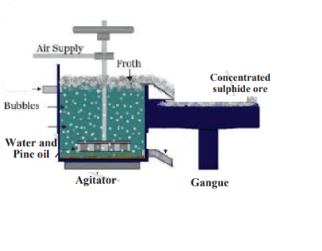
  • In this method, the finely divided metal ore is added in a big tank containing large amount of water. To this, certain vegetable oil (pine oil, eucalyptus oil, etc.) is added for the formation of froth.
  • In the tank, compressed air is circulated through the water. Bubbles are formed due to this blown air. A rotating agitator at the centre of the floatation tank agitates the mixture and draws air into it to form bubbles. As a result, foam is formed which carries metal sulphide particles. The foam rises to the surface of water and floats. Therefore, this method is called froth floatation process.
  • This method is used to separate metal sulphide ores such as zinc blende $(ZnS)$ and copper pyrite $(CuFeS_2).$
Image
Froth floatation method

Need a full question paper?

Generate a complete, print-ready paper with questions like this in minutes — across 16+ boards, with answer keys.

Start Generating Free

Similar questions

What is forest fire? What is its effect on environment?
When a person puts food in his mouth, then teeth cut it into small pieces, chew and grind it. The glands A in the mouth secrete a substance B which is mixed with the food by tongue. The substance B contains an enzyme C which starts the digestion of food in the mouth. The slightly digested food from the mouth goes down a tube D. The special type of movements E in the walls of tube D push the food into stomach for further digestion. The stomach wall secretes gastric juice containing three substance F, G and H. One of the functions of F is to kill bacteria which may enter the stomach with food. The substance G protects the inside layer of stomach from the damaging effect of substance F whereas substance H is and enzyme for digestion. The partially digested food then enters into small intestine for further digestion.
  1. What is Gland A, Substance B and Enzyme C?
  2. Name the tube D.
  3. What is the movement E known as?
  4. What are F, G and H?
What is the stimulus in:
  1. Phototropism?
  2. Geotropism?
  3. Chemotropism?
  4. Hydrotropism?
  5. Thigmotropism?
State any five physical properties of metals and five physical properties of non-metals.
Write the names of five endocrine glands found in the human body. Name the hormones secreted by each gland.
Read the information given below and solve the questions based on it.
Electric energy is produced in various ways like hydroelectric, wind power, solar energy, bio-fuel, etc. These energy sources are inexhaustible, sustainable. Besides, it does not cause any environmental problem.
Questions and Answers:
(1) Above information is about which type of energy?
(2) Whether the fossil fuel is an example of this energy?
(3) Draw the flow chart of production of electric energy.
Which changes occur in persons continuously using internet and mobile phones?
Answer the following questions
The observations made by Swarali while doing the experiment are given below. Based on these write answers to the questions;
Swarali found that the light ray travelling from the denser medium to rarer medium goes away from the normal. If the angle of incidence (i) is raised by Swarali, the angle of refraction ( $r$ ) went on increasing. However, after certain value of the angle of incidence the light ray is seen to return back into the denser medium.

i. What is the specific value of $\angle i$ called?
ii. What is the process of reflection of incident ray into denser medium called?
iii. Draw the diagrams of three observations made by Swarali.
Distinguish between the physical properties of metals and nonmetals with respect to the following points:
(1) Physical state (2) Lustre (3) Ductility and malleability (4) Conduction of heat and electricity (5) Hardness (6) Melting and boiling points.
There were lot of organisms A in the crop fields in an area. These organisms used to feed on organisms B also present in the crop fields but which damaged the standing crops. One day some people arrived in the fields and killed all the organisms A so that they could remove their C for making fancy items which were in great demand. Due to large scale killing of A, the population of B increased too much damaging all the crops in the area and causing a famine-like situation. Apart from A, there is another organism D which can also kill and eat B. Name A, B, C and D.