Question
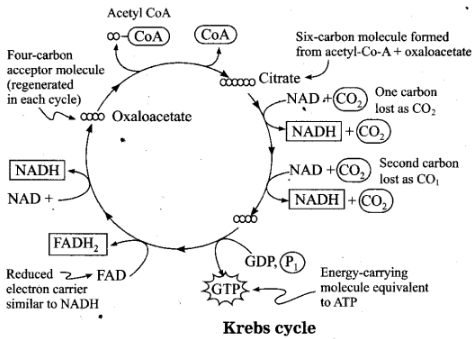
 Explain the Krebs cycle with reaction.
Answer

  • Krebs cycle was proposed by Sir Hans Kreb. This cycle is named after him. It is also called tricarboxylic acid cycle or citric acid cycle.
  • The acetyl-coenzyme-A molecules enter the mitochondria located in the cytoplasm.
  • They participate in the chemical reactions taking place in Krebs cycle.
  • In the cyclic chemical reactions, acetyl- coenzyme-A is completely oxidised
  • It yields molecules of $CO_2, H_2O, NADH_2, FADH_2$ and $ATP$ upon complete oxidation.
Image

Need a full question paper?

Generate a complete, print-ready paper with questions like this in minutes — across 16+ boards, with answer keys.
Start Generating Free

Similar questions

An element X belongs to group 2 and another element Y belongs to group 15 of the periodic table:
  1. What is the number of valence electrons in X?
  2. What is the valency of X?
  3. What is the number of valence electrons in Y?
  4. What is the valency of Y? Explain how you have arrived at your answers.
There are two important fuels A and B both of which are extracted from deep inside the earth. Fuel A is a thick, dark, foul smelling liquid whereas fuel B is a black solid. Combustion of both the fuels produces products, C, D, E and F. The product C makes the rainwater only slightly acidic but it is mainly responsible for causing global warming. The product D is neither acidic nor basic. It is harmless and does not affect the environment in any way. Both E and F attack breathing system of humans and are mainly responsible for causing acid rain. In addition to combustion of fuels A and B, the product F is also formed when lightning occurs in the sky.
  1. What are (i) fuel A, and (ii) fuel B?
  2. Name (i) C (ii) D (iii) E, and (iv) F?
  3. What is the process of formation of F during lightning known as?
  4. Which fuel is supposed to be exhausted sooner : A or B?
  5. Which fuel is mostly used for generating electricity at thermal power plants?
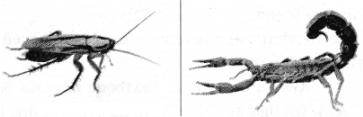
Observe the figures given below and answer the given questions:
Image
(a) In which phylum are these animals included?
(b) Which substance forms the outer layer of their exoskeleton?
(c) What are their locomotory organs?
Write short notes on the following: Galvanizing.
Into which phyla is Non-chordata divided? In which three subphyla are Chordates divided?
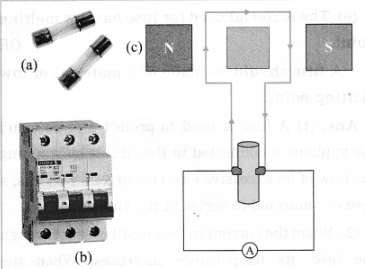
Identify the figures and explain their use.
Image

1. Fuse:
2.Miniature circuit breaker:
3.Figure shows the construction of a DC generator.

An electric circuit consisting of a 0.5m long nichrome wire XY, an ammeter, a voltmeter, four cells of 1.5V each and a plug key was set up.
  1. Draw a diagram of this electric circuit to study the relation between the potential difference maintained between the points ‘X’ and ‘Y’ and the electric current flowing through XY.
  2. Following graph was plotted between V and I values:
What would be the values of ratios when the potential difference is 0.8V, 1.2V and 1.6V respectively? What conclusion do you draw from these values?
  1. What is the resistance of the wire?
Write short note: Land-filling sites.
A metal salt $MX$ when exposed to light splits up to form metal $M$ and a gas $X_2.$ Metal M is used in making ornaments whereas gas $X_2$ is used in making bleaching powder. The salt $MX $ is itself used in black and white photography:
  1. What do you think metal M is?
  2. What could be gas $X_2?$
  3. Name the metal salt $MX.$
  4. Name any two salt solutions which on mixing together can produce a precipitate of salt $MX.$
  5. What type of chemical reaction takes place when salt MX is exposed to light? Write the equation of the reaction?
Study of fossils is an important aspect of study of evolution.