Question
Explain the lanthanoid contraction.
Answer

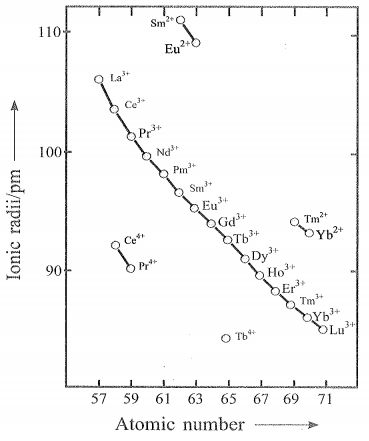
$\rightarrow$ As we move along the lanthanoid series, the atomic number increases gradually by one. This means that the number of electrons and protons present in an atom also increases by one.
$\rightarrow$ As electrons are being added to the same shell, the effective nuclear charge increases.
$\rightarrow$ This happens because the increase in nuclear attraction due to the addition of proton is more pronounced than the increase in the interelectronic repulsions due to the addition of electron.
$\rightarrow$ Also, with the increase in atomic number, the number of electrons in the $4f$ orbital also increases. The $4f$ electrons have poor shielding effect.
$\rightarrow$ Therefore, the effective nuclear charge experienced by the outer electrons increases. Consequently, the attraction of the nucleus for the outermost electrons increases.
$\rightarrow$ This results in a steady decrease in the size of lanthanoids with the increase in the atomic number. This is termed as lanthanoid contraction.
Image
$\rightarrow$ Consequences of lanthanoid contraction
$\rightarrow$ There is similarity in the properties of second and third transition series.
$\rightarrow$ Separation of lanthanoids is possible due to lanthanoid contraction.
$\rightarrow$ It is due to lanthanoid contraction that there is variation in the basic strength of lanthanoid hydroxides. $($Basic strength decreases from $\ce{La(OH)_3}$ to $ \ce{Lu(OH)_3}.)$

Need a full question paper?

Generate a complete, print-ready paper with questions like this in minutes — across 16+ boards, with answer keys.
Start Generating Free

Similar questions

Discuss the nature of bonding in metal carbonyls.
Predict the products of the following reactions$:$
What is meant by unidentate, didentate and ambidentate ligands? Give two examples for each.
Differentiate between rate of reaction and reaction rate constant.
A sample of drinking water was found to be severely contaminated with chloroform (CHCl3) supposed to be a carcinogen. The level of contamination was 15 ppm (by mass) :
(i) express this in percent by mass
(ii) determine the molality of chloroform in the water sample.
The decomposition of NH3 on platnium surface is zero order reaction. What are the rates of production of N2 and H2 if = 2.5 × 10⁻⁴ mol L-1 s-1?
  1. Explain why an alkylamine is more basic than ammonia.
  2. How would you convert:
  1. Aniline to nitrobenzene.
  2. Aniline to iodobenzene?
During nuclear explosion, one of the products is $^{90}$ Sr with half$-$life of $28.1$ years. If $1\mu g of ^{90}$ Sr was absorbed in the bones of a newly born baby instead of calcium, how much of it will remain after $10$ years and $60$ years if it is not lost metabolically.
For the reaction
$2NO_{(g)} + Cl_{2(g)} \rightarrow 2 NOCl_{(g)}$
The following data were collected. All the measurements were taken at 263K:
Experiment. No. Initial $[NO] (M)$ Initial $[Cl_2] (M)$ Initial rate of disappearance of $Cl_2(M/min)$
$1$ $0.15$ $0.15$ $0.60$
$2$ $0.15$ $0.30$ $1.20$
$3$ $0.30$ $0.15$ $2.40$
$4$ $0.25$ $0.25$ $?$
  1. Write the expression for rate law.
  2. Calculate the value of rate constant and specify its units.
  3. What is the initial rate of disappearance of $Cl_2$ in exp. $4?$
Amino acids may be acidic, alkaline or neutral. How does this happen? What are essential and non-essential amino acids? Name one of each type.