Question
Explain the lanthanoid contraction.

Answer

→ As we move along the lanthanoid series, the atomic number increases gradually by one. This means that the number of electrons and protons present in an atom also increases by one.
→ As electrons are being added to the same shell, the effective nuclear charge increases.
→ This happens because the increase in nuclear attraction due to the addition of proton is more pronounced than the increase in the interelectronic repulsions due to the addition of electron.
→ Also, with the increase in atomic number, the number of electrons in the 4f orbital also increases. The 4f electrons have poor shielding effect.
→ Therefore, the effective nuclear charge experienced by the outer electrons increases. Consequently, the attraction of the nucleus for the outermost electrons increases.
→ This results in a steady decrease in the size of lanthanoids with the increase in the atomic number. This is termed as lanthanoid contraction.
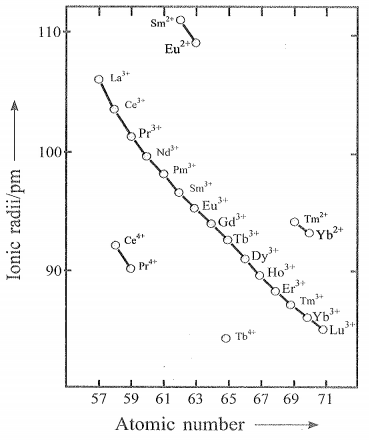
Image
→ Consequences of lanthanoid contraction
→ There is similarity in the properties of second and third transition series.
→ Separation of lanthanoids is possible due to lanthanoid contraction.
→ It is due to lanthanoid contraction that there is variation in the basic strength of lanthanoid hydroxides. (Basic strength decreases from La(OH)3 to Lu(OH)3.)

Need a full question paper?

Generate a complete, print-ready paper with questions like this in minutes — across 16+ boards, with answer keys.

Start Generating Free

Similar questions

What is galvanic cell? Give half cell reaction of Daniell cell.
List various types of isomerism possible for coordination compounds, giving an example of each.
Predict the major product formed when HCl is added to isobutylene. Explain the mechanism involved.
  1. E0 value for the Mn3+/Mn2+ couple is positive (+ 1.5V) whereas that of Cr3+/Cr2+ is negative (-0.4 V). Why?
  2. Transition metals form coloured compounds. Why?
  3. Complete the following equation:

$\text{2MnO}^{-}_{4}+\text{16H}^{+}+\text{5C}_{2}\text{O}^{2-}_{4}\xrightarrow{\text{ }\ \ \ \ \ \ \ \ \ \ \ \ }$

Answer the following question:
An organic compound A having molecular formula C6H6O gives a characteristic colour with aqueous FeCl3 solution. A on treatment with CO2 and NaOH at 400K under pressure gives B which on acidification gives a compound C. The compound C reacts with acetyl chloride to give D which is a popular pain killer. Deduce the structure of A, B, C and D.
tert-Butylbromide reacts with aq. NaOH by SN1 mechanism while n-butylbromide reacts by SN2 mechanism. Why?
(a) $Cu ^{+} X ^{-}$is unstable, why?
(b) Explain the structure of $Mn _2 O _7$ and $MnO _4^{-}$.
The electrical resistance of a column of 0.05 M KOH solution of diameter 1 cm and length 45·5 cm is 4.55 $\times$ 103 ohm. Calculate its molar conductivity.
What is meant by chelate effect?
At 300K, 36g of glucose, C6H12O6 present per litre in its solution has an osmotic pressure of 4.98 bar. If the osmotic pressure of another glucose solution is 1.52 bar at the same temperature, calculate the concentration of the other solution.