Question
Explain the Law of Dominance using a monohybrid cross.

Answer

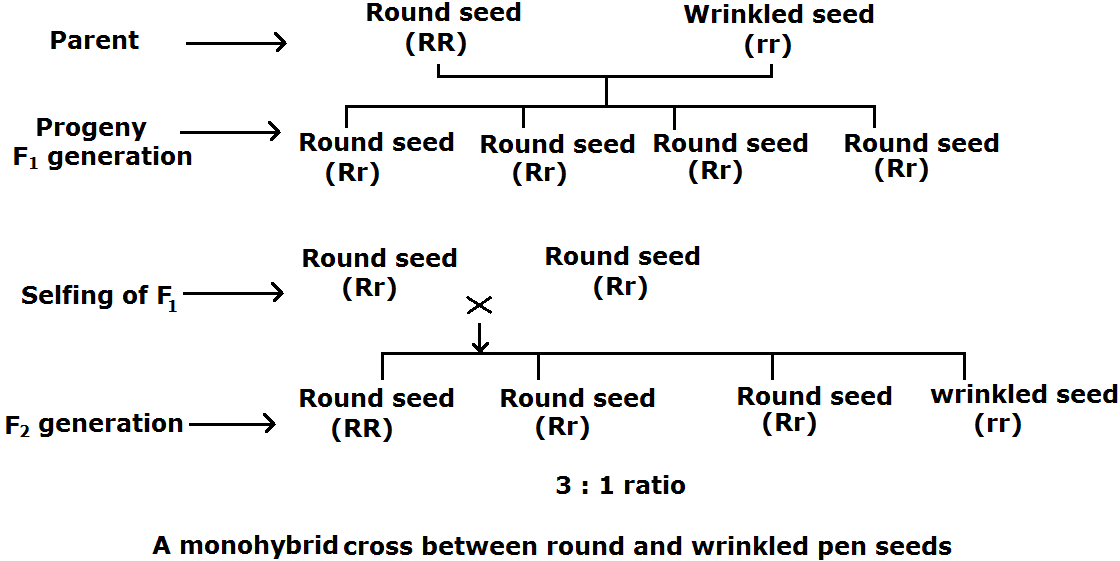
Mendel’s law of dominance states that a dominant allele expresses itself in a monohybrid cross and suppresses the expression of recessive allele. However, this recessive allele for a character is not lost and remains hidden or masked in the progenies of F1 generation and reappears in the next generation.

For example, when pea plants with round seeds (RR) are crossed with plants with wrinkled seeds (rr), all seeds in F1 generation were found to be round (Rr). When these round seeds were self-fertilized, both the round and wrinkled seeds appeared in F2 generation in 3 : 1 ratio. Hence, in F1 generation, the dominant character (round seeds) appeared and the recessive character (wrinkled seeds) got suppressed, which reappeared in F2 generation.

Need a full question paper?

Generate a complete, print-ready paper with questions like this in minutes — across 16+ boards, with answer keys.

Start Generating Free

Similar questions

Give an account of energy flow in an ecosystem.
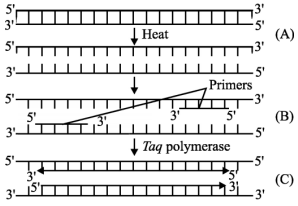
The melding of a technique for repeated rounds of DNA synthesis with the discovery of a thermostable DNA polymerase has given scientists the very powerful technique known as polymerase chain reaction (PCR). PCR is based on three simple steps required for any DNA synthesis reaction: (1) denaturation of the template into single strands; (2) annealing of primers to each original strand for new strand synthesis; and (3) extension of the new DNA strands from the primers.
In the given figure, one cycle of polymerase chain reaction (PCR) is shown:
Image
i. Name the steps A, B and C.
ii. Give the purpose of each of these steps.
iii. State the contribution of Thermus aquaticus in this process.
If a desired gene is identified in an organism for some experiments, explain the process of the following:
  1. Cutting this desired gene at specific location.
  2. Synthesis of multiple copies of this desired gene.
'Analysis of age pyramids for human population can provide important inputs for long-term planning strategies'. Explain.
Transcription in eukaryotes is more complex process than in prokaryotes. Justify and compare the initiation, elongation and termination in bacterial cells with eukaryotes.
Where do transcription and translation occur inside a living cell? Briefly describe the three steps involved in the process of translation?
Which methodology is used while sequencing the total DNA from a cell? Explain it in detail.
Explain how does lac operon in E. coli operate
a. in the absence of an inducer.
b. in the presence of an inducer.
What are the two groups of cells that work for specific immunity? Explain four unique features of specific immunity.
List three strategies that a bisexual chasmogamous flower can evolve to prevent self pollination (autogamy).