Question
Explain the life cycle of Plasmodium (with diagram).
Answer

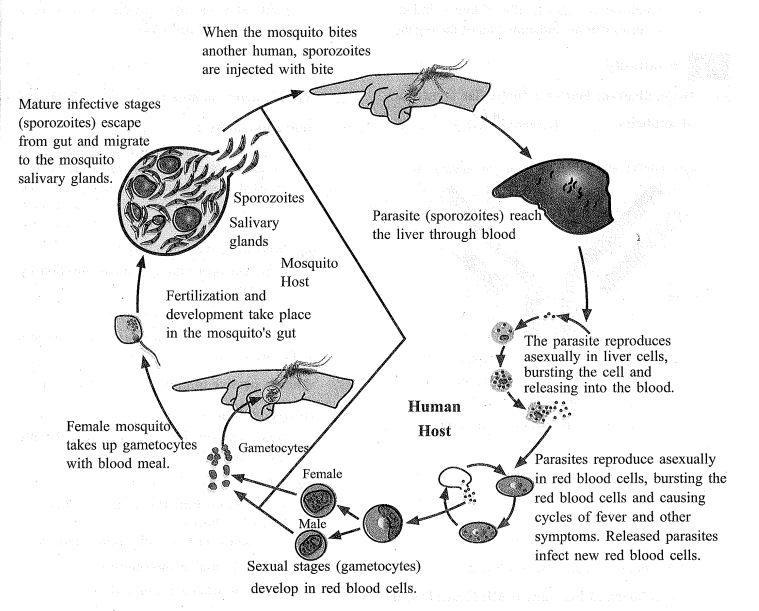
Plasmodium enters the human body in the form of sporozoites when an infected female Anopheles mosquito bites a human.
→Initially this parasite multiplies in the liver cells and then invades the blood cells causing RBC's to rupture.
→Rupture of RBC releases a toxic substance called hemozoin, which causes chills and high fever for 3 to 4 days.
→At this stage, when a female Anopheles mosquito bites an infected person, the parasite enters the mosquito's body, where it develops further.
→There they multiply and form sporozoites.
→This sporozoite is stored in the salivary gland of the mosquito.
When this infected female mosquito bites a person, the parasite enters her body and develops.
→Malaria parasite requires two hosts to complete its life cycle,
(1) Man,(2) Mosquitoes.
→Reproduction in Plasmodium
Asexual reproduction in humans:
→The parasite reproduces in the human RBC and destroys the RBC.
→In RBC the sexual stage (germ cells) develop male and female germs (male- microgamete, female-mega gamete).
→These genes enter mosquitoes from humans through mosquito bites.
Sexual reproduction in mosquito:
→The sexual genes (Gametes) entered into the mosquito from the human being are fertilized in the intestine of the mosquito and induce development.
→In order to develop, the sporozoite stage is stored in the salivary gland of the mosquito.
→Malaria is a disease caused by Plasmodium- like parasites in humans.
→Different species of Plasmodium like (Plasmodium falciparum, Plasmodium vivax, Plasmodium ovale) are responsible for different types of malaria.
Image

Need a full question paper?

Generate a complete, print-ready paper with questions like this in minutes — across 16+ boards, with answer keys.

Start Generating Free

Similar questions

Read the following and answer any four questions from (i) to (v) given below:

Reerna, Jai and Ankit are suffering from autoimmune diseases of adrenal cortex, joints and thyroid gland, respectively. Their immune system failed to recognise self and non-self and started destroying their body's own proteins. They are seeking proper medical help for their conditions but their condition cannot be cured completely.

Based on the above information, answer the following questions.

  1. Select the option that correctly identifies autoimmune diseases of Reema, Jai and Ankit.
S no.
Reema
Jai
Ankit
(a)
Diabetes
Grave's disease
Rheumatic fever
(b)
Pernicious anaemia
Multiple sclerosis
Myasthenia gravis
(c)
Addison's disease
Rheumatoid arthritis
Hashismoto's thyroiditis
(d)
Systemic lupus erythematosus
Severe combined immunodeficiency disease
AIDS
  1. Reema's autoimmune condition is characterised by
  1. Undersecretion of insulin.
  2. Destruction of RB Cs and low RB C count.
  3. Undersecretion of adrenal cortex hormones.
  4. Low production of intrinsic factor required for absorption of B12
  1. What do you think is the major cause of Jai's condition?
  1. Deterioration of myelin sheath around nerve cells, leading to loss of precise muscle control
  2. Destruction of heart cells, leading to weakening of entire heart wall.
  3. Destruction of beta cells, leading to undersecretion of insulin.
  4. Deposition of immune complexes of IgM, IgG and complement in joints thereby inflaming joints, destroying articular cartilage and fusing bones.
  1. How do you think Ankit's condition got diagnosed?
  1. Low level of thyroid hormone and elevated levels of TSH in Ankit's blood.
  2. Presence of antibodies against thyroid pen oxidase (TPO antibodies) in Ankit's blood.
  3. Elevated erythrocyte sedimentation rate (ESR), reduced C-reactive protein (CRP) in Ankit.
  4. Both (a) and (b)
  1. Assertion: Immunosuppressive drugs often reduce the severity of autoimmune disorders.

Reason: Monoclonal antibodies have been successfully used in the treatment of autoimmune disease.

  1. Both assertion and reason are true, and reason is the correct explanation of assertion.
  2. Both assertion and reason are true, but reason is not the correct explanation of assertion.
  3. Assertion is true, but reason is false.
  4. Both assertion and reason are false.
Explain 'rivet popper hypothesis with example.
Read the following and answer any four questions from (i) to (v) given below:

A young couple married for 5 years is unable to bear a child in spite of not practicing any birth control method. Upon consultation, doctor advised them an assisted reproductive technology involving transfer of gametes into oviducts.

  1. Identify the technique adopted by the couple.
  1. ZIFT
  2. JUI
  3. GIFT
  4. ICSI
  1. What is the pre-requisite of this technique?
  1. Gamete formation should be normal.
  2. Fallopian tubes should be normal.
  3. Female should have thick endometrial lining.
  4. Male should be able to copulate the female.
  1. Assertion: GIFT is an in-vitro fertilisation technique.

Reason: In GIFT, gametes are fertilised outside the female body.

  1. Both assertion and reason are true, and reason is the correct explanation of assertion.
  2. Both assertion and reason are true, but reason is not the correct explanation of assertion.
  3. Assertion is true, but reason is false.
  4. Both assertion and reason are false.
  1. The procedure advised to couple involves the transfer of:
  1. Fertilised ovum.
  2. Embryo with 8 blastomeres.
  3. Sperms and unfertilised ovum.
  4. Embryo with 16 blastomeres.
  1. What is the success rate of this procedure?
  1. 30-50%
  2. < 20%
  3. 80-85%
  4. 27-30%
Read the following and answer any four questions from (i) to (v) given below:

Study the given table and answer the questions based on it.

 
Hormone
Source
Function
(A)
Oxytocin
W
Ejection of milk
(B)
X
Anterior lobe of pituitary gland
Stimulates secretion of ABP from Sertoli cells
(C)
Y
Placenta
Maintains corpus luteum to secrete progesterone
(D)
Relaxin
Ovary
Z
  1. Identify the hormones X and Y, respectively.
  1. Testosterone, FSH.
  2. LH, hPL.
  3. FSH, hCG.
  4. ICSH, hCG.
  1. W in the given table is:
  1. Hypothalamus.
  2. Posterior lobe of pituitary.
  3. Placenta.
  4. Ovary.
  1. Which of the following is correct for Z?
  1. Dilation of uterine cervix during labour pains.
  2. Stimulates the growth of the mammary glands during pregnancy.
  3. Supports the fetal growth and prevents desiccation.
  4. Forms protective plug in cervix of uterus during pregnancy.
  1. Which set of hormones is secreted only during pregnancy?
  1. Human chorionic gonadotropin, relax in and human placental lactogen.
  2. Human placental lactogen, estrogen and chorionic thyrotropin.
  3. Human chorionic gonadotropin, human placental lactogen and progesterone.
  4. Chorionic thyrotropin, chorionic gonadotropin and estrogen.
  1. Assertion: Follicle stimulating hormone controls the maintenance and functions of male reproductive organs.

Reason: FSH acts directly on spermatogonia to stimulate sperm production.
  1. Both assertion and reason are true, and reason is the correct explanation of assertion.
  2. Both assertion and reason are true, but reason is not the correct explanation of assertion.
  3. Assertion is true, but reason is false.
  4. Both assertion and reason are false.
Read the following and answer any four questions from (i) to (v) given below:
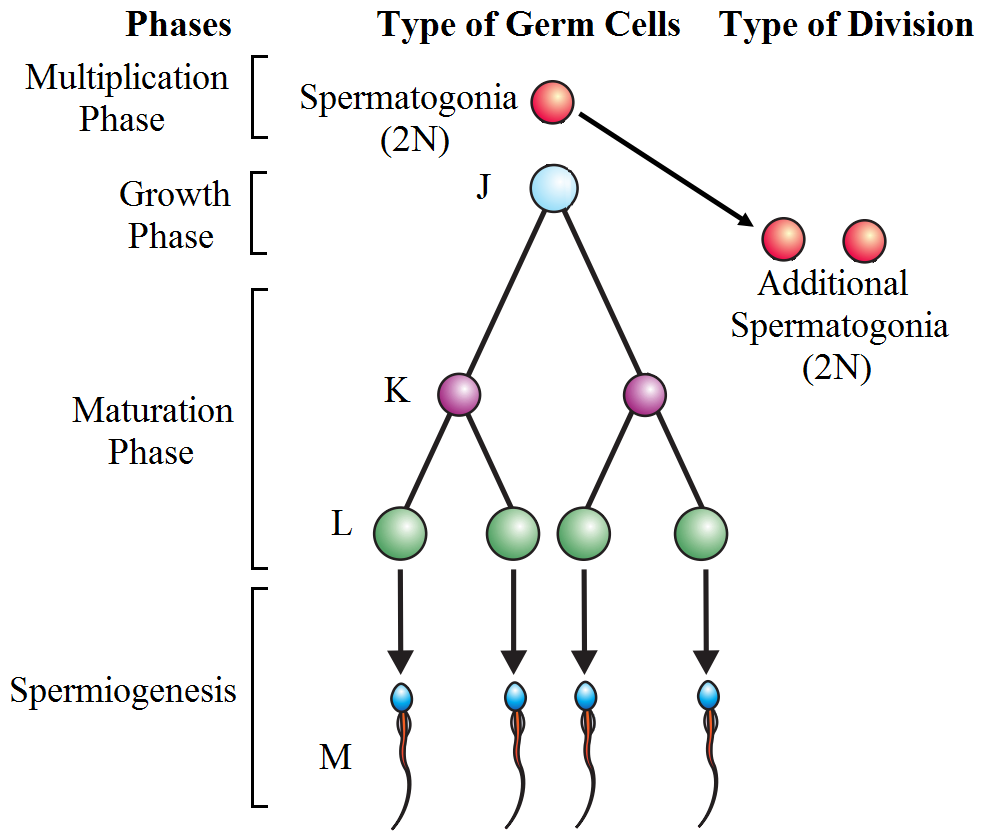
In testis, the immature male germ cells produce sperms by spermatogenesis that begins at puberty. It occurs in the seminiferous tubules of the testes. Seminiferous tubules are lined by germinal epithelium. Study the schematic representation of spermatogenesis and answer the following questions.

  1. Which cell division occurs during multiplication phase?
  1. Mitosis.
  2. Meiosis I.
  3. Meiosis II.
  4. Both (b) and (c).
  1. How many chromosomes are present in secondary spermatocyte and spermatid, respectively?
  1. 46, 23
  2. 46, 46
  3. 23, 23
  4. 23, XY
  1. Transformation of L into M is known as:
  1. Spermiation.
  2. Spermateliosis.
  3. Spermatogenesis.
  4. None of these.
  1. Select the correct option.
  1. Type A spermatogonia grows to larger primary spermatocyte.
  2. One spermatogonium forms two spermatids.
  3. Spenniation is the release of sperms from seminiferous tubules.
  4. Primary spermatocyte undergoes mitosis to form secondary spermatocytes.
  1. Which hormone acts on spermatogonia to stimulate sperm production?
  1. LH.
  2. GnRH.
  3. ABP.
  4. FSH.
Describe different outbreeding devices in detail.###Describe different devices to discourage self pollination.###Describe different devices to encourage cross pollination.
Read the following and answer any four questions from (i) to (v) given below:

The endosperm makes the main source of food for the embryo. Generally the endosperm nucleus divides after the division of the oospore, but in several cases the endosperm is formed to a great extent even before the first division of the oospore. There are three general types of endosperm formation: (a) nuclear type, (b) cellular type and (c) helobial type. The endosperm is usually triploid, but haploid endosperm is also found. Endosperm may either be completely consumed by the developing embryo before seed maturation, or it may persist in the mature seed.

  1. Haploid endosperm is found in:
  1. Pin us.
  2. Cauliflower.
  3. Sunflower.
  4. Pea.
  1. Persistent endosperm is found in:

P. Pea Q. Castor R. Bean S. Coconut T. Groundnut.

  1. Q and S.
  2. P and T.
  3. R, S and T.
  4. P, S and T.
  1. Milk of tender coconut represents (A) and the surrounding white coconut meal represents (B).
S. No
A
B
(a)
Cellular endosperm
Free- nuclear endosperm
(b)
Free-nuclear endosperm
Cellular endosperm
(c)
Helobial endosperm
Cellular endosperm
(d)
Free-nuclear endosperm
Helobial endosperm
  1. If an endosperm cell of a gymnosperm contains 12 chromosomes, the number of chromosomes in each cell of the root will be:
  1. 4
  2. 24
  3. 16
  4. 6
  1. In angiosperms, normally after fertilization:
  1. The zygote divides earlier than the primary endosperm nucleus.
  2. The primary endosperm nucleus divides earlier than the zygote.
  3. Both the zygote and primary endosperm nucleus divide simultaneously.
  4. Both the zygote and primary endosperm nucleus undergo a resting period.
Explain exponential growth equation with well labeled diagram.###Explain exponential growth.
Read the following and answer any four questions from (i) to (v) given below:
IUCN maintains a Red Data Book or Red List which is a catalogue of taxa facing risk of extinction. The IUCN Red List (2004) documents the extinction of 784 species in the last 500 years. Some examples of recent extinctions include the dodo, quagga, thylacine and Steller's sea cow. The last twenty years alone have witnessed the disappearance of 27 species. Red List has eight categories of species.
  1. Dodo, an extinct taxon, belongs to which country?
  1. Mauritius
  2. Africa
  3. Australia
  4. Russia
  1. To which of the following categories of IUCN, Berberis nilghiriensis belongs?
  1. Extinct.
  2. Extinct in wild.
  3. Endangered.
  4. Critically endangered.
  1. Steller's sea cow and passenger pigeon became extinct due to:
  1. Alien species invasion.
  2. Over-exploitation.
  3. Coextinctions.
  4. Intensive agriculture.
  1. Bali, Javan and Caspian are:
  1. Species of tiger.
  2. Species of cheetah.
  3. Subspecies of cheetah.
  4. Subspecies of tiger.
  1. Select the correct term for the following definitions (i, ii, iii, iv).
  • The taxon is liable to become extinct if not allowed to realise its full biotic potential by providing protection from exotic species/ human exploitation/habitat deterioration/depletion of food.
  • The taxon has been completely eliminated or died out from earth, e.g., Dodo.
  • The taxon is facing a high risk of extinction in the wild in the near future due to decrease in its habitat, excessive predation or poaching.
  • They are species with naturally small populations, either localised or thinly scattered, which are always at risk from pests/ pathogens/ predators/ exotic species.
 
(i)
(ii)
(iii)
(iv)
(a)
Threatened
Extinct
Endangered
Rare
(b)
Endangered
Extinct
Threatened
Rare
(c)
Extinct
Rare
Threatened
Endangered
(d)
Threatened
Extinct
Rare
Endangered
Read the following and answer any four questions from (i) to (v) given below:
Translation is the process of polymerisation of amino acids to form a polypeptide. The order and sequence of amino acids are defined by the sequence bases in the mRNA. The amino acids are joined by a bond called peptide bond. Ribosome is the site of protein synthesis.
  1. Which ion is essential for association of both units of ribosome at the time of protein formation?
  1. Mg2+
  2. Mn2+
  3. CI-
  4. Ca2+
  1. During translation, how many initiation factors are required in eukaryotes for initiation reactions?
  1. 3
  2. 6
  3. 7
  4. 9
  1. Which part of mRNA contains untranslated regions (UTR)?
  1. 3' end
  2. 5' end
  3. Either 3' or 5' end
  4. Both 5' end and 3' end
  1. Name the enzyme that helps in combining amino acid to its particular tRNA?
  1. Activating enzyme
  2. Amino-acyl tRNA-synthetas
  3. PeptidyI transferase
  4. Both (a) and (b)
  1. From the given list, select the translation machinery.
  1. mRNA
  2. Ribosomes
  3. Amino acids
  4. tRNAs
  5. Peptidyl transferase
  6. Amino acyl tRNA synthetase
  7. Pyrophosphatase
  1. (1), (2), (3), (4) and (6)
  2. (1), (2), (3), (4) and (5)
  3. (1), (2), (3), (4), (5) and (6)
  4. (1), (2), (3), (4), (5), (6) and (7)