Question
Explain the mechanism of compost formation.

Answer

Mechanism of compost formation:
  1. A trench of dimension of 4 to 5m long, 1.5 to 1.8m broad and 1.0 to 1.8m deep is dug.
  2. A layer of well mixed refuse of about 30cm thickness is spread in the trench.
  3. The refuse layer is well moistened by slurry of cow dung, earth and water.
  4. Now, a second layer of well mixed refuse is spread in trench till the heap rises to a height of 45 to 60cm above the ground level.
  5. The top of the heap is covered with a thin layer of moist earth.
  6. After three months, the material is taken out of the trench and placed in the form of conical heap. The conical heap, if required, be suitably moistened and should be covered with earth.
  7. Conical heap is left undisturbed for about one to two months. After this period, compost can be used in crop fields.

Need a full question paper?

Generate a complete, print-ready paper with questions like this in minutes — across 16+ boards, with answer keys.
Start Generating Free

Similar questions

There are three substances $X, Y$ and $Z$. The substance $X$ does not have a fixed melting point or boiling point and it still shows the individual properties of its constituents. The substance $Y$ is a pure substance which occurs in nature as such. The substance $Y$ has a fixed melting point and boiling point but it cannot be broken down into simpler substances by any chemical means. The substance $Z$ is also a pure substance whose properties are entirely different from those of its constituents. The substance $Z$ can, however, be divided by electrolysis into two substances which belong to the same class of substances as $Y$.
  1. What type of substance could $X$ be? Name one substance like $X$.
  2. What type of substance could $Y$ be? Name one substance like $Y$.
  3. What type of substance could $Z$ be? Name one substance like $Z$.
  4. Whish process involves absorption or release of an appreciable amount of energy: formation of substance $X$ or formation of substance $Z$?
  5. Name the three groups into which all the substances like $Y$ are divided on the basis of their properties.
a. How does a boat float in water$?$
b. A piece of steel has a volume of $12 cm^3$, and a mass of $96\ g .$ What is its density: $(i)$ in $g / cm ^3$ $(ii)$ in $kg / m ^3 ?$
Explain the following:
  1. Eutrophication.
  2. Biomagnification.
Describe some flight adapiations of the birds.
Which has more atoms, $50g$ of aluminium or $50g$ of iron? Illustrate your answer with the help of calculations. (Atomic masses: $Al = 27u; Fe = 56u$)
Draw a neat labelled diagram of an animal cell.
How will you separate camphor, common salt and iron nails from their mixture?
Draw a labelled diagram of human ear and discuss the function of its parts and its working.
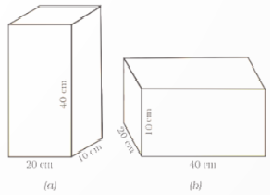
A block of wood is kept on a tabletop. The mass of the wooden block is $5 \ kg$ and its dimensions are $40 \ cm \times 20 \ cm\times 10 \ cm$. Find the pressure exerted by the wooden block on the table top if it is made to lie on the table top with its sides of dimensions
Image
$i. 20 \ cm \times 10 \ cm$ and
$ii. 40 \ cm \times 20 \ cm$.
Write a short note on prevention of animal diseases.