Question
Explain the method of posting a Petty Cash Book.

Answer

Entries in the Petty Cash Book are posted into the ledger accounts at the end of the specified period, i.e., month or quarter as the case is. Petty Cash Book is considered as a memorandum book. The petty expenses are not directly posted to ledger accounts. A Petty Cash Account is maintained in the ledger. When Petty Cash is advanced to the petty cashier, the Chief Cashier records it on the credit side of Cash Book as “By Petty Cash A/c". At the end of specified period (say a week, a fortnight or a month), for the total expenses paid a Journal entry is passed by debiting individual petty expenses and crediting to Petty Cash Account. All the accounts reating to petty expenses are maintained in the ledger individually. Posting is made on the debit side of these accounts by writing "To Petty Cash A/c” in the Particulars Column.

Need a full question paper?

Generate a complete, print-ready paper with questions like this in minutes — across 16+ boards, with answer keys.

Start Generating Free

Similar questions

From the following information, calculate Total Sales made during the period:
 
Debtors as on 1st April, 2017 20,400
Cash received from debtors during the year (as per Cash Book) 60,800
Returns Inward 5,400
Bad Debts 2,400
Debtors as on 31st March, 2018 27,600
Cash Sales (as per Cash Book) 56,800
From the following information, calculate Total Sales made during the period:
 
Debtors as on 1st April, 2017 20,400
Cash received from debtors during the year (as per Cash Book) 60,800
Returns Inward 5,400
Bad Debts 2,400
Debtors as on 31st March, 2018 27,600
Cash Sales (as per Cash Book) 56,800
On 20th March, 2019, Naresh sold goods to Kailash to the value of ₹ 1,250, taking a bill at 3 months for the amount. On maturity, the bill was dishonoured. Naresh paid ₹ 10 as noting charges. On 1st July, Kailash cleared his account by paying ₹ 1,260.
Make the entries in the books of both the parties to record the above transactions.
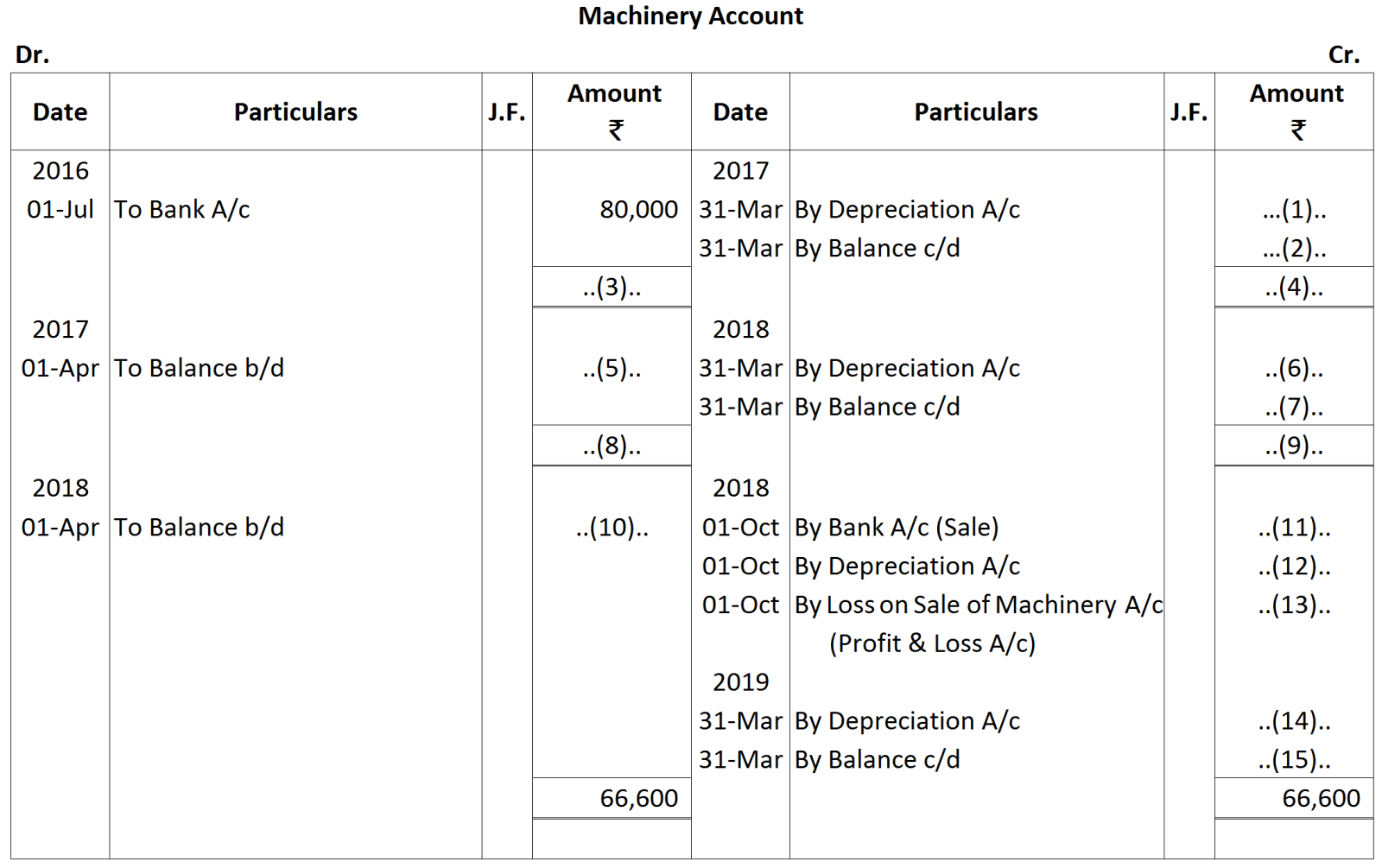
In the following Machinery Account, determine the missing values, if depreciation is to be charged @ 10% p.a. per Diminishing Balance Method. On 1st October, 2018, a part of the machinery valued in the books of the firm at ₹ 16,000 on 1st July, 2016 was sold for ₹ 10,000.
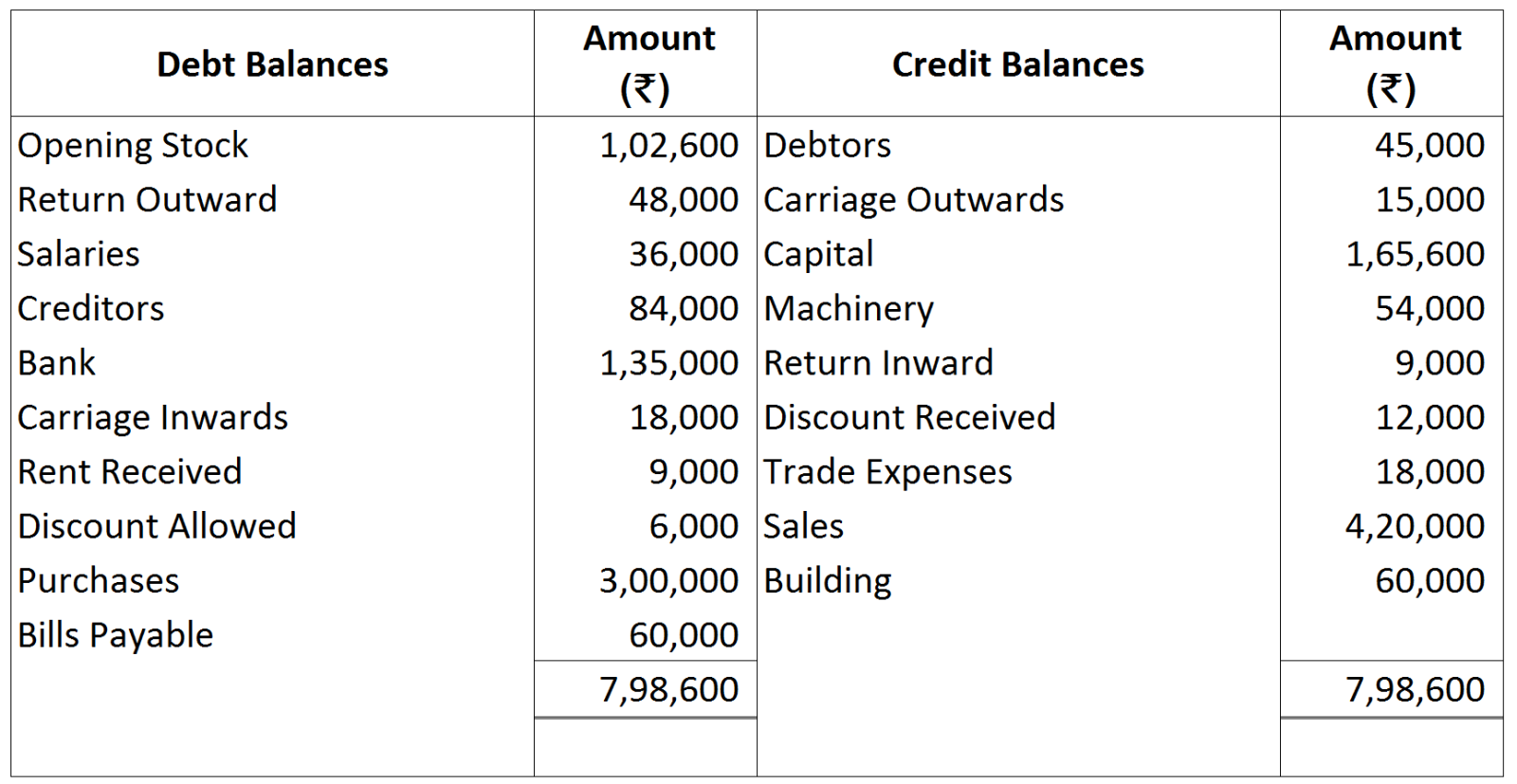
Correct the following Trial Balance:
Tiwari & Sons find that the bank balance shown by their Cash Book on 31st March, 2019 is ₹ 40,500 (credit) but the Pass Book shows a difference due to the following reasons:
  1. A cheque for ₹ 5,000 drawn in favour of Manohar has not yet been presented for payment.
  2. A post-dated cheque for ₹ 900 has been debited in the bank column of the Cash Book but it could not have been presented in any case.
  3. Cheques totalling ₹ 10,200 deposited with the bank have not yet been collected and a cheque for ₹ 4,000 has been dishonoured.
  4. A bill for ₹ 10,000 was retired by the Bank under a rebate of ₹ 150 but the full amount of the bill was credited in the bank column of the Cash Book.
Prepare Bank Reconciliation Statement and find out the balance as per Pass Book.
Following balances appear in the Trial Balance of a firm as on $31^{st}$ March, $2019$:
 
 
Opening Stock:
Raw Material
80,000
 
Finished Goods
1,40,000
Purchases
 
3,60,000
Sales
 
7,00,000
Returns:
Purchases
10,000
 
Sales
6,000
Wages
 
1,30,000
Factory Expenses
 
90,000
Freight:
Inwards
20,000
 
Outwards
30,000
At the end of the accounting period, stock was:
 
Raw Materials
 
70,000
Work-in-Process
 
20,000
Finished Goods
 
1,10,000
Prepare Trading Account of the firm.
Rectify the following errors:
  1. Goods purchased from Kunal for ₹ 8,000 and from Kapil of ₹ 9,000 recorded correctly in the Purchases Book. However, ₹ 9,000 was posted to Kunal and ₹ 8,000 to Kapil.
  2. Anil's Account was excess debited by ₹ 500 while Suraj's Account was short debited by ₹ 500.
  3. Parkar's Account was short credited by ₹ 700 while Manisha's Account was excess credited by ₹ 700.
  4. Goods sold to Roopak for ₹ 1,000 and to Sagar for ₹ 1,800 recorded correctly in the Sales Book. However, ₹ 1,800 was posted to Roopak and ₹ 1,000 to Sagar.
Write Short Notes on:
Applications of Computers in Accounting.
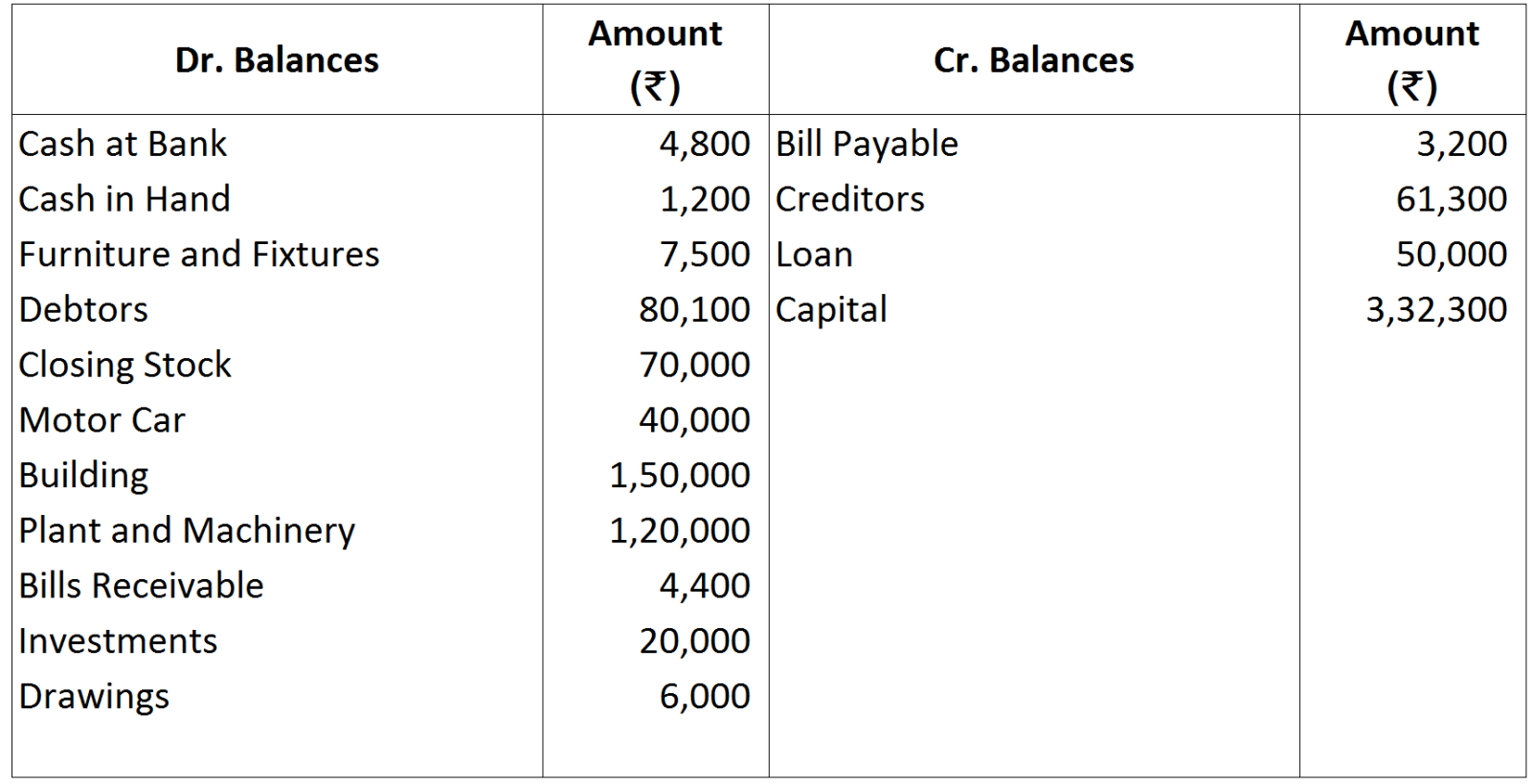
A merchant has earned a Net Profit of ₹ 57,200 for the year ended 31st March, 2017. Other balances in his Ledger are as under:
Prepare his Balance Sheet as at 31st March, 2017.