Question
Explain the nomenclature of phenols by giving examples.

Answer

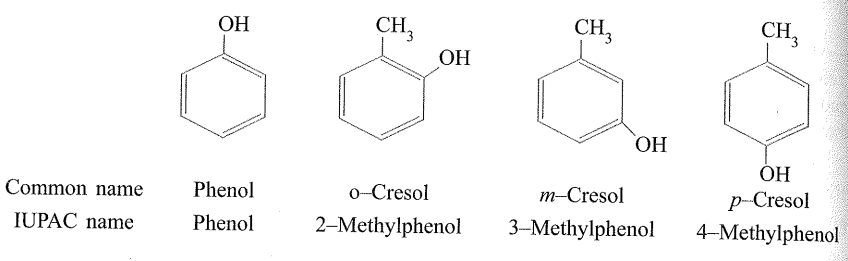
→ The simplest hydroxyl derivative of benzene is phenol. It is its common name and also an accepted IUPAC name. As structure of phenol involves a benzene ring, in its substituted compounds the term ortho (1,2- disubstituted), meta (1,3- disubstituted) and para (1,4- disubstituted) are often used in the common names.
Example:
Image
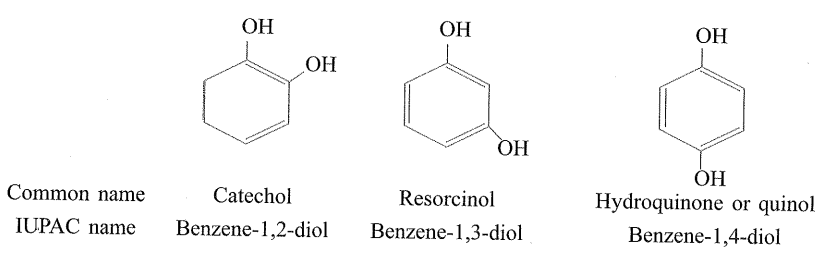
→ Dihydroxy derivatives of benzene are known as 1, 2, 1, 3- and 1, 4-benzenediol.
Image

Need a full question paper?

Generate a complete, print-ready paper with questions like this in minutes — across 16+ boards, with answer keys.

Start Generating Free

Similar questions

A solution prepared by dissolving 8.95mg of a gene fragment in 35.0mL. of water has an osmotic pressure of 0.335 torr at 25°C. Assuming that the gene fragment is a non-electrolyte, calculate its molar mass.
Give reactions taking place at the two electrodes if these are made up of Ag.
A first order reaction is 50% completed in 40 minutes at 300 K and in 20 minute at 320 K. Calculate the activation energy of the reaction. (Given: log 2=0.3010, log 4=0.6021, $R=8.314$ $J~K^{-1}$ mol).
Assign reasons for the following:
The transition metals and many of their compounds act as good catalysts.
How do you differentiate between reaction rate and reaction rate constant. What is meant by the rate controlling step in a reaction?
The vapour pressure of pure liquids A and B are 450 and 700 mm Hg respectively, at 350 K . Find out the composition of the liquid mixture if total vapour pressure is 600 mm Hg. Also find the composition of the vapour phase.
Ionisation enthalpies of Ce, Pr and Nd are higher than Th, Pa and U.
Permanganate ion $\left( MnO _4^{-}\right)$gives different reduction products at different concentration of hydrogen ions, write their equations.
Depict the galvanic cell in which the reaction $Zn(s) + 2Ag^+(aq) \rightarrow Zn^{2+}(aq) + 2Ag(s)$ takes place. Further show:
  1. Which of the electrode is negatively charged?
  2. The carriers of the current in the cell.
  3. Individual reaction at each electrode.
Explain the products obtained from electrolysis of aqueous solution of sodium chloride on the basis of electrode potential values.