Question
Explain the oxidation of primary, secondary and tertiary alcohols.

Answer

self

Need a full question paper?

Generate a complete, print-ready paper with questions like this in minutes — across 16+ boards, with answer keys.
Start Generating Free

Similar questions

i. Write the structure of main products when aniline reacts with the following reagents :
a. $Br _2$ water
b. HCl
c. $\left( CH _3 CO \right)_2 O /$ pyridine
ii. Arrange the following in the increasing order of their boiling point:$C _2 H _5 NH _2, C _2 H _5 OH ,\left( CH _3\right)_3 N$
iii. Give a simple chemical test to distinguish between the following pair of compounds : $\left( CH _3\right)_2 NH$ and $\left( CH _3\right)_3 N$.
Give the oxidation state, d-orbital occupation and coordination number of the central metal ion in the following complexes:
$i. K_3\left[ Co \left( C _2 O _4\right)_3\right]$
$ii.$ cis- $\left[ Cr (e n)_2 Cl _2\right] Cl$
$iii. \left( NH _4\right)_2\left[ CoF _4\right]$
$iv. \left[ Mn \left( H _2 O \right)_6\right] SO _4$
  1. ‘Hormones are chemical messengers.’ Explain.
  2. Name the main disease caused due to lack of the vitamin and its source in each of the following: A, $B_6$ and E.
Answer the following question:
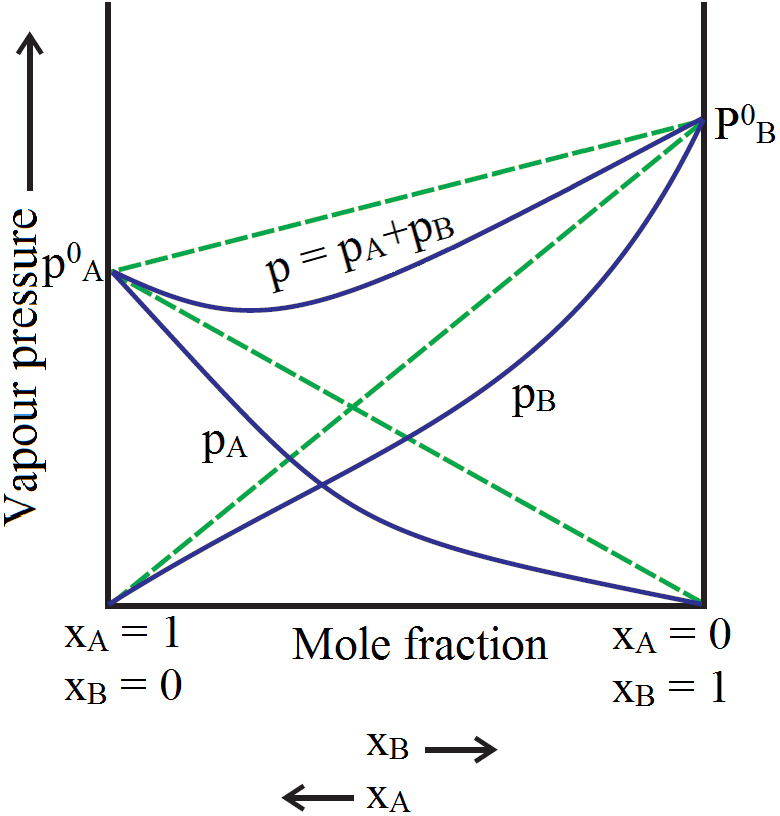
The graphical representation of vapour pressures of two component system as a function of composition is given alongside. By graphic inspection, answer the following questions:
  1. Are the A-B interactions weaker, stronger or of the same magnitude as A-A and B-B?
  2. Name the type of deviation shown by this system from Raoult’s law.
  3. Predict the sign of $\Delta_\text{mix}\text{H}$ for this system.
  4. Predict the sign of $\Delta_\text{mix}\text{H}$ for this system.
  5. Give an example of such a system.
  6. What type of azeotrope will this system form, if possible?
Explain on the basis of valence bond theory that $\left[ Ni ( CN )_4\right]^{2-}$ ion with square planar structure is diamagnetic and the $\left[ NiCl _4\right]^{2-}$ ion with tetrahedral geometry is paramagnetic.
(a) Why $\alpha$-hydrogen of carbonyl compound are acidic in nature?
(b) Explain aldol condensation reaction of ethanal.
  1. Define the following terms:
  1. Molarity.
  2. Molal elevation constant(Kb).
  1. A solution containing 15 g urea (molar mass = $60 g\ mol^{–1}$​​​​​​​) per litre of solution in water has the same osmotic pressure (isotonic) as a solution of glucose (molar mass = $180 g\ mol^{–1}​​​​​​​$) in water. Calculate the mass of glucose present in one litre of its solution.

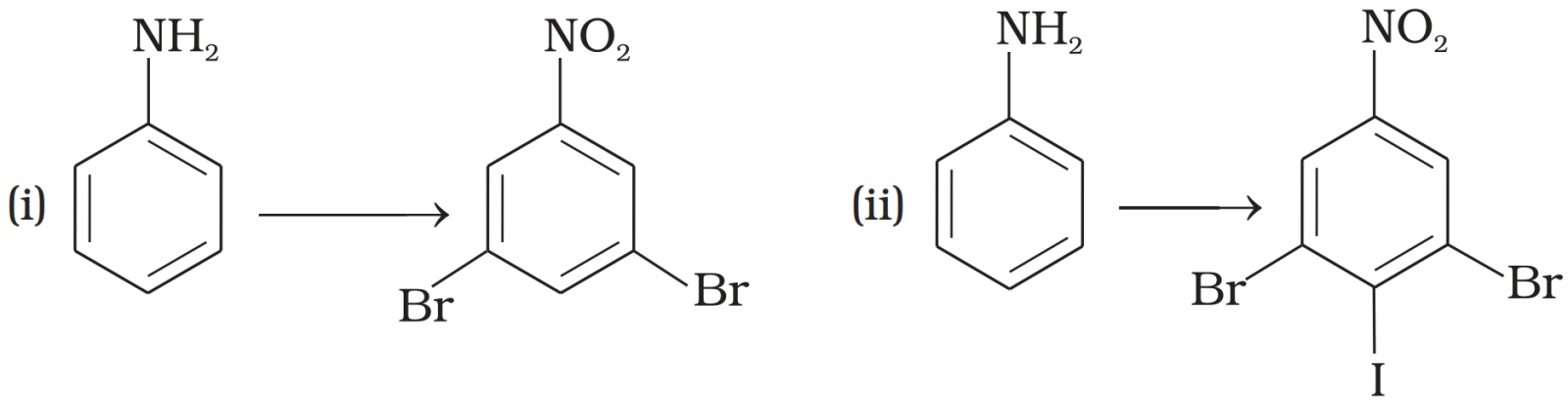
How will you carry out the following conversions?
Answer the following questions:
Is the variability in oxidation number of transition elements different from that of non–transition elements? Illustrate with examples.
A colourless substance 'A' $(C_6H_7N)$ is sparingly soluble in water and gives a water soluble compound 'B' on treating with mineral acid. On reacting with $CHCl_3$ and alcoholic potash 'A' produces an obnoxious smell due to the formation of compound 'C'. Reaction of 'A' with benzenesulphonyl chloride gives compound 'D' which is soluble in alkali. With $NaNO_2$ and HCl, 'A' forms compound 'E' which reacts with phenol in alkaline medium to give an orange dye 'F'. Identify compounds 'A' to 'F'.