Question
Explain the phenomenon of nuclear fission.

Answer

$\rightarrow $ When a heavy nucleus is bombarded with a neutron, then first neutron is absorbed. This nucleus is in a highly excited state. As a result, it splits into two lighter nuclei of approximately equal mass to become stable.
$\rightarrow $ Neutron is chargeless so it does not have to face coulomb forces. So neutron is a best projectile.
$\rightarrow $ When a neutron is bombarded on the nucleus of uranium its nucleus breaks into two almost equal parts. Its nuclear reaction is as below :
${ }_{92}^{235} U +{ }_0^1 n \rightarrow{ }_{92}^{236} U \rightarrow{ }_{56}^{144} B a+{ }_{36}^{89} K r+3\left({ }_0^1 n\right)+ Q$
${ }_{92}^{235} U +{ }_0^1 n \rightarrow{ }_{92}^{236} U \rightarrow{ }_{51}^{133} S b+{ }_{41}^{99} N b+4\left({ }_0^1 n\right)+ Q$
${ }_{92}^{235} U +{ }_0^1 n \rightarrow{ }_{92}^{236} U \rightarrow{ }_{54}^{140} Xe +{ }_{38}^{94} S r+2\left({ }_0^1 n\right)+ Q$
$\rightarrow $ The fission fragments are radioactive and by successive emmision of $\beta$-particles results in the stable nuclei.
$\rightarrow $ During the fission process of uranium the energy released per fission is almost $200 \ MeV$ .
$\rightarrow $ Suppose a nucleus with mass number $A =240$ breaks into two fragments each of $A =120$.
$\rightarrow $ Binding energy per nucleon for a nucleus with $A =240$ is $7.6 \ MeV$ and for a nucleus with $A =120$ is $8.5 \ MeV .$
$\rightarrow $ Gain in binding energy per nucleon
$=8.5-7.6$
$=0.9 MeV$
$\rightarrow $ Total gain in binding energy
$=0.9 \times 240$
$=216 MeV .$
$\rightarrow $ The disintegration energy in fission events first appears as the kinetic energy of the fragments and neutrons. Eventually it is transferred to the surrounding matter appearing as heat.
$\rightarrow $ In a nuclear reactor this process takes place in a controlled manner whereas in an atomic bomb this process takes place in an uncontrolled manner.

Need a full question paper?

Generate a complete, print-ready paper with questions like this in minutes — across 16+ boards, with answer keys.
Start Generating Free

Similar questions

A plane electromagnetic wave travels in vacuum, along the Y-direction. Write down the:
  1. Ratio of the magnitudes,
  2. The direction, of its electric and magnetic field vectors.
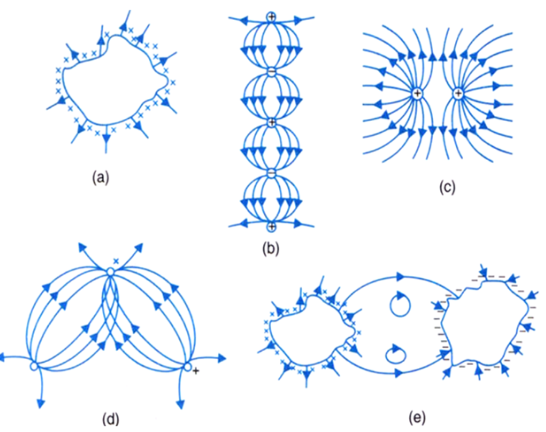
Which among the curves shown in Fig. 1.35 cannot possibly represent electrostatic field lines?
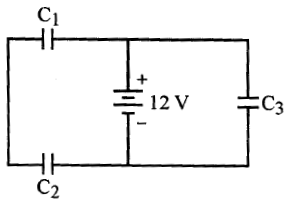
Three identical capacitors $C_1, C_2$ and $C_3$ of capacitance 6 µF each are connected to a 12 V battery as shown.
Find:
  1. charge on each capacitor.
  2. equivalent capacitance of the network.
  3. energy stored in the network of capacitors.
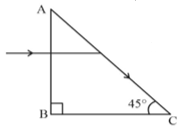
A light ray entering a right $-$ angled prism undergoes refraction at the face $AC$ as shown in Figure
$(I)$ What is the refractive index of the material of the prism in Figure?
Image
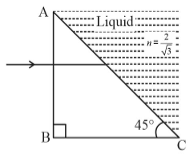
$(II) \ (a) $ If the side $AC$ of the above prism is now surrounded by a liquid of refractive index $\frac{2}{\sqrt{3}}$ as shown in Figure, determine if the light ray continues to graze along the interface $AC$ or undergoes total internal reflection or undergoes refraction into the liquid.

Image

$(b)$ Draw the ray diagram to represent the path followed by the incident ray with the corresponding angle values.
$($Given, $\sin ^{-1}\left(\frac{\sqrt{2}}{\sqrt{3}}\right)=54.6^{\circ})$
The radius of innertmost orbit of hydrogen atom is $5.3 \times 10^{-11} m$. What is the radius of second excited state?
Define the term magnetic inclination. Deduce the relation connecting the horizontal component and inclination with the help of a diagram.
In the Bohr model of hydrogen atom, the electron is treated as a particle going in a circle with the centre at the proton. The proton it self is assumed to be fixed in an inertial frame. The centripetal force is provided by the Coloumb attraction. In the ground state, the electron goes round the proton in a circle of radius $5.3 \times 10^{-11}m.$ Find the speed of the electron in the ground state. Mass of the electron $= 9.1 \times 10^{-31}kg$ and charge of the electron $= 1.6 \times 10^{-19}C.$
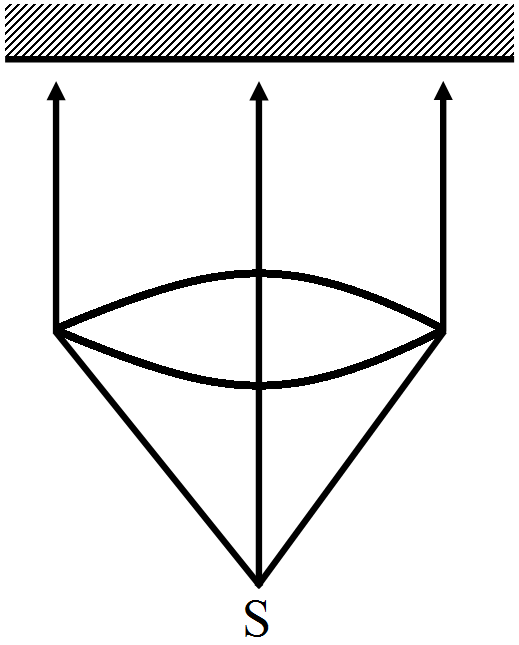
A totally reflecting, small plane mirror placed horizontally faces a parallel beam of light, as shown in the figure. The mass of the mirror is 20g. Assume that there is no absorption in the lens and that 30% of the light emitted by the source goes through the lens. Find the power of the source needed to support the weight of the mirror. Take $g = 10m/s^2.$​​​​​​​
Find the angle of minimum deviation for an equilateral prism made of a material of refractive index 1.732. What is the angle of incidence for this deviation?
Trace the rays which are passing through a convex lens and a concave lens.