Question
Explain the principle of paper chromatography.

Answer

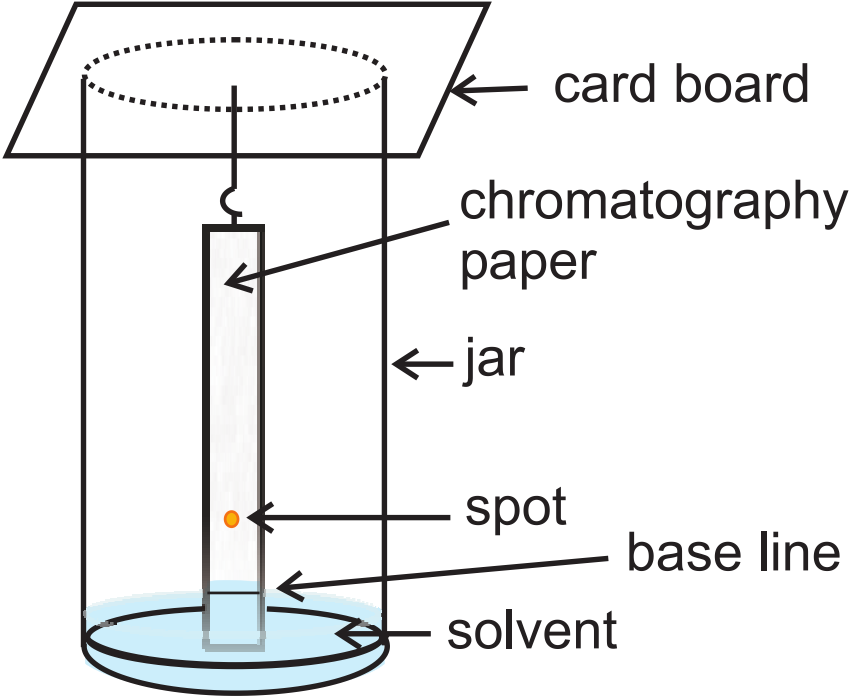
In paper chromatography, chromatography paper is used. This paper contains water trapped in it, which acts as the stationary phase. On the base of this chromatography paper, the solution of the mixture is spotted. The paper strip is then suspended in a suitable solvent, which acts as the mobile phase. This solvent rises up the chromatography paper by capillary action and in the procedure, it flows over the spot. The components are selectively retained on the paper (according to their differing partition in these two phases). The spots of different components travel with the mobile phase to different heights. The paper so obtained (shown in the given figure) is known as a chromatogram.

Need a full question paper?

Generate a complete, print-ready paper with questions like this in minutes — across 16+ boards, with answer keys.
Start Generating Free

Similar questions

  1. Why is $+2$ oxidation state of Mn (25) quite stable, while the same is not true for iron (26)?
  2. What is meant by dual nature of electrons? Calculate the energy and wavelength of the photon emitted by hydrogen atom when electron makes a transition from $n = 2$ to $n = 1$. Given that the ionisation potential is $13.6 eV. (1eV = 1.6 \times 10^{-19}J)$.
Discuss the concept of hybridisation. What are its different types in a carbon atom.
  1. Identify the oxidising agent and reducing agent in the following reactions:
  1. $\text{MnO}_2+4\text{HCl}\xrightarrow{ \ \ \ \ \ \ \ }\text{MnCl}_2+\text{Cl}_2+2\text{H}_2\text{O}$
  2. $2\text{MnO}_4^-10\text{Cl}^-+16\text{H}^+\\ \xrightarrow{ \ \ \ \ }2\text{Mn}^{2+}+5\text{Cl}_2+8\text{H}_2\text{O}$
  1. Calculate the oxidation number of underlined elements in the following speries.
$\text{Pb}_3\text{O}_4,$ $\text{H}_2\text{Cl}$, $\text{PO}_4^{3-}$
Write the effect of common ion effect on solubility of ionic salts.
How is heat change $(\Delta H )$ measured at constant pressure? Explain.
  1. Define solubility product. Write solubility product expression for $Zr_3(PO_4)_4$.
  2. Calculate the pH of $0.01 M CH_3COOH$ solution. $[K_a(CH_2COOH) = 1.74 \times 10^{-51}$
  3. Explain why NaCl is precipitated when HCl(g) is passed through the saturated solution of NaCl.
A student forgot to add the reaction mixture to the round bottomed flask at $27^\circ\ C$ but instead he/she placed the flask on the flame. After a lapse of time, he realized his mistake, and using a pyrometer he found the temperature of the flask was $477^\circ\ C$. What fraction of air would have been expelled out?
Graphically show the total work done in an expansion when the state of an ideal gas is changed reversibly and isothermally from $\left(p_i, V_i\right)$ to $\left(p_f, V_f\right)$. With the help of a pV plot compare the work done in the above case with that carried out against a constant external pressure $p _{ f }$
Arrange the following:
  1. During Clark's method, name the compound in which 'Mg' is precipated out?
  2. Give the formula of Zeolite used in ion exchange method to remove permanent hardness of water.
  3. Complete the following reaction:
$\text{BaO}_2.8\text{H}_2\text{O}(\text{s})+\text{H}_2\text{SO}_4(\text{aq})\xrightarrow{\ \ \ \ \ \ \ \ \ \ \ \ }$
  1. $H_2O_2$ is miscible with water. Assign reason.
  2. Name the compound which can be used as a hair bleach, mild antiseptic in form of perhydrol, as a rocket propellant in concentrated solution.
Predict the products of electrolysis in the following:
An aqueous solution of $CuCl_2$ with platinum electrodes.