Question
Explain the principle of paper chromatography.

Answer

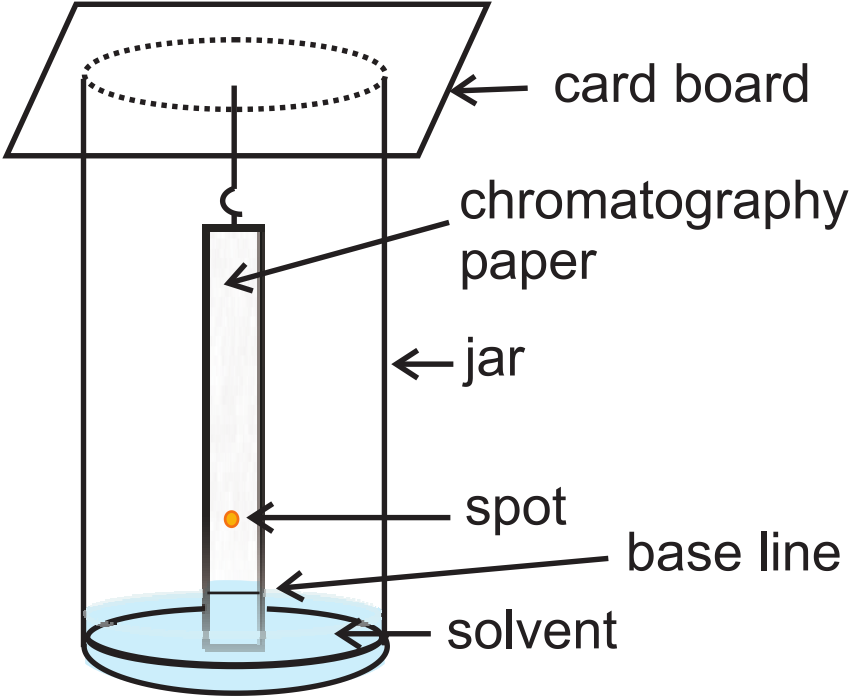
In paper chromatography, chromatography paper is used. This paper contains water trapped in it, which acts as the stationary phase. On the base of this chromatography paper, the solution of the mixture is spotted. The paper strip is then suspended in a suitable solvent, which acts as the mobile phase. This solvent rises up the chromatography paper by capillary action and in the procedure, it flows over the spot. The components are selectively retained on the paper (according to their differing partition in these two phases). The spots of different components travel with the mobile phase to different heights. The paper so obtained (shown in the given figure) is known as a chromatogram.

Need a full question paper?

Generate a complete, print-ready paper with questions like this in minutes — across 16+ boards, with answer keys.
Start Generating Free

Similar questions

What transition in the hydrogen spectrum would have the same wavelength as the Balmer transition n = 4 to n = 2 of He+ spectrum?
State the industrial uses of common ion effect and solubility product.
Write a relation between $\Delta\text{G}$ and Q and define the meaning of each term and answer the following:

  1. Why a reaction proceeds forward when Q < K and no net reaction occurs when Q = K?
  2. Explain the effect of increase in pressure in terms of reaction quotient Q.

For the reaction,

According to molecular orbital theory, how many types of molecular orbitals are there? How are they formed and also tell the order of energy of molecular orbitals formed form different atomic orbitals?
How do you count for the following observations?
Though alkaline potassium permanganate and acidic potassium permanganate both are used as oxidants, yet in the manufacture of benzoic acid from toluene we use alcoholic potassium permanganate as an oxidant. Why? Write a balanced redox equation for the reaction.
Calculate pH when 9.8g of H2SO4 is dissolved in 2L solution.
(i) Calculate the total number of electrons present in one mole of methane.
(ii) Find (a) the total number and (b) the total mass of neutrons in 7 mg of 14C. (Assume that mass of a neutron $=1.675 \times 10^{-27} kg$ )
(iii) Find (a) the total number and (b) the total mass of protons in 34 mg of $NH _3$ at STP.
Will the answer change if the temperature and pressure are changed?
In terms of period and group where would you locate the element with Z =114?
The ionization constant of propanoic acid is 1.32 × 10⁻⁵. Calculate the degree of ionization of the acid in its 0.05M solution and also its pH. What will be its degree of ionization if the solution is 0.01M in HCl also?
Classify the following substances into oxidising and reducing agents:
  1. Carbon.
  2. Ozone.
  3. Nascent hydrogen.
  4. Nitric acid.
  5. Chlorine.