Question
Explain the procedure of balancing the personal accounts.

Answer

From the balancing of these accounts we can ascertain as to how much amount is owing from each individual customer and how much amount is owed to each individual creditor. If a personal account shows a debit balance, it indicates the amount owing from him. On the contrary, if a personal account shows a credit balance, it indicates the amount owing to him.In case the total of the debit side is in excess of the credit side, the difference between the two is inserted on the credit side of the account in order to make their totals equal. The words ‘By Balance c/d’, i.e., balance carried down are written against the amount of the difference. In the next accounting period, the balance is brought down on the debit side by writing the words ‘To Balance b/d'.
On the contrary, if the total of the credit side is in excess of the debit side, the difference between the two is inserted on the debit side of the account in order to make their totals equal. The words ‘To Balance c/d' are written against the amount of the difference. In the next accounting period, the balance is brought down on the credit side by writing the words 'By Balance b/d’.

Need a full question paper?

Generate a complete, print-ready paper with questions like this in minutes — across 16+ boards, with answer keys.
Start Generating Free

Similar questions

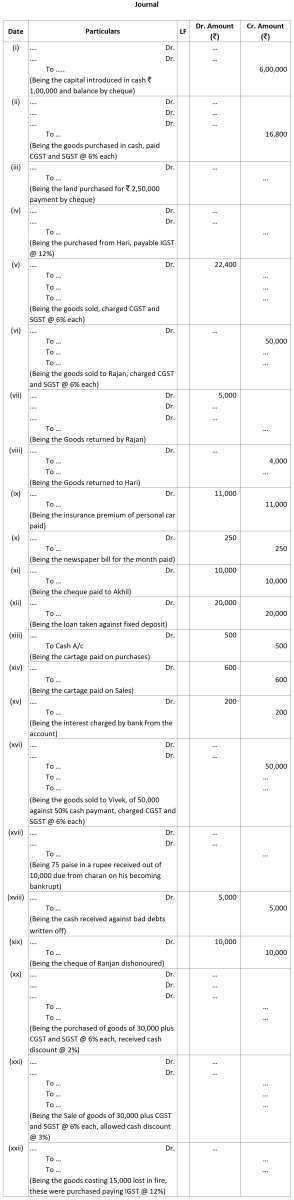
On the basis of the narrations, fill in the missing values:
What are ‘provisions’. How are they created? Give accounting treatment in case of provision for doubtful Debts.
Enter the following transactions in the Cash Book with Cash and Bank Columns:
2019
 
April 1
Balance of Cash in hand ₹ 4,000, overdraft at Bank ₹ 50,000.
April 4
Invested further capital ₹ 1,00,000 out of which ₹ 60,000 deposited into the bank.
April 5
Sold goods for cash ₹ 30,000 plus CGST and SGST @ 6% each.
April 10
Purchased goods ₹ 55,000 plus CGST and SGST @ 6% each and issued a cheque for the same.
April 11
Paid to Ram Vilas, our creditor ₹ 25,000; discount allowed by him ₹ 1,000.
April 14
Rent of ₹ 8,000 plus CGST and SGST @ 6% each paid by cheque.
April 15
Office Furniture purchased and a cheque of ₹ 22,400 issued for the same including CGST and SGST @ 6% each.
April 16
Drew cheque for personal use ₹ 5,000.
April 18
Collection from Atul ₹ 15,000, deposited in the bank on 19th April.
April 20
Goods sold to Amritraj for ₹ 80,000 plus CGST and SGST @6% each.
April 25
Received a cheque of ₹ 88,000 from Amritraj in full settlement of his account; deposited into bank on 28th April.
April 29
Drew from the bank for salary of the office staff ₹ 25,000.
April 29
Paid salary of the manager by cheque ₹ 10,000.
Prepare the Accounting Vouchers for the following transactions:?
2019
Particular
Jan-1
Started business with cash
2,00,000
Jan-1
Purchased furniture vide Cash Memo No. 210*
10,000
Jan-5
Opened a Bank Account in Canara Bank
60,000
Jan-10
Purchased garments on credit from M/s Madras Store vide Bill No. 291*
20,000
Jan-12
Sold shirts to Ram Parkash on credit vide Bill No. 1*
5,000
Jan-15
Sold shirts for cash vide Cash Memo No. 1*
7,000
Jan-20
Withdrew from bank for office use by cheque No. 23301
20,000
Jan-27
Withdrew for personal use by cheque No. 51003
5,000
Transactions marked with * are subject to levy of CGST and SGST @ 6% each.
Verma Bros. Kolkata carry on business as wholesale cloth dealer. From the following, write up their Purchases Book for January, 2019:
Show the posting from Purchases Book to Ledger accounts also.
A sold goods to B for ₹ 60,000 Charging IGST @18% and immediately drew a bill on Bwho duly accepted the same. A endorsed the bill to C. C endorsed it to his creditor D. Ddiscounted the bill for ₹ 68,000. On the date of maturity, the bill was dishonoured and Bank paid noting charges amounting to ₹ 200.
Show Journal entries in the books of all the parties to record these transactions.
Use Accounting Equation to show the effect of the following transactions of M/s Royal Traders:
 
 
(₹)
(a)
Started Business with Cash
1,20,000
(b)
Purchased goods for cash
10,000
(c)
Rent received
5,000
(d)
Salary outstanding
2,000
(e)
Received interest
700
(f)
Sold goods for cash (costing ₹ 5,000)
7,000
(g)
Goods destroyed by fire
500
What is Double-Entry System? Explain its principles and advantages.
Vishal sold goods for ₹ 7,000 to Manju on Jan 05, 2016 and drew upon her a bill of exchange payable after 2 months. Manju accepted Vishal’s draft and handed over the same to Vishal after acceptance. Vishal immediately discounted the bill with his bank @ 12% p.a. On the due date Manju met her acceptance. Journalise the above transactions in the books of Vishal and Manju.
The cash book shows a bank balance of ₹ 7,800. On comparing the cash book with passbook the following discrepancies were noted:
  1. Cheque deposited in bank but not credited ₹ 3,000
  2. Cheque issued but not yet present for payment ₹ 1,500
  3. Insurance premium paid by the bank ₹ 2,000
  4. Bank interest credit by the bank ₹ 400
  5. Bank charges ₹ 100
  6. Directly deposited by a customer ₹ 4,000