Question
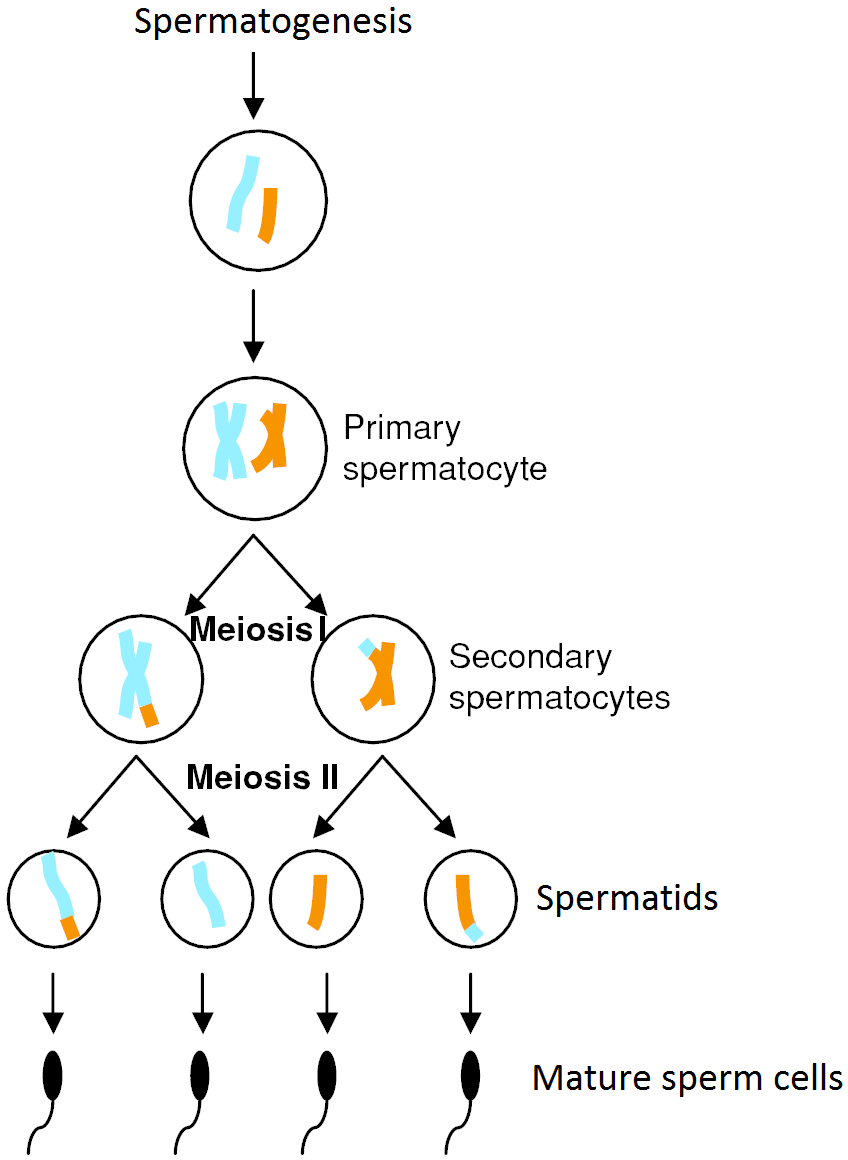
  1. Explain the process of spermatogenesis in humans.
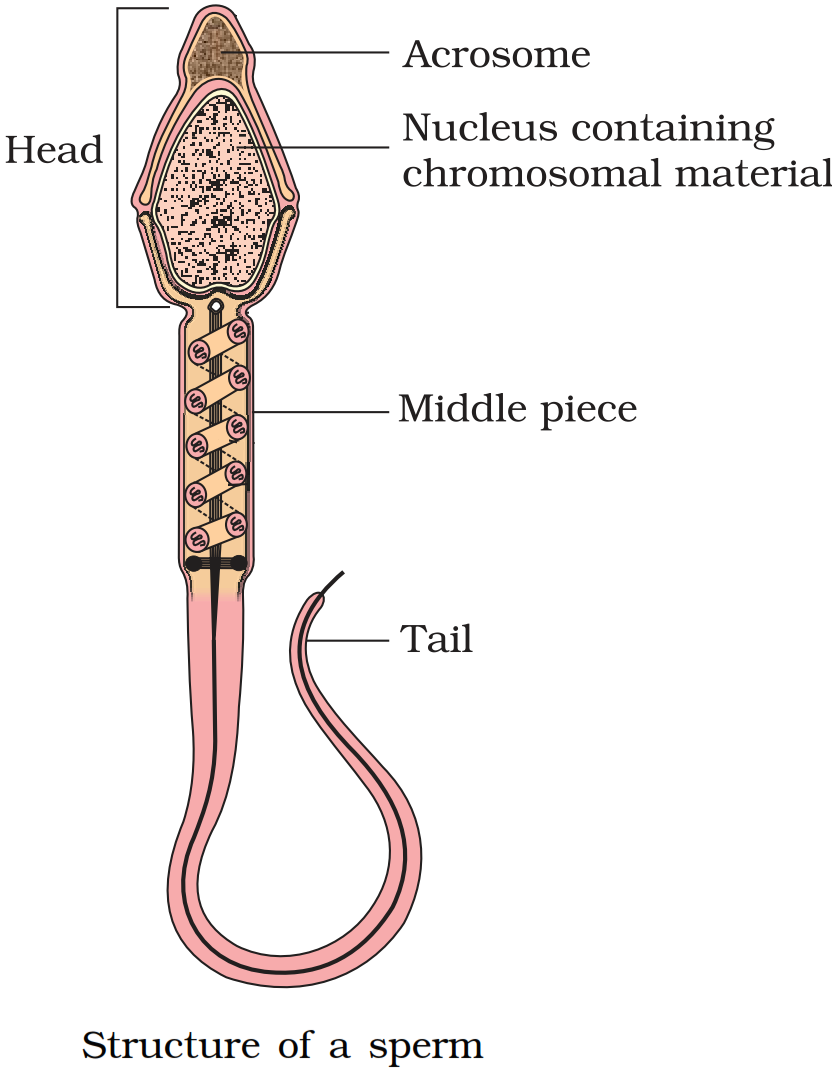
  2. Draw a human sperm and label acrosome and middle piece. Mention their functions.
Answer

  1. Spermatogenesis is the process of the production of sperms from the immature germ cells in males. It takes place in seminiferous tubules present inside the testes. During spermatogenesis, a diploid spermatogonium (male germ cell) increases its size to form a diploid primary spermatocyte. This diploid primary spermatocyte undergoes first meiotic division (meiosis I), which is a reductional division to form two equal haploid secondary spermatocytes. Each secondary spermatocyte then undergoes second meiotic division (meiosis II) to form two equal haploid spermatids. Hence, a diploid spermatogonium produces four haploid spermatids. These spermatids are transformed into spermatozoa (sperm) by the process called spermiogenesis.
  1.  
  • Acrosome: It is flat, oval in shape and composed of a large haploid nucleus and a small anterior cap-like structure, called acrosome. The acrosome lies at the tip of the nucleus and is formed from the Golgi complex. It contains hydrolytic enzymes and is used to contact and penetrate the egg (ovum) during fertilisation.
  • Middle piece: It is cylindrical in shape and known as powerhouse of the sperm. It possesses many mitochondria to produce energy for the movement of the tail that facilitates sperm motility essential for fertilization.

Need a full question paper?

Generate a complete, print-ready paper with questions like this in minutes — across 16+ boards, with answer keys.

Start Generating Free

Similar questions

Read the following and answer any four questions from (i) to (v) given below:
Crown gall is a neoplastic disease of most dicotyledonous plants and is caused by the soil bacterium Agrobacterium tumefaciens. A large extra chromosomal plasmid in these bacteria was found to be responsible for this disease. The plasmid is known as Ti plasmid. Bacteria free crown gall cells can be cultured in the absence of phytohormones. Ti plasmid is widely used in genetic engineering to deliver the desirable genes. The part of Ti plasmid transferred into plant cell DNA is called T-DNA. T-DNA with desired DNA segment is inserted into the chromosome of the host plant where it produces copies of itself.
  1. Which of the following is the full full of T-DNA?
  1. Transfer DNA.
  2. Tumour inducing DNA.
  3. Transgenic DNA.
  4. None of these.
  1. Ti plasmid cannot infect and develop crown gall in,
  1. Tomato.
  2. Maize.
  3. Soybean.
  4. sunflower.
  1. While making transgenic plant, T-DNA is inserted into the host cell, it is then:
  1. Integrated into the target host genome.
  2. Lie independent of the host genome.
  3. Rupture the host cell wall.
  4. Produce oncogenic factors in the host.
  1. Agrobacterium mediated gene transfer in plants:
  1. Allows relatively large segment of DNA.
  2. Transfer of DNA with defined ends and minimal rearrangement.
  3. High quality and fertility in transgenic plants.
  4. All of these.
  1. Assertion: In Agrobacterium mediated gene transfer in plants, transgenic plants do not develop tumors.
Reason: In T-DNA tumor producing genes are deleted during the process of gene transfer.
  1. Both assertion and reason are true and reason is the correct explanation of assertion.
  2. Both assertion and reason are true but reason is not the correct explanation of assertion.
  3. Assertion is true but reason is false.
  4. Both assertion and reason are false.
What are the factors which led to flourishing fishery industry in India?
Long Answer Questions: PKU.
Describe the mechanism of sex determination in human beings with a suitable cross.
With the help of diagrammatic representation, explain the process of spermatogenesis.
Read the following and answer any four questions from (i) to (v) given below:
Apomixis is a mode of reproduction which does not involve formation of zygote through gametic fusion. In plants, apomixis commonly mimics sexual reproduction but produces seeds without fertilization. There are several methods of atomistic development in seeds. Thee two common ones are recurrent agamospermy and advective embryony.
  1. Apomixis is a type of reproduction in plants, in which?
  1. Fertilization does not take place.
  2. Male nucleus takes part in fertilization.
  3. Pollen fusion takes place.
  4. Generative nucleus takes part in fertilization.
  1. Which of the following statements is incorrect regarding recurrent agamospermy?
  1. It is the formation of seed that has an embryo formed without meiosis and syngamy.
  2. All the cells of embryo sac are diploid.
  3. An embryo develops directly from a diploid cell other than egg like that of nucleus and integument.
  4. None of these.
  1. Adventive embryony is found in:
  1. Citrus.
  2. Opuntia.
  3. Apple.
  4. Both (a) and (b).
  1. Formation of embryo directly from diploid egg without fertilization is called:
  1. Apospory.
  2. Diplospory.
  3. Polyembryony.
  4. Diploid parthenogenesis.
  1. If any somatic cell of sporophyte produces gametophyte without reduction division, it is called:
  1. Parthenogenesis.
  2. Apogamy.
  3. Apospory.
  4. Amphimixis.
Give significance : Transgenic plants.
Describe carbon cycle and add a note on the impact of human activities on carbon cycle.
'Analysis of age pyramids for human population can provide important inputs for long-term planning strategies'. Explain.
What is nitrogen cycle? Describe it briefly.