Question
Explain the process of thermonuclear fusion with example.

Answer

$\rightarrow$ When two light nuclei fuse to form a larger nucleus, energy is released, because binding energy increases during the process.
$\rightarrow$ Some examples of such energy liberating nuclear fusion reactions are :
${ }_1 H ^1+{ }_1 H ^1 \rightarrow{ }_1 H ^2+e^{+}+v+0.42 MeV$
${ }_1 H ^2+{ }_1 H ^2 \rightarrow{ }_2 He ^3+n+3.27 MeV$
${ }_1 H ^2+{ }_1 H ^2 \rightarrow{ }_1 H ^3+{ }_1 H ^1+4.03 MeV$
$\rightarrow $ In the first reaction, two protons combine to form a deuteron and a positron with a release of $0.42 MeV$ energy.
$\rightarrow$ In the second reaction, two deuterons combine to form the isotope of helium ${ }_2 He ^3$.
$\rightarrow$​​​​​​​ In third reaction two deuterons combine to form a tritium and a proton. $4.03 MeV$ energy is released during this process.
$\rightarrow$ For a fusion to take place, the two nuclei must come close enough so that nuclear force is able to affect them.
$\rightarrow$ This force must be strong enough to overcome the repulsive barrier between two positively charged nuclei.
$\rightarrow $The height of the barrier depends on the charges and radii of the two interacting nuclei.
$\rightarrow$ For example :
The barrier height for two protons is $\sim 400 keV$.
​​​​​​​The temperature required for a proton to overcome this barrier is $T$ .
$\therefore \frac{3}{2} k T =400 keV$
$T =\frac{2 \times 400 \times 10^3 \times 1.6 \times 10^{-19}}{3 \times 1.38 \times 10^{-23}}$
$T =3 \times 10^9 K$
$\rightarrow$​​​​​​​ When fusion is achieved by raising the temperature of the system so that particles have enough kinetic energy to overcome the Coulomb repulsive barrier, it is called thermo $-$ nuclear fusion.

Need a full question paper?

Generate a complete, print-ready paper with questions like this in minutes — across 16+ boards, with answer keys.
Start Generating Free

Similar questions

A bomb is dropped from a plane flying horizontally with uniform speed. Show that the bomb will explode vertically below the plane. Is the statement true if the plane flies with uniform speed but not horizontally?
A certain sample of a radioactive material decays at the rate of 500 per second at a certain time. The count rate falls to 200 per second after 50 minutes.
  1. What is the decay constant of the sample?
  2. What is its half-life?
For a $CE-$transistor amplifier, the audio signal voltage across the collected resistance of $2k \Omega$ is $2 V$. Suppose the current amplification factor of the transistor is $100,$ find the input signal voltage and base current, if the base resistance is $1k \Omega$ .
A light ray is incident at an angle of 45° with the normal to a $\sqrt{2}\text{cm}$ thick plate $(\mu = 2.0)$. Find the shift in the path of the light as it emerges out from the plate.
How many time constants will elapse before the current in a charging RC circuit drops to half of its initial value? Answer the same question for a discharging RC circuit.
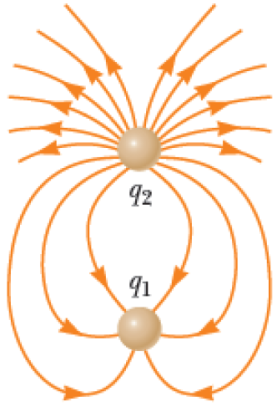
Consider the situation shown in figure. What are the signs of $q_1$ and $q_2\ ?$ If the lines are drawn in proportion to the charge, what is the ratio $\frac{\text{q}_1}{\text{q}_2}?$
  1. Define mutual inductance and write its $S.I$. unit.
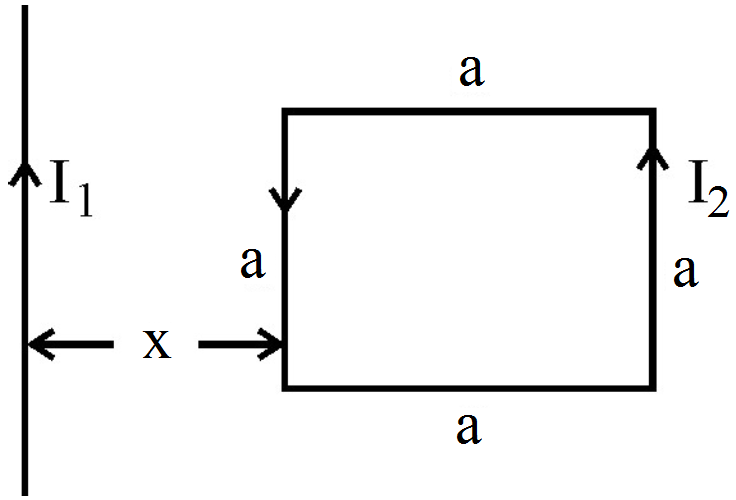
  2. A square loop of side $'a\ '$carrying a current $I_2$ is kept at distance $x$ from an infinitely long straight wire carrying a current $ I_1$ as shown in the figure. Obtain the expression for the resultant force acting on the loop.
Explain giving reasons for the following:
  1. Photoelectric current in a photocell increases with the increase in the intensity of the incident radiation.
  2. The stopping potential $(V_0)$ varies linearly with the frequency $(v)$ of the incident radiation for a given photosensitive surface with the slope remaining the same for different surfaces.
  3. Maximum kinetic energy of the photoelectrons is independent of the intensity of incident radiation.
Is it possible for two bodies to be in thermal equilibrium if they are not in contact?
$\text{ }^{197}_{80}\text{Hg}$ decay to $\text{ }^{197}_{79}\text{Au}$ through electron capture with a decay constant of 0.257 per day.
  1. What other particle or particles are emitted in the decay?
  2. Assume that the electron is captured from the K shell. Use Moseley's law $\sqrt{\text{v}}=\text{a(Z}-\text{b})$ with $\text{a}=4.95\times10^7\text{s}^{-\frac{1}{2}}$ and b = 1 to find the wavelength of the $\text{K}_{\alpha}$ X-ray emitted following the electron capture.