Question
Explain the qualitative characteristics of accounting information.

Answer

Qualitative characteristics are the attributes of accounting information which tend to enhance its understandability and usefulness. In order to assess whether accounting information is decision useful, it must possess the characteristics of reliability, relevance, understandability and comparability.
  • Reliability: Reliability means the users must be able to depend on the information. The reliability of accounting information is determined by the degree of correspondence between what the information conveys about the transactions or events that have occurred, measured and displayed. A reliable information should be free from error and bias and faithfully represents what it is meant to represent. To ensure reliability, the information disclosed must be credible, verifiable by independent parties use the same method of measuring, and be neutral and faithful.
  • Relevance: To be relevant, information must be available in time, must help in prediction and feedback, and must influence the decisions of users by:
  1. helping them form prediction about the outcomes of past, present or future events; and/ or
  2. confirming or correcting their past evaluations.
  • Understandability: Understandability means decision-makers must interpret accounting information in the same sense as it is prepared and conveyed to them. The qualities that distinguish between good and bad communication in a message are fundamental to the understandability of the message. A message is said to be effectively communicated when it is interpreted by the receiver of the message in the same sense in which the sender has sent. Accountants should present the comparable information in the most intenlligible manner without sacrificing relevance and reliability.
  • Comparability: It is not sufficient that the financial information is relevant and reliable at a particular time, in a particular circumstance or for a particular reporting entity. But it is equally important that the users of the general purpose financial reports are able to compare various aspects of an entity over different time period and with other entities. To be comparable, accounting reports must belong to a common period and use common unit of measurement and format of reporting.

Need a full question paper?

Generate a complete, print-ready paper with questions like this in minutes — across 16+ boards, with answer keys.
Start Generating Free

Similar questions

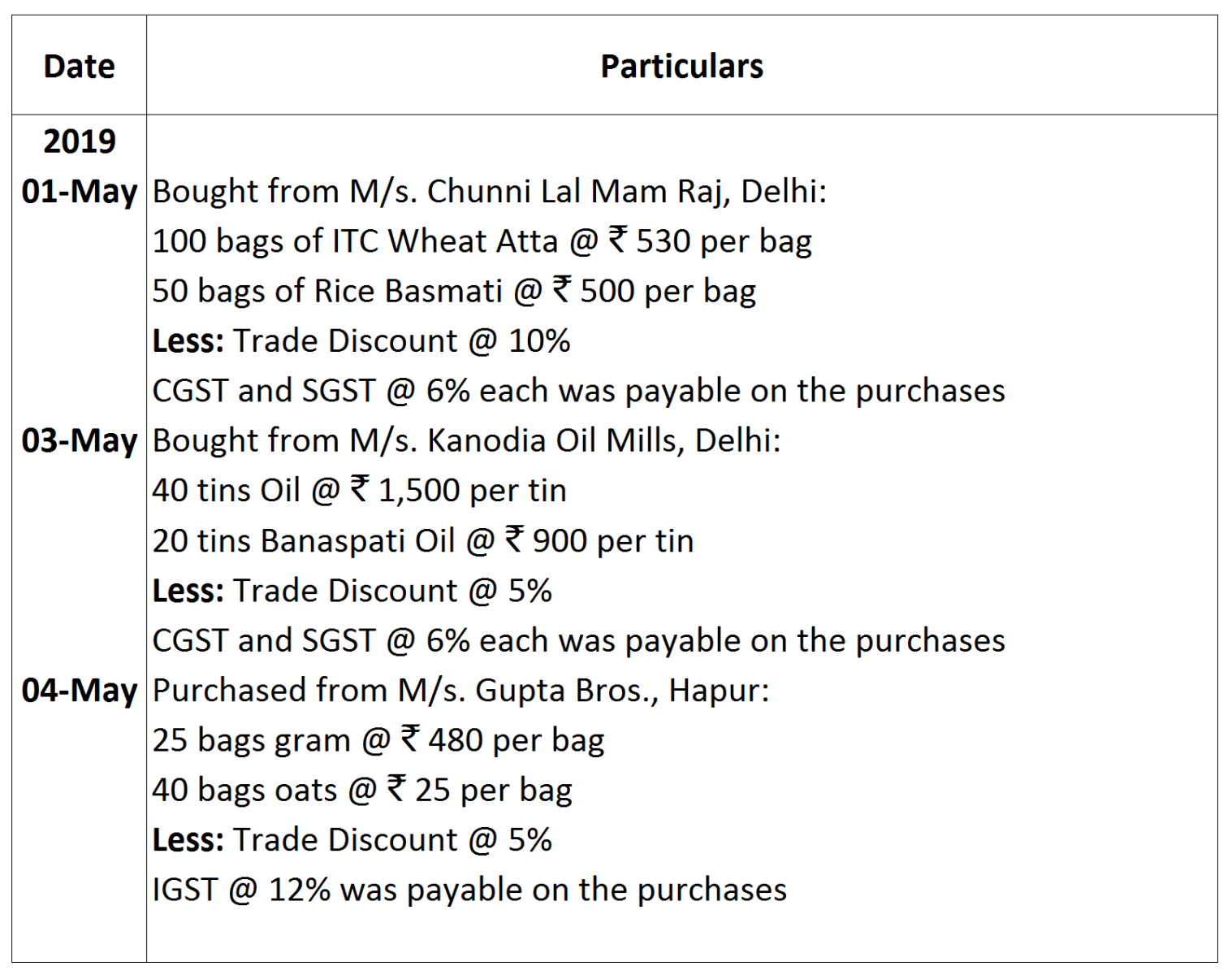
Record the following transactions in the Purchases Book of Subhash General Stores, Delhi:
Mr. Chaturvedi maintains two bank accounts. Prepare his columnar cash book from the following particulars:
2016
 
(₹)
May 1
Cash in hand
34,000
Balance with Hongkong Bank
75,200
Balance with Citi Bank
1,20,000
May 3
Cash drawn from Citi Bank for office use
25,000
May 8
Sold goods to Diwedi for ₹ 80,000 and received from him ₹ 20,000 in cash and a cheque for the balance. The cheque is deposited in Hongkong Bank on 9th and the bank credited the amount on 15th and debited ₹ 25 as its collection charges.
 
May 12
Purchased goods for ₹ 40,000 at 20% trade discount. 25% of the amount is paid in cash and issued a cheque on Citi Bank for the balance amount.
 
May 20
Paid Wages ₹ 36,000 and Salary ₹ 4,000.
 
May 22
A cheque for ₹ 50,000 is drawn on Citi Bank and it is deposited in Hongkong Bank.
 
May 23
Purchased land for ₹ 3,20,000 and a cheque is issued on Hongkong Bank.
 
May 24
A cheque for ₹ 10,000 which was received from Mohan and was deposited in Citi Bank on 25th April is dishonoured and the bank debited ₹ 100 as bank charges on this cheque. The amount of dishonoured cheque and bank charges is received from Mohan in cash on 25th.
 
May 26
Deposited cash ₹ 30,000 in Hongkong Bank.
 
May 28
Sold old typewriter for ₹ 2,000 and old newspapers for ₹200 in cash.
 
May 30
Interest charged by Hongkong Bank ₹ 400.
 
May 31
Bank charges by Citi Bank ₹ 180 and Hongkong Bank ₹ 340.
 
Enter the following transactions in Return Outward Book of Modern Furniture House, Udaipur (Rajasthan) assuming CGST @ 6% and SGST @ 6% and post it into Ledger:
2017
 
Nov. 7
Returned to Sachdeva Furniture Store, Ahmedabad (Gujarat):
5 Chairs @ ₹ 2,000 each
1 Table for ₹ 15,000
Less: 10% Trade Discount
Nov. 22
Returned 8 Chairs to India Furniture House, Jodhpur (Rajasthan) @ ₹ 1,500 each, being not of specified quality
Nov. 24
Returned one Dining Table to Arora & Co., Jaipur (Rajasthan) being not according to sample ₹ 50,000
Nov. 28
Allowance claimed from Delhi Furniture Shop, Ahmedabad (Gujarat) on account of mistake in the invoice ₹ 16,000
Classify the following into Assets, Liabilities, Capital, Expenses and Revenue:
i Land ii Investments
iii Building iv Interest Received
v Salary vi Bank Overdraft
vii Debtors viii Creditors
ix Bad Debts x Capital
xi Depreciation xii Motor Vehicles
xiii Freight xiv Wages
xv Goodwill xvi Repairs.
Kapil purchased goods for ₹ 21,000 from Gaurav on 1.2.2017 and accepted a bill of exchange drawn by Gaurav for the same amount. The bill was payable after one month. On 25.2.2017 Gaurav sent the bill to his bank for collection. The bill was duly presented by the bank. Kapil dishonoured the bill and the bank paid ₹ 100 as noting charges. Record the necessary journal entries for the above transactions in the books of Kapil and Gourav.
Give journal entries of M/s. Mohit traders; post them to the Ledger from the following transactions:
August, 2017
 
1
Commenced business with cash
1,10,000
2
Opened bank account with H.D.F.C.
50,000
3
Purchased furniture
20,000
7
Bought goods for cash from M/s. Rupa Traders
30,000
8
Purchased good from M/s. Hema Traders
42,000
10
Sold goods for cash
30,000
14
Sold goods on credit to M/s. Gupta Traders
12,000
16
Rent paid
4,000
18
Paid trade expenses
1,000
20
Received cash from Gupta Traders
12,000
22
Goods return to Hema Traders
2,000
23
Cash paid to Hema Traders
40,000
25
Bought postage stamps
100
30
Paid salary to Rishabh
4,000
Rectify the following errors assuming that Suspense Account was opened. Ascertain the difference in Trial Balance.
  1. Credit sales to Mohan ₹ 7,000 were recorded in Purchase Book. However, Mohan's Account was correctly debited.
  2. Credit purchases from Rohan ₹ 9,000 were recorded in Sales Book. However, Rohan's Account was correctly credited.
  3. Goods returned to Rakesh ₹ 4,000 were recorded in Sale Returns Book. However, Rakesh's Account was correctly debited.
  4. Goods returned from Mahesh ₹ 1,000 were recorded through Purchase Returns Book. However, Mahesh's Account was correctly credited.
  5. Goods returned to Naresh ₹ 2,000 were recorded through Purchases Book. However, Naresh's Account was correctly debited.
Discuss in detail the straight line method and written down value method of depreciation. Distinguish between the two and also give situations where they are useful.
Use accounting equation to show the effect of the following transactions of M/s Royal Traders:
a.
Started business with cash
₹ 1,20.000
b.
Purchased goods for cash
₹ 10,000
c.
Rent received
₹ 5,000
d.
Salary outstanding
₹ 2,000
e.
Prepaid Insurance
₹ 1,000
f.
Received interest
₹ 700
g.
Sold goods for cash (Costing ₹ 5,000)
₹ 7,000
h.
Goods destroyed by fire
₹ 500
(Ans: Assets = Cash ₹ 1,21,200 + Goods ₹ 4,500 + Prepaid insurance ₹ 1,000; Liabilities = Outstanding salary ₹ 2,000 + Capital ₹ 1,25,200)
What do you mean by dishonour of a bill? What entries will be made in the books of Drawer, if:
  1. Bill is with the drawer himself.
  2. Bill is discounted with the Bank.
  3. Bill is with the endorsee.
  4. Bill is sent to the Bank for collection.