Question
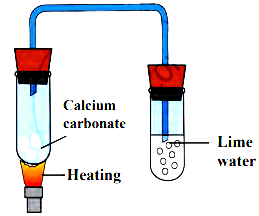
Explain the reaction given in the figure.

Answer

1. Calcium carbonate undergoes a decomposition reaction in the first test tube forming calcium oxide powder and carbon dioxide gas.
2. Carbon dioxide gas formed in the first test tube turns the lime water milky in the second test tube due to the formation of calcium carbonate, which is insoluble in water.
$
\underset{\text { Calcium hydroxide }}{ Ca ( OH )_{2( aq )}}+\underset{\text { Carbon dioxide }}{ CO _{2( g )}} \longrightarrow \underset{\text { Calcium carbonate }}{ CaCO _{3( s )}}+\underset{\text { Water }}{ H _2 O _{( l )}}
$
3. The calcium oxide powder, remains behind in the first test tube.
Activate Win

Need a full question paper?

Generate a complete, print-ready paper with questions like this in minutes — across 16+ boards, with answer keys.
Start Generating Free

Similar questions

If a concave mirror has a focal length of 10cm, find the two positions where an object can be placed to give, in each case, an image twice the height of the object.
The organisms A, B and C can obtain their food in three different ways. Organism A derives its food from the body of another living organism which is called its D, without killing it. The organism B takes in the solid food by the process of ingestion, digests a part of this food and throws out undigested food in the process called E. The organism C obtains its food from dead and decaying plants.
  1. What is the mode of nutrition of (i) organism A (ii) organism B, and (iii) organism C?
  2. What is the organism like D called?
  3. Name the process E.
  4. Give one example each of organisms like A, B and C.
  5. What is the general name of three modes of nutrition exhibited by organisms A, B and C?
Express the magnification produced by a lens in terms of the focal length of the lens and (1) the object distance (2) the image distance.
With the help of suitable diagrams, explain the five stages of prophase-I of meiosis.
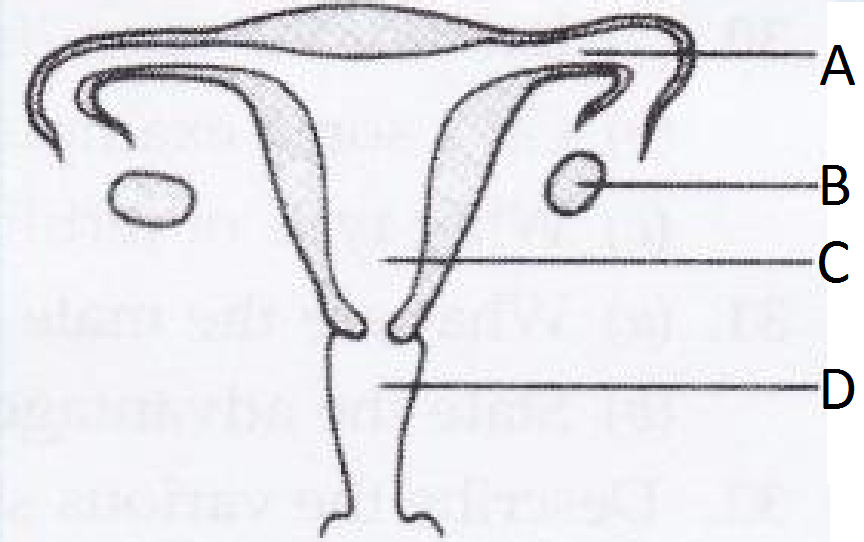
The diagram shows female reproductive system. Name the parts labelled A to D.
  1. In which part do the sperms enter?
  2. Which part releases the egg?
  3. In which part does fertilisation take place?
  4. In which part does the foetus develop?
Observe the figure and answer the following questions:
Image
i. Name the defect of vision represented in above figure.
ii. State the reasons for this defect.
iii. How is it corrected?
iv. Draw the diagram to show the correction of this defect.
Write short note :
Transition Elements.
A food chain consists of fish, larvae, phytoplanktons and birds. The level of pesticides in water in which the fish, larvae and phytoplanktons live is quite high.
  1. In which organisms the pesticides enter from the polluted water? What is this level of organisms known as?
  2. Which organism will have the maximum amount of pesticides accumulated through the food chain? What is this process known as?
  3. Write the food chain comprising all the organisms mentioned above.
  4. Which other organism you could write in place of bird in the above food chain?
Which factors affect the social health?
Observe the figure and name and explain in brief the following method: