→ The reproductive parts of angiosperms are located in the flower. We have already studied the different parts of a flower - sepals, petals, stamens and pistil. Stamens and pistil are the reproductive parts of a flower which contain the germ cell.
→ Petals and sepals protect the flower in budding stage. They do not take part in reproduction.
→ The flower may be unisexual (papaya, watermelon) when it contains either stamens or pistil or bisexual (Hibiscus, mustard) when it contains both stamen and pistil.
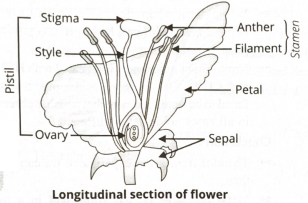
⇒ Stamen is the male reproductive part and it produces pollen grains that are yellowish in colour. You must have seen this yellowish powder that often sticks to our hands if we touch the stamen of a flower.
⇒ Pistil is present in the centre of a flower and is the female reproductive part. It is made of three parts.
(1) The swollen bottom part is the ovary.
(2) Middle elongated part is the style.
(3) Terminal part which may be sticky is the stigma.
⇒ Stigma is usually sticky. The ovary contains ovules and each ovule has an egg cell. The male germ-cell produced by pollen grain fuses with the female gamate present in the ovule. This fusion of the germ-cells or fertilisation gives us the zygote which is capable of growing into a new plant.