Question
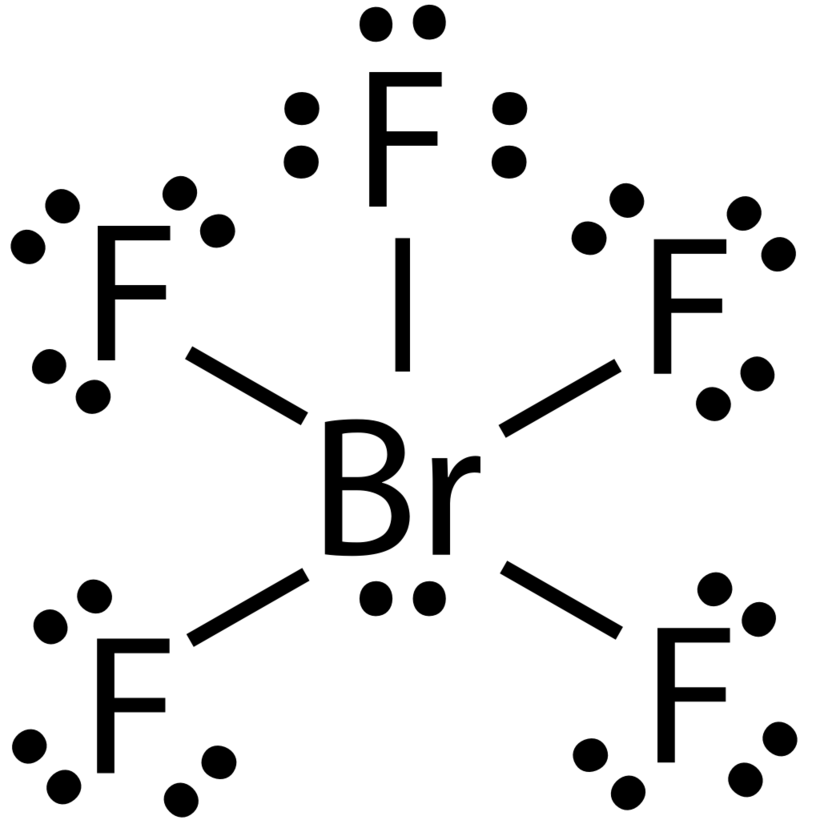
Explain the shape of $BrF_5$.

Answer

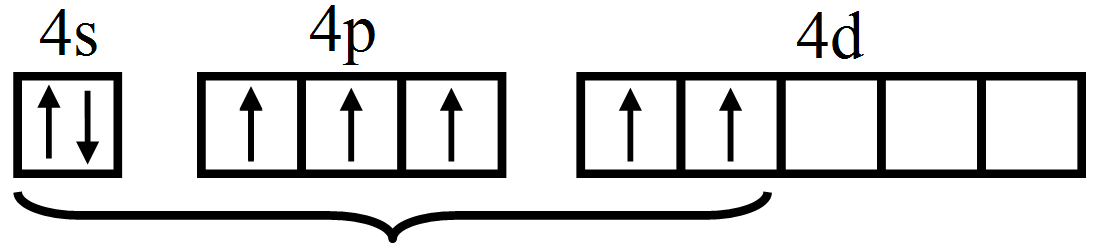
Br-atom has configuration:
$1s^2, 2s^22p^6 , 3s^23p^63d^{10}, 4s^24p^5$
To get pentavalency, two of the p-orbitals are unpaired and electrons are shifted to 4d-orbitals.

In this excited state, $sp^3d^2$ hybridisation occurs giving octahedral structure. Five positions are occupied by $F$ atoms forming sigma bonds with hybrid bonds and one position occupied by lone pair, i.e., the molecule as a square pyramidal shape.

Need a full question paper?

Generate a complete, print-ready paper with questions like this in minutes — across 16+ boards, with answer keys.
Start Generating Free

Similar questions

  1. How is $BeF_2$ prepared? Write chemical equation.
  2. What happens when $BeCl_2$​​​​​​​ is reduced with $LiAIH_4​​​​​​​$​​​​​​​? Give chemical equation.
  3. Which metals are used to remove air from vacuum tubes?
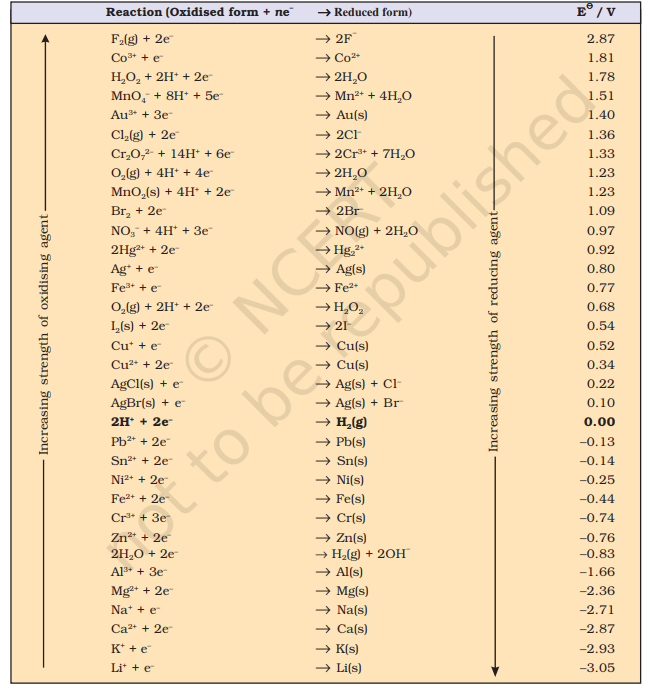
Using the standard electrode potentials given in the Table, predict if the reaction between the following is feasible:
$\mathrm{Ag}^{+}(\mathrm{aq})$ and $\mathrm{Cu}(\mathrm{s})$.
Three pairs of compounds are given below. Identify that compound in each of the pairs which has group 13 element in more stable oxidation state. Give reason for your choice. State the nature of bonding also.
i. $\mathrm{TICl}_3, \mathrm{TICl}$.
ii. $\mathrm{AlCl}_3, \mathrm{AlCl}_3$.
iii. $\mathrm{InCl}_3, \mathrm{InCl}$.
Give the electronic configuration of the transition elements. Write their four important characteristics.

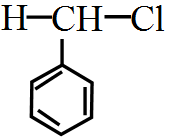
In which of the following compounds the C-Cl bond ionisation shall give most stable carbocation?
  1. $\text{CH}_3-\text{CH}-\text{Cl}\\ \ \ \ \ \ \ \ \ \ \ \ \ \ |\\\\ \ \ \ \ \ \ \ \ \ \ \ \ \text{CH}_3$
  2. $\ \ \ \ \ \ \ \ \ \ \ \ \text{Cl}\\ \ \ \ \ \ \ \ \ \ \ \ \ \ |\\\text{CH}_3-\text{C}-\text{CH}_3\\ \ \ \ \ \ \ \ \ \ \ \ \ \ |\\ \ \ \ \ \ \ \ \ \ \ \text{CH}_3$
  3.  
  1. $\ \ \ \ \ \ \ \ \ \ \ \ \ \ \ \ \ \ \ \ {\text{H}}\\ \ \ \ \ \ \ \ \ \ \ \ \ \ \ \ \ \ \ \ \ \ |\\\text{O}_2\text{NH}_2\text{C}-\text{C}-\text{Cl}\\ \ \ \ \ \ \ \ \ \ \ \ \ \ \ \ \ \ \ \ \ \ |\\ \ \ \ \ \ \ \ \ \ \ \ \ \ \ \ \ \ \ \ \ \text{H}$
For the reaction at 298K, 2A + B → C$\Delta\text{H} = 400\text{kJ} \ \text{mol}^{–1} \text{and} \Delta\text{S} = 0.2\text{kJ} \ \text{K}^{–1} \ \text{mol}^{–1} $
At what temperature will the reaction become spontaneous considering $\Delta\text{H}$ and $\Delta\text{S}$ to be constant over the temperature range.
When a substance 'A' reacts with water it produces a combustible gas 'B' and a solution of substance 'C' in water. When another substance 'D' reacts with this solution of 'C' it produces same gas 'B' on warming but 'D' can produce 'B' on reaction with dil. $\mathrm{H}_2 \mathrm{SO}_4$ at room temperature. A imparts deep golden yellow colour to the smokeless flame of bunsen burner. Identify A, B, C and D and write the reactions involved.
State the law of thermodynamics that was first formulated by Nernst in 1906. What is the utility of this law? The equilibrium constant for the reaction $A \rightleftharpoons B$ is $1.8 \times 10^{-7}$ at 298 K . Calculate the value of $\Delta G ^{\circ}$ for the reaction $\left( R =8.314 JK ^{-1} mol^{-1}\right)$. Predict the feasibility of the reaction under standard states.
An ion with mass number 56 contains 3 units of positive charge and 30.4% more neutrons than electrons. Assign the symbol to this ion.
  1. Classify the following processes as reversible or irreversible:
  1. Dissolution of sodium chloride.
  2. Evaporation of water at 373K and 1atm pressure.
  3. Mixing of two gases by diffusion.
  4. Melting of ice without rise in temperature.
  1. When an ideal gas expands in vacuum, there is neither absorption nor evolution of heat. Why?