Question
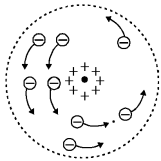
Explain the shortcomings of Rutherford's Atomic Model.###Write two shortcomings of Rutherford's Atomic Model.
Need a full question paper?

Generate a complete, print-ready paper with questions like this in minutes — across 16+ boards, with answer keys.

Start Generating Free

Similar questions

When an electron goes from the valence band to the conduction band in silicon, its energy is increased by 1.1eV. The average energy exchanged in a thermal collision is of the order of kT which is only 0.026eV at room temperature. How is a thermal collision able to take some of the electrons from the valence band to the conduction band?
Deutrium was discovered in 1932 by Harold Urey by measuring the small change in wavelength for a particular transition in ${ }^1 \mathrm{H}$ and ${ }^2 \mathrm{H}$. This is because, the wavelength of transition depend to a certain extent on the nuclear mass. If nuclear motion is taken into account then the electrons and nucleus revolve around their common centre of mass. Such a system is equivalent to a single particle with a reduced mass $\mu$, revolving around the nucleus at a distance equal to the electron-nucleus separation. Here $\mu=\frac{m_e M}{m_e+M}$ where $M$ is the nuclear mass and me is the electronic mass. Estimate the percentage difference in wavelength for the $1^{\text {st }}$ line of the Lyman series in ${ }^1 \mathrm{H}$ and ${ }^2 \mathrm{H}$. (Mass of ${ }^1 \mathrm{H}$ nucleus is $1.6725 \times 10^{-27} \mathrm{~kg}$, Mass of ${ }^2 \mathrm{H}$ nucleus is $3.3374 \times 10^{-27} \mathrm{~kg}$, Mass of electron $=9.109 \times 10^{-31} \mathrm{~kg}$ ).
A U-tube having unequal arm-lengths has water in it. A tuning fork of frequency 440Hz can set up the air in the shorter arm in its fundamental mode of vibration and the same tuning fork can set up the air in the longer arm in its first overtone vibration. Find the length of the air columns. Neglect any end effect and assume that the speed of sound in air = 330m/s.
If neutrons exert only attractive force, why don't we have a nucleus containing neutrons alone?
A small block of superdense material has a mass of $3 \times 10^{24}kg.$ It is situated at a height h (much smaller than the earth's radius) from where it falls on the earth's surface. Find its speed when its height from the earth's surface has reduced to $\frac{\text{h}}{2}.$ The mass of the earth is $6 \times 10^{24}kg.$
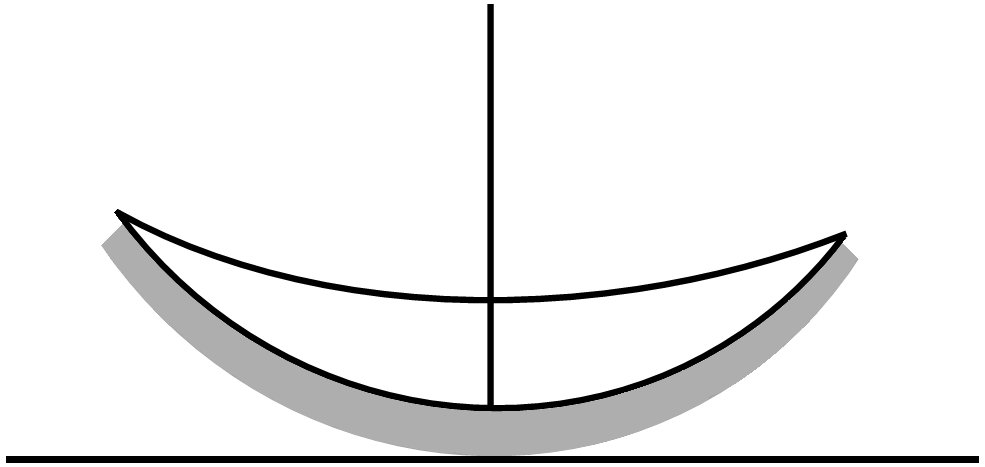
The convex surface of a thin concavo-convex lens of glass of refractive index 1.5 has a radius of curvature 20cm. The concave surface has a radius of curvature 60cm. The convex side is silvered and placed on a horizontal surface as shown in figure.
  1. Where should a pin be placed on the axis so that its image is formed at the same place?
  2. If the concave part is filled with water $\Big(\mu=\frac{4}{3}\Big),$ find the distance through which the pin should be moved so that the image of the pin again coincides with the pin.
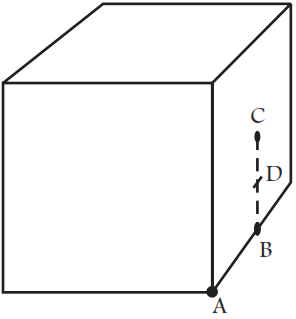
What will be the total flux through the faces of the cube (Fig.) with side of length a if a charge q is placed at:
  1. A: a corner of the cube.
  2. B: mid-point of an edge of the cube.
  3. C: centre of a face of the cube.
  4. D: mid-point of B and C.
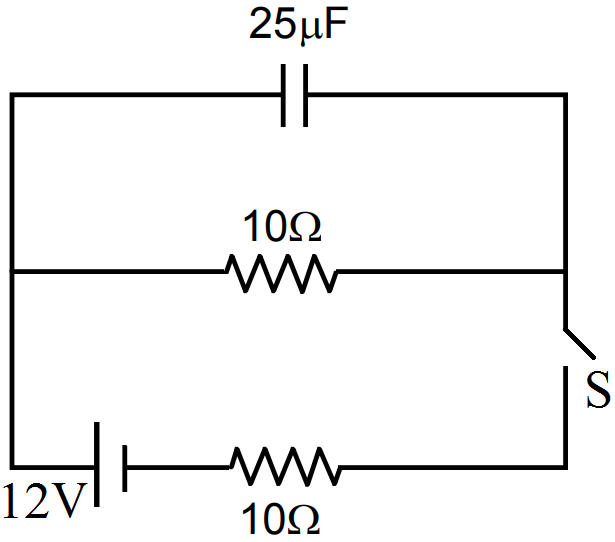
The switch S shown in figure. is kept closed for a long time and is then opened at t = 0. Find the current in the middle $1.0\Omega$ resistor at t = 1ms.
Four particles of equal masses M move along a circle of radius R under the action of their mutual gravitational attraction. Find the speed of each particle.
Compute induced current and induced charge in electromagnetic induction and also write Fleming's right hand rule.