Question
Explain the significance of peristalsis.

Answer

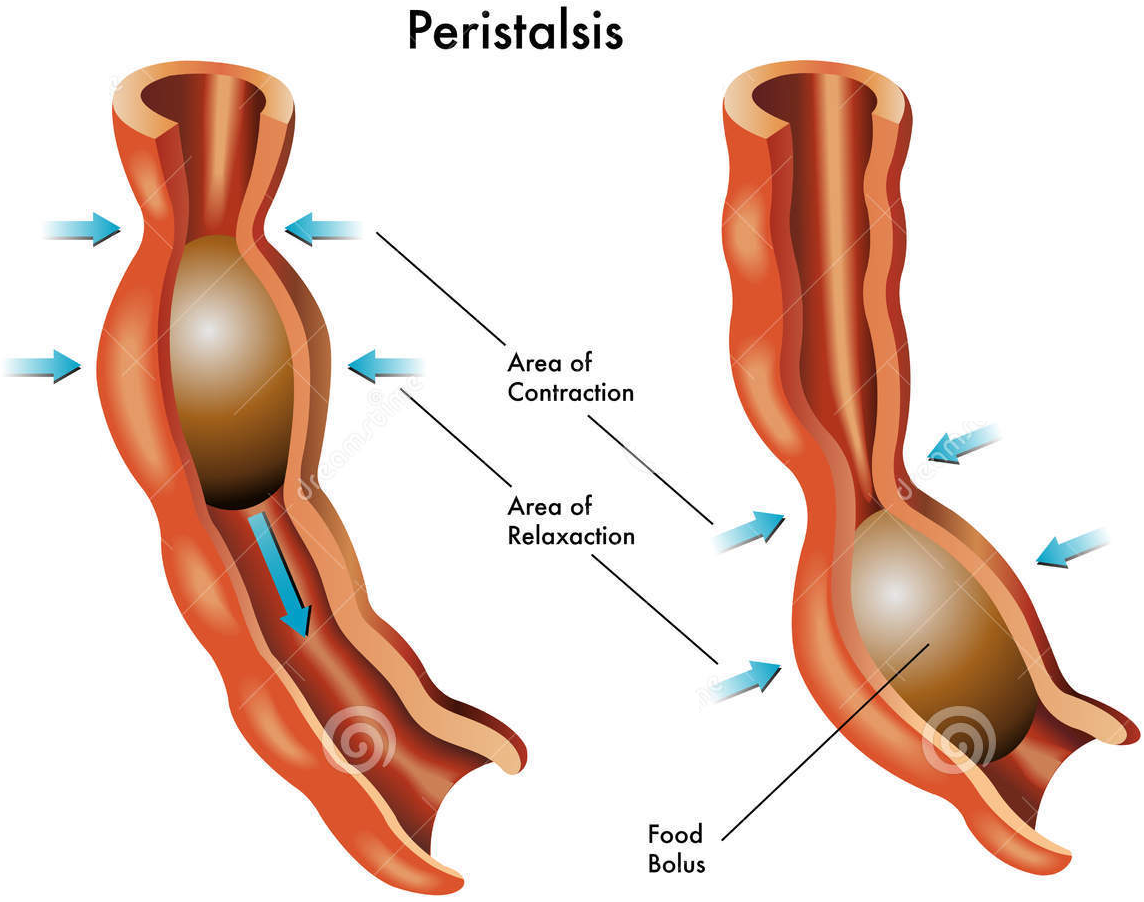
Peristaltic movement is the type of movement in which there is the constriction and relaxation of muscles of the esophagus, intestine, and stomach. It is a wave-like structure, which starts in the esophagus when the bolus of food is swallowed.
The contraction and relaxation of the muscles during the peristaltic movement help in bringing down the food with the food pipe into the stomach. It is an important and automatic process which help in movement of food.

Need a full question paper?

Generate a complete, print-ready paper with questions like this in minutes — across 16+ boards, with answer keys.
Start Generating Free

Similar questions

  1. State Fleming’s left hand rule.
  2. Write the principle of working of an electric motor.
  3. Explain the function of the following parts of an electric motor.
  1. Armature.
  2. Brushes.
  3. Split ring.
Gas A, which is the major cause of global warming, combines with hydrogen oxide B in nature in the presence of an environmental factor C and a green material D to form a six carbon organic compounds E and a gas F. The gas F is necessary for breathing.
  1. What is gas A?
  2. What is the common name of B?
  3. What do you think could be C?
  4. What is material D? Where is it found?
  5. Name the organic compound E.
  6. What is gas F? Name the natural process during which it is released.
a. What is reproduction? List its two types.
b. How are the modes of reproduction different in unicellular and multicellular organisms?
  1. Draw a diagram of excretory system in human beings and label on it: Aorta, Vena cava, Urinary bladder, Urethra.
  2. List two vital functions of the kidney.
What do you mean by multiple covalent bonding? Explain with the help of examples.
Differentiate between myopia and hypermetropia. What type of spectacles should be worn by a person having the defects of myopia as well as hypermetropia? How does it help?
Define ‘speciation’. Explain how speciation occurs.
State and explain the laws of reflection of light at a plane surface (like a plane mirror), with the help of a labelled ray-diagram. Mark the angles of ‘incidence’ and ‘reflection’ clearly on the diagram. If the angle of reflection is 47.5°, what will be the angle of incidence?
What are the disadvantages of using nuclear power?
You are given three resistances of 1,2 and 3 ohms. Show by diagrams, how with the help of these resistances you can get:
  1. $6\Omega$
  2. $\frac{6}{11}\Omega$
  3. $1.5\Omega$