Question
Explain the sources of electric and magnetic field.

Answer

A steady charge Q produces an electric field (from chapter-1) E.
The electric field on point at a distance $r$ from the point charge $Q$ is
$\therefore \overrightarrow{ E }=\frac{1}{4 \pi \varepsilon_0} \cdot \frac{ Q }{r^2} \cdot \hat{r}\left(\text { or } \frac{ KQ }{r^2} \hat{r}\right)$
Apart from being dependent on every point in space, the electric field can vary with time.
If more than one electric field converge near a point, the resultant electric field at the point is equal to the vector sum of all the electric field.
Just as static charges produce an electric field, moving charges or current produces a magnetic field denoted by $\overrightarrow{ B }(\vec{r})$.
Similar to electric field, the magnetic field can also be defined at every point in space and it also follows the principle of superposition.

Need a full question paper?

Generate a complete, print-ready paper with questions like this in minutes — across 16+ boards, with answer keys.
Start Generating Free

Similar questions

Calculate the orbital period of the electron in the first excited state of hydrogen atom.
Derive the formula for the magnetic fieid produced by a current-carrying circular coil as a magnetic dipole on its axis and equator. (Perpendicular bisector.)
Mention the disadvantages of phasor method of analysing AC circuits.
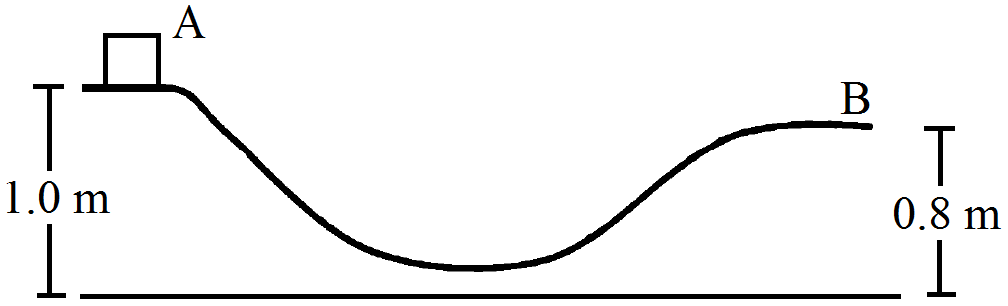
A block of mass 1kg is placed at the point A of a rough track shown in figure. If slightly pushed towards right, it stops at the point B of the track. Calculate the work done by the frictional force on the block during its transit from A to B.
The changes in a function y and the independent dy variable x are related as $\frac{\text{dy}}{\text{dx}}=\text{x}^2.$ Find y as a function of x.
Elemental semiconductor and compound semiconductors. Explain with examples.
N small conducting liquid droplets, each of radius r, are charged to a potential V each. These droplets coalesce to form a single large drop without any charge leakage. Find the potential of the large drop.
A block of mass 0.2kg is suspended from the ceiling by a light string. A second block of mass 0.3kg is suspended from the first block through another string. Find the tensions in the two strings. Take $g = 10m/s^2$.
A proton and an a-particle have the same de-Broglie wavelength. Determine the ratio of (i) Their accelerating potentials and (ii) Their speeds.
The refractive index of a material changes by 0.014 as the colour of the light changes from red to violet. A rectangular slab of height 2.00cm made of this material is placed on a newspaper. When viewed normally in yellow light, the letters appear 1.32cm below the top surface of the slab. Calculate the dispersive power of the material.