Question
Explain the steps involved in the elongation of polypeptide chain during its synthesis.

Answer

  1. An amino acyl tRNA complex reaches the A site and attaches to mRNA codon next to initiation codon with the help of its anticodon. The step requires GTP and an elongation factor.
  2. A peptide bond (-CO-NH-) is established between the carboxylic gp of (-COOH) amino acid attached to tRNA at P site and amino gp (NH) of amino acid attached to tRNA at A-site. The reaction is catalysed by enzyme peptidyl. transferase.
  3. In the process the connection between tRNA and amino acid at the P-site breaks. The free t-RNA of the P-site slips away and the A site carries peptidyl tRNA complex.
  4. Now the ribosome or mRNA rotates slightly. The process is called translocation.
  5. As a result of translocation, the A site codon along with peptidyl-tRNA complex reaches the P site. A new codon is exposed at the A site. It attracts a new amino-acyl tRNA complex.
  6. The process of bond formation and translocation is repeated. One by one all the codons of mRNA are exposed at the A' site and get decoded through incorporation of amino acids in the peptide chain. The peptide chain elongates.

Need a full question paper?

Generate a complete, print-ready paper with questions like this in minutes — across 16+ boards, with answer keys.

Start Generating Free

Similar questions

Give reasons why:
Most zygotes in angiosperms divide only after certain amount of endosperm is formed.
Read the following and answer any four questions from (i) to (v) given below:
Gene therapy is the technique of genetic engineering to replace a faulty gene by a normal healthy functional gene. It is a way of treating genetic disease by introducing a piece of DNA into the cells of an affected individual. Liposomes can be used for gene therapy as they target the cells affected by a genetic disease.
  1. A patient suffers from adenosine deaminase (ADA) deficiency, an autosomal recessive immune deficiency in which bone marrow lymphoblasts cannot replicate to generate immuno-competent lymphocytes. The treatment option that would cure the patient is:
  1. Germ-line gene therapy to replace one ADA gene copy.
  2. Germ-line gene therapy to replace both ADA gene copies.
  3. Somatic cell gene therapy to replace both ADA gene copies in circulating lymphocytes.
  4. Somatic cell gene therapy to replace one ADA gene copy in bone marrow lymphoblasts.
  1. Which type of gene therapy is least effective in transferring DNA to the nucleus?
  1. Adenoviruses.
  2. DNA attached to a ligand.
  3. Liposomes.
  4. Retroviruses.
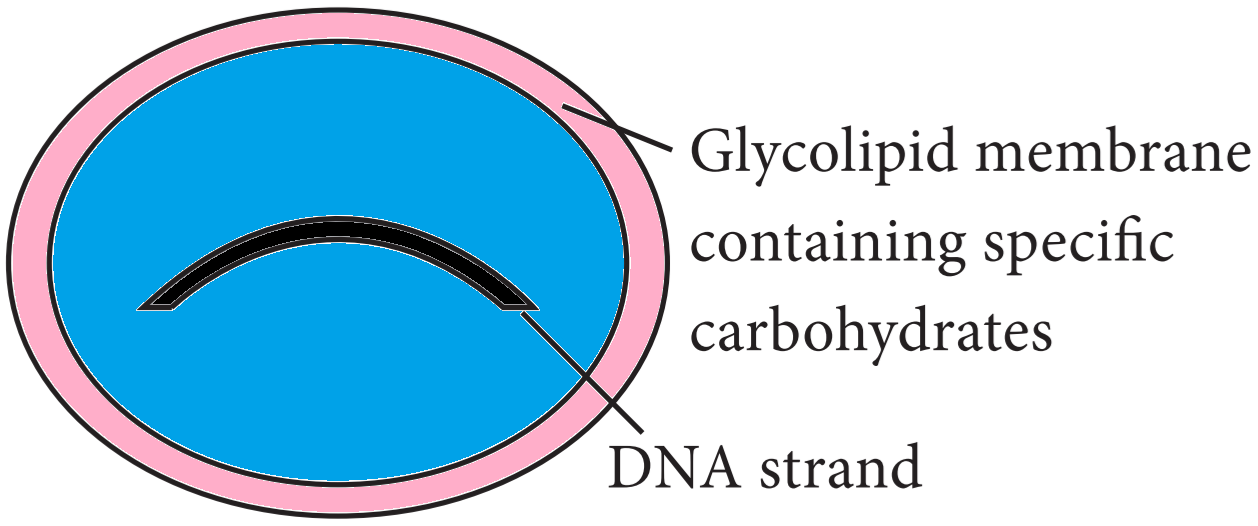
  1. Liposomes can be used for gene therapy as they target the cells affected by a genetic disease. The diagram shows the structure of a liposome.


What feature of a cell surface membrane allows the liposome to target cells affected by a genetic disease?
  1. Carrier molecules.
  2. Phosphate groups.
  3. Protein channels.
  4. Receptor molecules.
  1. Which of the following disorders would gene therapy be least effective?
  1. Cystic fibrosis.
  2. Huntington's disease.
  3. Sickle cell anaemia.
  4. Type II diabetes.
  1. Following are some reasons explaining why gene therapy is not yet fully an effective treatment for genetic diseases.
  1. Lack of knowledge of DNA sequences.
  2. Lack of efficient and safe gene delivery system.
  3. Cost of the technology.
  4. Some diseases involve multiple genes.
  5. Problems with appropriate gene regulation.
Select the correct option.
  1. I, III and V only
  2. II, IV and V only
  3. Ill, IV and V only
  4. I, III and IV only
Answer the following questions:
Explain the role of ovarian hormones in inducing changes in the uterus during menstrual cycle.
How is the placenta connected to the embryo?
Write any four ways used to introduce a desired DNA segment into a bacterial cell in recombinant technology experiments.
i. Why must a cell be made 'competent' in biotechnology experiments? How does calcium ion help in doing so?
ii. State the role of 'biolistic gun' in biotechnology experiments.
What does an Ecological Pyramid indicate? Explain the three different types of Upright Pyramids in nature with the help of an example of each.
The following is the illustration of the sequence of ovarian events (a – i) in a human female.
Explain the changes that occur in the uterus simultaneously in anticipation.
Expand FOAM. Describe the project of integrated waste water treatment, it is responsible for the upkeep.
  1. Explain with the help of Griffith's experiment, how the search for genetic material was conducted and what was the conclusion drawn.
  2. How did Mac Leod, Mc Carty and Avery establish the Biochemical nature of the socalled. "genetic material' identified by Griffith in his experiments?