Question
Explain the term $: Mole$

Answer

The $mole$ is a unit of measurement for the amount of substance. Moles give us a consistent method to convert between atoms/molecules and grams.
The mathematical expression for calculating moles is expressed as:
$moles =$ mass / molar mass
We can express moles in terms of molecular mass, number of atoms/molecules and in terms of volume.
  • $1\ mole$ of a pure substance has a mass in grams equal to its molecular mass.
  • $1 \ mole$ contains the same number of particles as there are in $12g$ of carbon-$12$ atoms. This number is called Avogadro’s number and is equal to $6.023 \times 10^{23}$ particles.$1 \ mole$ of a gas occupies a volume of: $22.4$ litres at $\text{S.T.P}.$
For example: $1 \ mole$ of sodium atom has mass $23 g$. It contains $6.023 \times 10^{23}$ atoms and occupies $22.4$ litres of volume at $\text{S.T.P}.$

Need a full question paper?

Generate a complete, print-ready paper with questions like this in minutes — across 16+ boards, with answer keys.

Start Generating Free

Similar questions

How would you prepare :
zinc sulphate crystals from zinc dust (powdered zinc and zinc oxide).
The questions below are related to the manufacture of ammonia. (i) Name the process (ii) In what ratio must the reactants be taken (iii) Name the catalyst used (iv) Give the equation for the manufacture of ammonia (v) Ammonia can act as a reducing agent write a relevant equation for such a reaction.
Sodium hydroxide solution is added first in a small quantity, then in excess to the aqueous salt solutions of copper (II) sulphate, zinc nitrate, lead nitrate, calcium chloride and iron (III) sulphate. Copy the following table and write the colour of the precipitate in (i) to (v) and the nature of the precipiatate (soluble or insoluble) in (vi) to (x)
Aqueous salt SolutionColour of Participitate when NaOH is added in a samll quantityNature of precipitate(soluble or insoluble) when NaOH added in excess
Copper (II) Solution
Zinc nitrate
Lead nitrate
Calcium chloride
Iron(III) sulphate
How will you bring about following conversions:
(a) Methane to methanol
(b) Ethane to ethanol (acetaldehyde)
(c) Methane to methanoic acid
A compound of lead has following percentage composition$, Pb = 90.66\%, O = 9.34\%.$ Calculate empirical formula of a compound. $[Pb = 207, O = 16]$
XY
Normal Electronic Configuration 2,8,72,8,2
Nature of OxideDissolves in water  and truns blue litmus red.Very low solublity in water. Dissolves in hydrochloric acid
Tendency for Oxidising and reducing reactionsTends to oxidise elements and compoundTends to act as a reducing agent
Electrical and Thermal ConductivityVery poor electrical conductor Poor thermal conductivityGood electrical conductor Good thermal conductor
Tendency to form Alloys and AmalgamsNo tendency to form alloysForms alloys
Using the information above, complete the following :
(i) _________ is the metallic element.
(ii) Metal atoms tend to have a maximum of ________ electrons in the outermost energy level.
(iii) Non-metallic elements tend to form _________ oxides while metals tend to form _______oxides.
(iv) Non-metallic elements tend to be ______ conductors of heat and electricity.
(v) Metals tend to _______ electrons and act as ________ agents in their reactions with elements and compounds.
Name the method used for preparation of the following salts from the list given below:
(i) Sodium nitrate
(ii) Iron (III) chloride
(iii) Lead chloride
(iv) Zinc sulphate
(v) Sodium hydrogen sulphate
List :
(a) Simple displacement
(b) Neutralization
(c) Decomposition by acid
(d) Double decomposition
(e) Direct synthesis
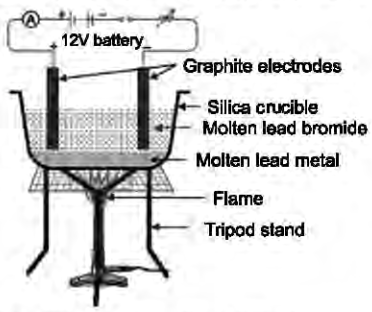
A diagram of the apparatus set up is given below for the electrolysis of fused lead bromide.
Image
(i) Write two properties of silica crucible used in the above apparatus.
(ii) Molten (fused) lead bromide is used as an electrolyte instead of solid lead bromide. Give reason.
(iii) Write the conditions required during the process.
(iv) Write the reactions taking place at the electrodes.
(v) Write the observations during the process.
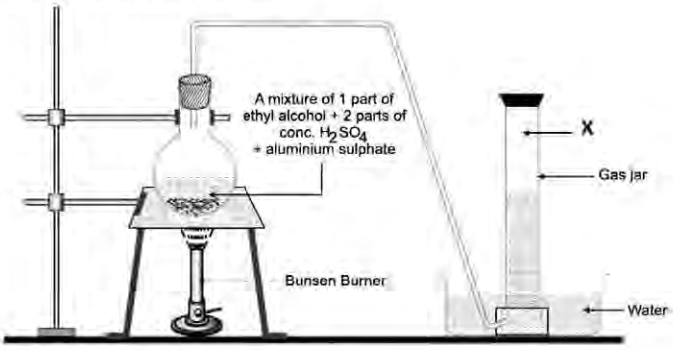
Look at the set-up of given apparatus carefully.
Image
(i) Identify 'X'.
(ii) Name the process of collection of 'X'. Justify.
(iii) Write the chemical equations involved.
(iv) What is the role of sulphuric acid in the above process?
State the factors that influence the preferential discharge of ions at the electrodes.