Question
Explain the Term :
Parturition

Answer

Parturition or birth : It is the expelling of the foetus from the body of the mother. It begins by the contraction of the uterine walls resulting in labor pains.

Need a full question paper?

Generate a complete, print-ready paper with questions like this in minutes — across 16+ boards, with answer keys.

Start Generating Free

Similar questions

Mention one difference between the following on the basis of what is given in bracket.
Grass and grasshopper (mode of nutrition)
Why is meiosis referred to as 'reductional division'?
The diagram below represents a mammalian kidney tubule (nephron) and its blood supply. Parts indicated by the guidelines 1 to 8 are as follows:
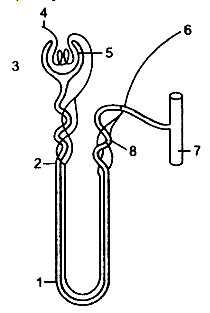
1. U-shaped loop of Henle
2. Proximal convoluted tubule with blood capillaries
3. Bowman’s capsule
4. Afferent arteriole from the renal artery
5. Glomerulus
6. Venule to the renal vein
7. Collecting tubule
8. Distal convoluted tubule with blood capillaries Study the diagram and answer the following questions in each case:
(i) Where does ultrafiltration take place?
(ii) Which structure contains the lowest concentration of urea?
(iii) Which structure contains the highest concentration of urea?
(iv) Which structure contains the lowest concentration of glucose?
(v) Where is the most water reabsorbed?
Name the different endocrine glands found in the body of man.
Explain the Term :
Cretinism
SHORT ANSWER TYPE QUESTIONS
Given below are two statements which are incorrect. Rewrite the correct statements;
(i) Arteries carry blood away from the heart, while veins carry blood to the heart.
(ii) Capillaries are thick-walled blood vessels that transport oxygenated blood.
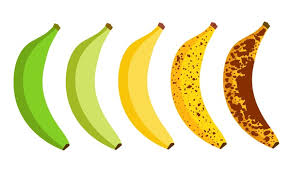
The figure given below shows the stages of ripening in a banana. Answer the question that follow: Image
Mention two characteristic features of this hormone.
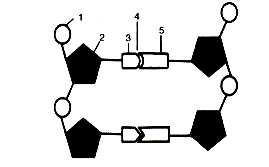
Given below is a schematic diagram of a portion of DNA

(a) How many strands are shown in the pic?
(b) How many nucleotides have been shown in each strand?
(c) Name the parts numbered 1, 2, 3, 4 and 5 respectively.
(d) Name the DNA unit constituted by the parts 1, 2, 3 collectively.
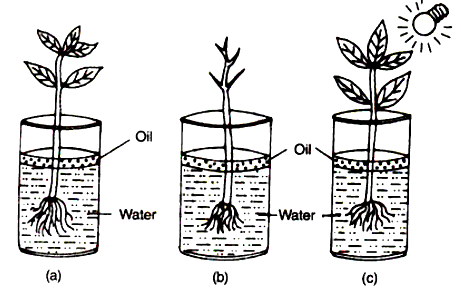
Three plants (a), (b) and (c) were placed in beakers containing coloured water. The water in each beaker was covered with a layer of oil. The leaves were removed from plant (b), while plant (c) was exposed to strong light.
(i) In which plant, (a), (b) or (c) would the water move up the fastest?
(ii) In which plant (a), (b) or (c), would the water move up slowly?
(iii) Why was the water covered with a layer of oil?
(iv) What is being investigated by this experiment?
Give reason:
A matured mammalian erythrocyte lacks nucleus and mitochondria.