Chromosomal Basis of Inheritance. — BIO BOTANY STD 12 — Question
Tamilnadu BoardEnglish MediumSTD 12BIO BOTANYChromosomal Basis of Inheritance.5 Marks
Question
Explain the Translocation type of chromosomal aberration. Translocation
✓
Answer
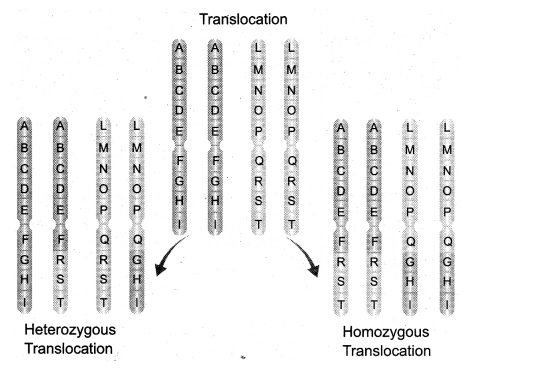
The transfer of a segment of the chromosome to a non-homologous chromosome is called translocation. Translocation should not be confused with crossing over, in which an exchange of genetic material between homologous chromosomes takes place. Translocation occurs as a result of the interchange of chromosome segments in non-homologous chromosomes.
There are three types:
Simple translocation
Shift translocation
Reciprocal translocation
i. Simple translocation: A single break is made in only one chromosome. The broken segment gets attached to one end of a non-homologous chromosome. It occurs very rarely in nature.ii. Shift translocation: A broken segment of one chromosome gets inserted interstitially in a non-homologous chromosome.iii. Reciprocal translocations: It involves the mutual exchange of chromosomal segments between two non-homologous chromosomes. It is also called illegitimate crossing over. It is further divided into two types.a. Homozygous translocation: Both the chromosomes of two pairs are involved in translocation. Two homologous of each translocated chromosomes are identical.b. Heterozygous translocation: Only one of the chromosome from each pair of two homologous are involved in translocation, while the remaining chromosome is normal. Translocations play a major role in the formation of species.
Need a full question paper?
Generate a complete, print-ready paper with questions like this in minutes — across 16+ boards, with answer keys.