Question
Explain the transportation of holes inside a p-type semiconductor.

Answer

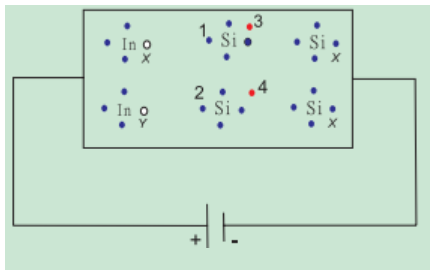
i. Consider a p-type semiconductor connected to terminals of a battery as shown.
ii. When the circuit is switched on, electrons at 1 and 2 are attracted to the positive terminal of the battery and occupy nearby holes at x and y. This creates holes at the positions 1 and 2 previously occupied by electrons.
Image
iii. Next, electrons at 3 and 4 move towards the positive terminal and create holes in their previous positions.
iv. But, the holes are captured at the negative terminal by the electrons supplied by the battery.
v. In this way, holes are transported from one place to other and density of holes is kept constant so long as the battery is working.
Need a full question paper?

Generate a complete, print-ready paper with questions like this in minutes — across 16+ boards, with answer keys.

Start Generating Free

Similar questions

Distinguish between ohmic and non ohmic substances; explain with the help of example.
Write a note on:
i. Electric devices
ii. Electronic devices
How do we determine strength of magnetic field at a given point due to a magnet? Write down units of magnetic field in SI and CGS system and their interconversion.
State the formula for calculating work done by a force. Are there any conditions or limitations in using it directly? If so, state those clearly. Is there any mathematical way out for it? Explain.
Define gravitational force. Give its examples.
Two weights 5 kg and 8 kg are suspended from a uniform rod of length 10 m and weighing 3 kg. The distances of the weights from one end are 2 m and 7 m. Find the point at which the rod balances.
A metro train runs from station A to B to C. It takes 4 minutes in travelling from station A to station B. The train halts at station B for 20 s. Then it starts from station B and reaches station C in next 3 minutes. At the start, the train accelerates for 10 sec to reach the constant speed of 72 km/hr. The train moving at the constant speed is brought to rest in 10 sec. at next station.
(i) Plot the velocity- time graph for the train travelling from the station A to B to C.
(ii) Calculate the distance between the stations A, B and C.
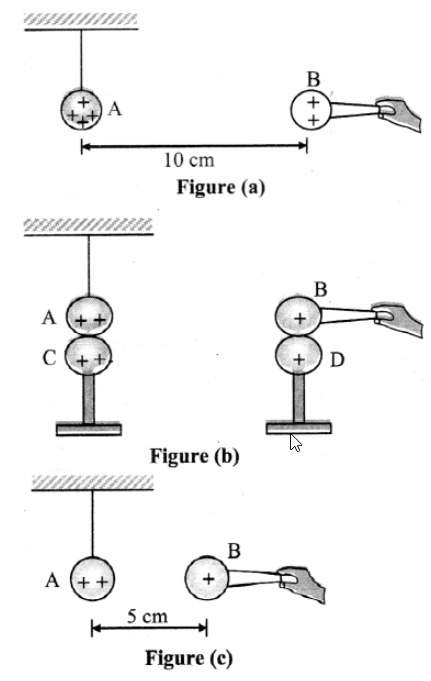
A charged metallic sphere A is suspended by a nylon thread. Another charged metallic sphere B held by an insulating handle is brought close to A such that the distance between their centres is 10 cm, as shown in figure (a). The resulting repulsion of A is noted (for example, by shining a beam of light and measuring the deflection of its shadow on a screen.) Spheres A and B are touched by uncharged spheres C and D respectively, as shown in figure (b). C and D are then removed and B is brought closer to A to a distance of 5.0 cm between their centres, as shown in figure (c). What is the expected repulsion of A on the basis of Coulomb’s law? Spheres A and C and spheres B and D have identical sizes. Ignore the sizes of A and B comparison to the separation between their centres.
Image
The sound emitted from the siren of an ambulance has frequency of $1500\ Hz$. The speed of sound is $340\ m/s$. Calculate the difference in frequencies heard by a stationary observer if the ambulance initially travels towards and then away from the observer at a speed of $30\ m/s$.
At a given place on the Earth, a bar magnet of magnetic moment $\vec{m}$ is kept horizontal in the EastWest direction. $P$ and $Q$ are the two neutral points due to magnetic field of this magnet and $\vec{B}_{ H }$ is the horizontal component of the Earth's magnetic field.
$i$. Calculate the angles between position vectors of $P$ and $Q$ with the direction of $\vec{m}$.
$ii$. Points $P$ and $Q$ are $1 m$ from the centre of the bar magnet and $B_H=3.5 \times 10^{-5} T$. Calculate magnetic dipole moment of the bar magnet.
Neutral point is that point where the resultant magnetic field is zero.