Question
Explain the two complexities that are observed in the process of transcription in eukaryotes and not in prokaryotes.

Answer

Two complexities that are observed in the process of transcription in eukaryotes and not in Prokaryotes are as follows
i. There are three RNA polymerases in the nucleus RNA polymerase I transcribes - rRNAs, RNA polymerase II transcribes - heterogenous nuclear RNA/hnRNA, RNA polymerase III transcribes - tRNA/5 srRNA/snRNA (small nuclear RNAs).
ii. Primary transcripts/hnRNA contain both the exons and non functional introns, subjected to splicing where introns are removed, exons are joined in a defined order, hnRNA undergoes processing called capping and tailing, In capping nucleotide methyl guanosine triphosphate is added to 5' end of hnRNA, In tailing adenylate residues (200-300) are added at 3"- end in a template independent manner, this fully processed hnRNA is now called mRNA (and transported out of the nucleus for translation).
Need a full question paper?

Generate a complete, print-ready paper with questions like this in minutes — across 16+ boards, with answer keys.

Start Generating Free

Similar questions

What is ecological succession? What is climax community? How is climax community established?
(i) Define the cross-pollination.
(ii) Give one example each of aluminious, exalbuminous, perispermic seeds.
(iii) Draw a well labelled diagram showing the growth of pollen tube in longitudinal section of pistil.
What is agamospermy? How is agamospermy different from parthenogenesis and parthenocarpy?
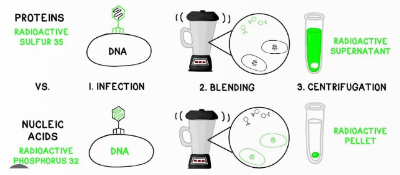
In 1952, Alfred Hershey and Martha Chase took an effort to find the genetic material in organisms. Their experiments led to an unequivocal proof to DNA as genetic material.
Image

Answer the following questions based on Hershey and Chases's experiments:
i. Name the kind of virus they worked with and why?
ii. Why did they use two types of culture media to grow viruses in? Explain.
iii. What was the need for using a blender and later a centrifuge during their experiments? OR
iv. State the conclusion drawn by them after the experiments.
(i) Write the causes of cancer.
(ii) Explain cancer detection.
(iii) Draw a schematic diagram of the lymphatic system.
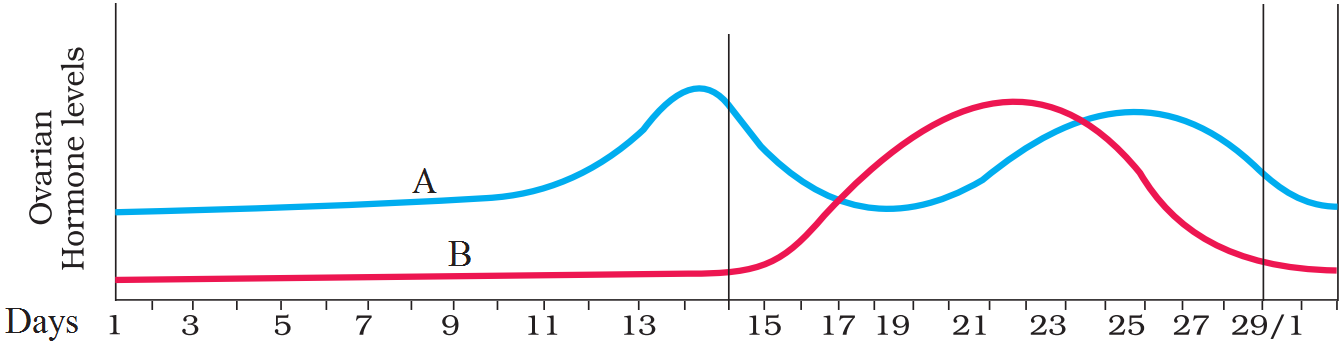
The graph given below shows the variation in the levels of ovarian hormones during various phases of menstrual cycle:

Compare the role of A and B.

You have a friend whose parents are too indulgent in his/her daily affairs. They think him/her to be still young which makes him/her sad and is upset all the time. As he/she feels that the parents should give him/her opportunity to take independent decision on some issues.
  1. Would you support your friend and why?
  2. Write the characteristics of this age group.
  3. List two curative measures.
Read the following and answer any four questions from (i) to (v) given below:

Crown gall is a neoplastic disease of most dicotyledonous plants and is caused by the soil bacterium Agrobacterium tumefaciens. A large extra chromosomal plasmid in these bacteria was found to be responsible for this disease. The plasmid is known as Ti plasmid. Bacteria free crown gall cells can be cultured in the absence of phytohormones. Ti plasmid is widely used in genetic engineering to deliver the desirable genes. The part of Ti plasmid transferred into plant cell DNA is called T-DNA. T-DNA with desired DNA segment is inserted into the chromosome of the host plant where it produces copies of itself.

  1. Which of the following is the full full of T-DNA?
  1. Transfer DNA.
  2. Tumour inducing DNA.
  3. Transgenic DNA.
  4. None of these.
  1. Ti plasmid cannot infect and develop crown gall in,
  1. Tomato.
  2. Maize.
  3. Soybean.
  4. sunflower.
  1. While making transgenic plant, T-DNA is inserted into the host cell, it is then:
  1. Integrated into the target host genome.
  2. Lie independent of the host genome.
  3. Rupture the host cell wall.
  4. Produce oncogenic factors in the host.
  1. Agrobacterium mediated gene transfer in plants:
  1. Allows relatively large segment of DNA.
  2. Transfer of DNA with defined ends and minimal rearrangement.
  3. High quality and fertility in transgenic plants.
  4. All of these.
  1. Assertion: In Agrobacterium mediated gene transfer in plants, transgenic plants do not develop tumors.

Reason: In T-DNA tumor producing genes are deleted during the process of gene transfer.

  1. Both assertion and reason are true and reason is the correct explanation of assertion.
  2. Both assertion and reason are true but reason is not the correct explanation of assertion.
  3. Assertion is true but reason is false.
  4. Both assertion and reason are false.
State and explain with the help of a cross, the law of segregation as proposed by Mendel.
What is incomplete dominance? Explain it taking the example of snapdragon plant by checker board. Also write the phenotypic and genotypic ratio.