Question
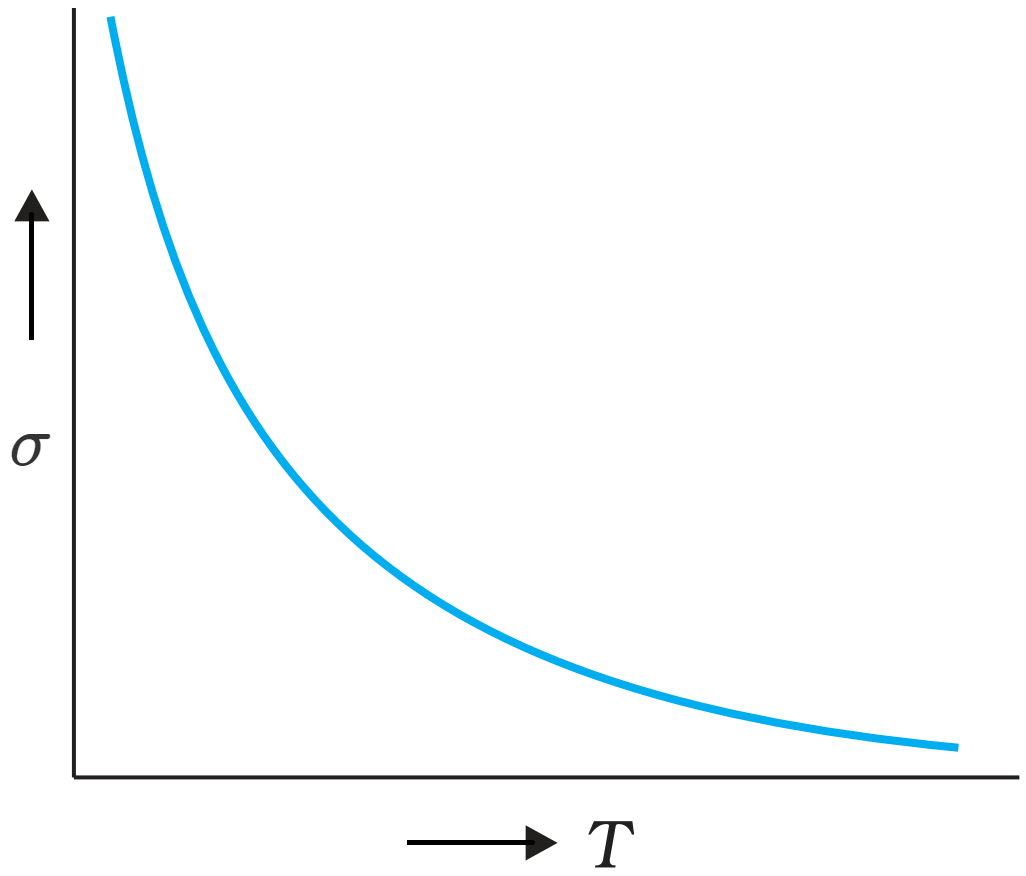
Explain the variation of conductivity with temperature for:
  1. A metallic conductor.
  2. Ionic conductors.
  3. Semiconductors.

Answer

Conductivity of a metallic conductor $\sigma=\frac{1}{\rho}=\frac{\text{ne}^2\tau}{\text{m}}.$

Where m = mass of charge carrier, e = charge on each carrier

$\tau$ = relaxation time, n = number density of charge carriers

  1. With rise of temperature, the collision of electrons with fixed lattice ions/ atoms increases so that relaxation time $(\tau)$ decreases. Consequently, the conductivity of metals decreases with rise of temperature.
  2. Conductivity of ionic conductor increases with increase of temperature because with increase of temperature, the ionic bonds break releasing positive and negative ions which are charge carriers in ionic conductors.
  3. In the case of a semiconductors, when temperature increases, covalent bonds break and charge carriers (electrons and holes) become free i.e., n increases, so conductivity increases with rise of temperature.

Need a full question paper?

Generate a complete, print-ready paper with questions like this in minutes — across 16+ boards, with answer keys.
Start Generating Free

Similar questions

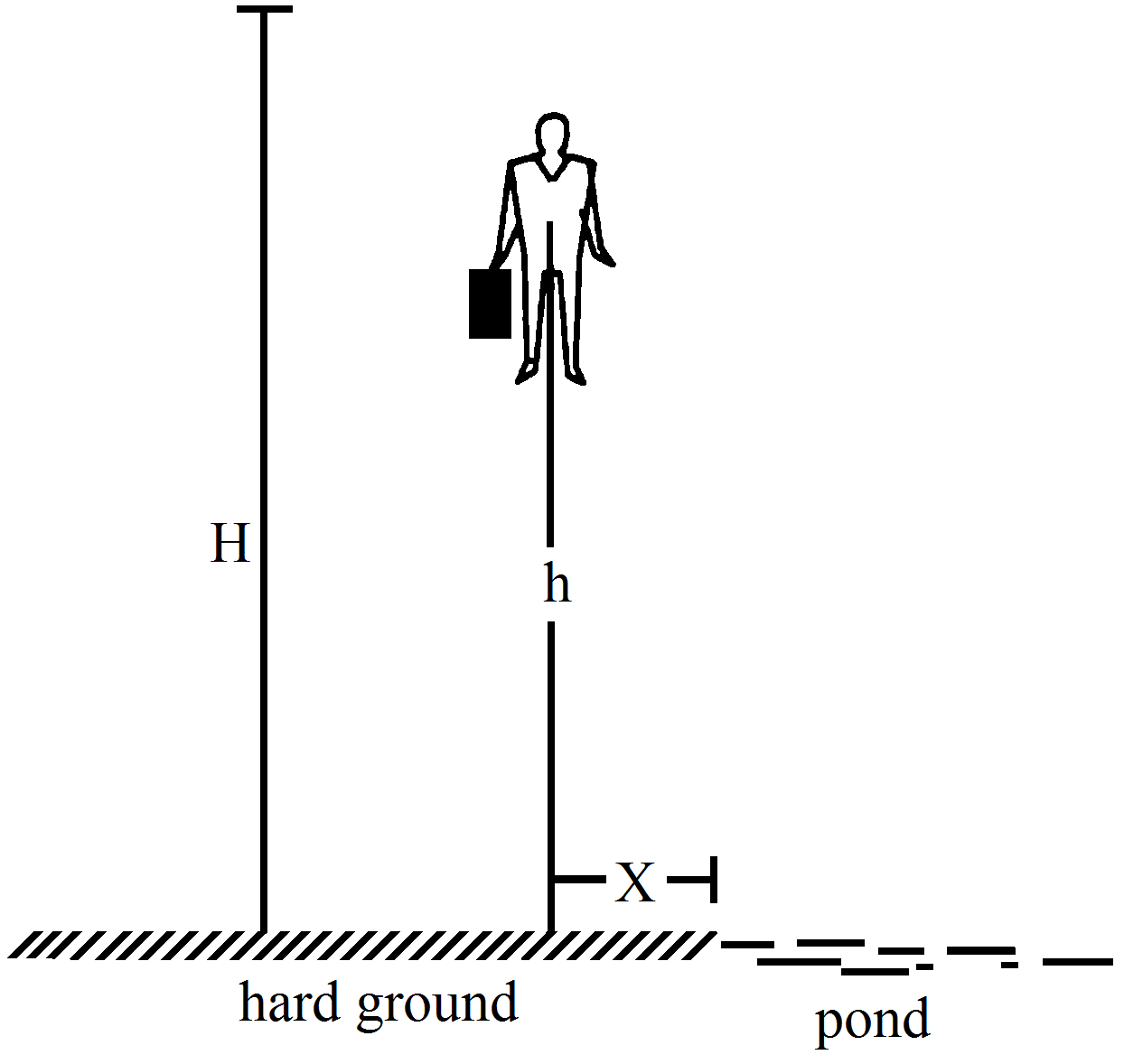
A man of mass M having a bag of mass m slips from the roof of a tall building of height H and starts falling vertically. When at a height h from the ground, he notices that the ground below him is pretty hard, but there is a pond at a horizontal distance x from the line of fall. In order to save himself he throws the bag horizontally (with respect to himself) in the direction opposite to the pond. Calculate the minimum horizontal velocity imparted to the bag so that the man lands in the water. If the man just succeeds to avoid the hard ground, where will the bag land?

  1. Compare the individual dipole moment and the specimen dipole moment for H2O molecule and O2 molecule when placed in:
  1. Absence of external electric field.
  2. Presence of external eclectic field. Justify your answer.
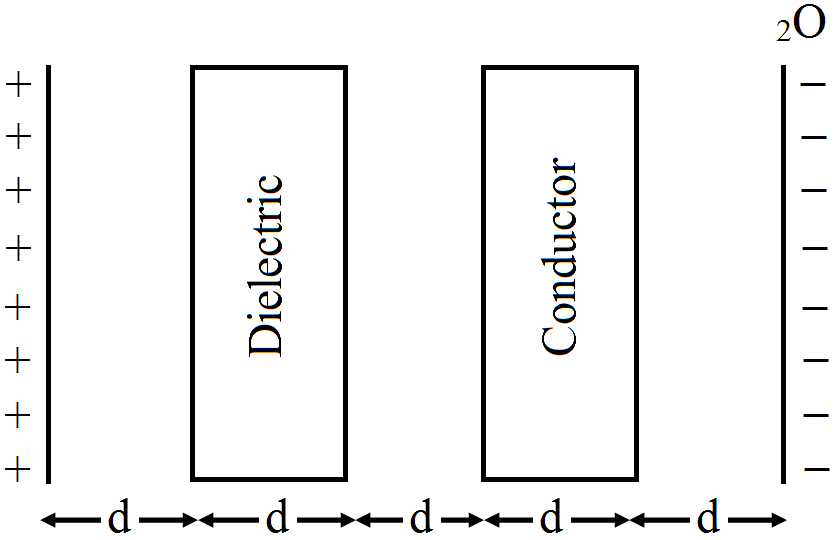
  1. Given two parallel conducting plates of area A and charge densities $+\sigma$ and $-\sigma.$ A dielectric slab of constant K and a conducting slab of thickness d each are inserted in between them as shown.

  1. Find the potential difference between the plates.
  2. Plot E versus x graph, taking x = 0 at positive plate and x = 5d at negative plate.
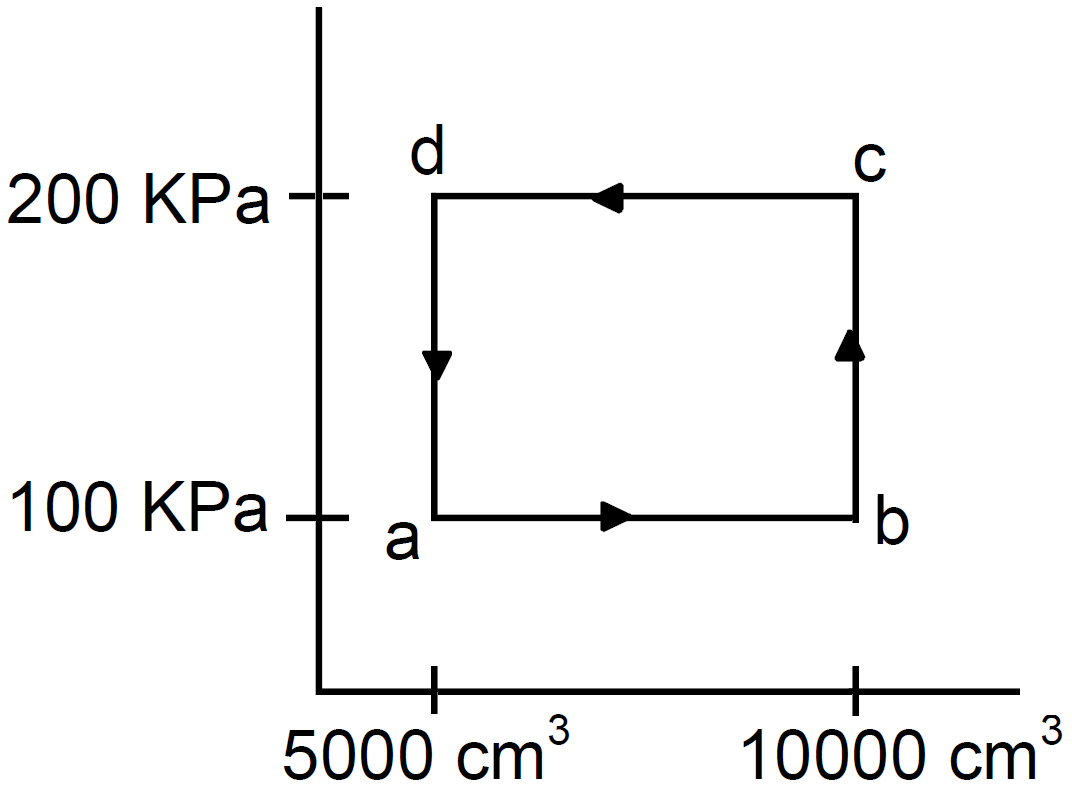
Half mole of an ideal gas $\Big(\gamma=\frac{5}{3}\Big)$ is taken through the cycle abcda, as shown in the figure. Take $\text{R}=\frac{25}{3}\text{JK}^{-1}\text{mol}^{-1}.$
  1. Find the temperature of the gas in the states a, b, c and d.
  2. Find the amount of heat supplied in the processes ab and bc.
  3. Find the amount of heat liberated in the processes cd and da.

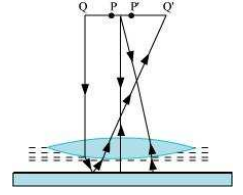
equiconvex lens (of refractive index 1.50) in contact with a liquid layer on top of a plane mirror. A small needle with its tip on the principal axis is moved along the axis until its inverted image is found at the position of the needle. The distance of the needle from the lens is measured to be 45.0 cm. The liquid is removed and the experiment is repeated. The new distance is measured to be 30.0 cm. What is the refractive index of the liquid?

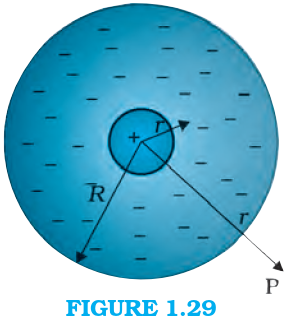
An early model for an atom considered it to have a positively charged point nucleus of charge $Z e$, surrounded by a uniform density of negative charge up to a radius $R$. The atom as a whole is neutral. For this model, what is the electric field at a distance $r$ from the nucleus?
Image
A travelling wave is produced on a long horizontal string by vibrating an end up and down sinusoidally. The amplitude of vibration is 1.0cm and the displacement becomes zero 200 times per second. The linear mass density of the string is 0.10kg/m and it is kept under a tension of 90N.
  1. Find the speed and the wavelength of the wave.
  2. Assume that the wave moves in the positive x-direction and at t = 0, the end x = 0 is at its positive extreme position. Write the wave equation.
  3. Find the velocity and acceleration of the particle at x - 50cm at time t = 10ms.
An icebox almost completely filled with ice at 0°C is dipped into a large volume of water at 20°C. The box has walls of surface area 2400cm2, thickness 2.0mm and thermal conductivity $0.06\text{Wm}^{-1}{^{\circ}}\text{C}^{-1}.$ Calculate the rate at which the ice melts in the box. Latent heat of fusion of ice $= 3.4\times10^5\text{Jkg}^{-1}.$
Solve the previous problem if the friction coefficient between the 2.0kg block and the plane below it is 0.5 and the plane below the 4.0kg block is frictionless.
What is the
  1. Momentum,
  2. Speed, and
  3. De Broglie wavelength of an electron with kinetic energy of 120 eV.
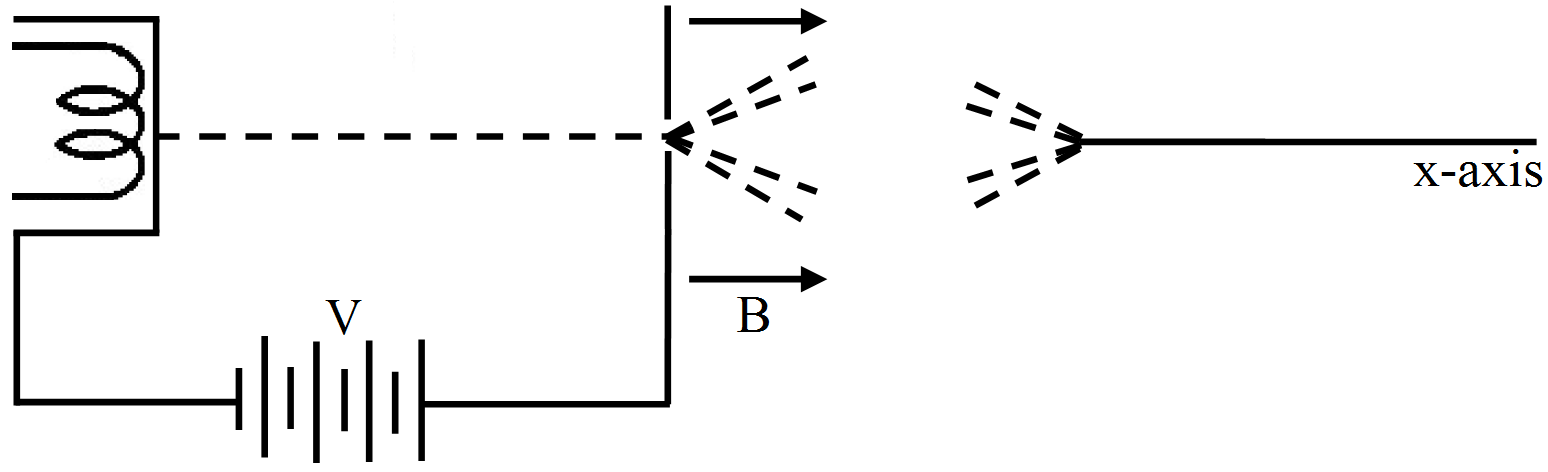
Electrons emitted with negligible speed from an electron gun are accelerated through a potential difference V along the x-axis. These electrons emerge from a narrow hole into a uniform magnetic field B directed along this axis. However, some of the electrons emerging from the hole make slightly divergent angles, as shown in the figure. Show that these paraxial electrons are refocussed on the x-axis at a distance $\sqrt{\frac{8\pi^2\text{mV}}{\text{eB}^2}}.$