Question
Explain the various types of interactions between species.

Answer

In nature, living organisms such as animals, plants and microbes, cannot live in isolation and therefore, interact in various ways to form a biological community.
The interactions between populations of species in a community are broadly divided into two categories:
Positive Interactions:
Symbiosis or Mutualism: When two species live together in a close association that is helpful to both species, the relationship is known as symbiosis. The oxpecker bird and the rhinoceros exhibit this relationship. The oxpecker receives protection and obtains food from the ticks and other pests infesting the rhino’s skin.

Commensalism: Some organisms live together so that one organism benefits by the relationship while the other organism is neither helped nor harmed. This type of relationship is known as commensalism. An example of this association is the relationship between the shark and the small remora fish.

Negative Interactions: Certain interactions between different species give rise to negative effect on either or both species. Parasitism and predation are interaction where one species gains and the other suffers. While in the interaction called competition both species are harmed.
Parasitism: This is a relationship in which one organism, the parasite spends much or all of its life living in or another organism, the host. The parasite is dependent upon the host for food. The parasite benefits from the relationship and the host is always harmed. Parasites may bring about the death of their host, but most often only weaken their host. Human parasites may be external (ectoparasites) such as body lice, ticks, mites and leeches, or internal (endoparasites) such as tapeworms, some types of roundworms, malarial parasite, microfilaria and guineaworm.
Predation: This is commonly associated with the idea of strong attacking the weak such as the tiger pouncing upon the deer, the hawk upon the sparrow, and the frog upon the insects and so on. A species such as the frog may be both a prey and a predator. The relationship between a snake and a rat is more than that between a prey and a predator as the snake also seeks shelter in the rat holes.
Competition: The amount of food, light, space, minerals and water that are available in a particular habitat is limited. As a result, organisms are in competition with one another for one or more of these factors. Competition occurs not only among individuals of a given species but also between members of two or more species.
For instance, carnivorous animals such as tigers and leopards, compete for the prey. The members of kingdom Plantae, such as trees, shrubs and herbs in a forest are to compete for sunlight, nutrients and water and biological agents for pollination and dispersal.
Need a full question paper?

Generate a complete, print-ready paper with questions like this in minutes — across 16+ boards, with answer keys.

Start Generating Free

Similar questions

Ventricles in human brain.
How are the transgenic mice used in cancer research?
Placenta acts as an endocrine gland. Explain.
Sakshi's father announced that the children are going to spend this weekend with their grandparents. During the journey, Sakshi saw some farmers who were spraying agrochemicals in their field. She requested her father to stop them. Her father praised her and contacted the farmers. He explained the side effects of such agrochemicals. He also suggested them to use biopesticides and biofertilisers instead of such chemicals. The farmers gave up spraying agrochemicals.
  1. What did Sakshi's father explain to the farmers?
  2. What are agrochemicals?
  3. Why are biofertilisers or biopesticides preferred to chemical fertilisers or pesticides?
  4. What values did Sakshi promote?
  1. Taking example of a small pond, explain how the four components of an ecosystem function as a unit.
  2. Name the type of food chain that exist in a pond.
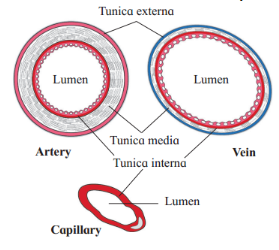
Describe histological structure of artery, vein and capillary.

Image

Morula and Blastula.
m-RNA, t-RNA and r-RNA.
Read the following and answer any four questions from (i) to (v) given below:
Stem cells hold the potential for manifold applications in biotechnology based next generation therapeutics. Scientists are trying to formulate better and more personalised treatment modalities against some seemingly irremediable diseases, by harnessing body's own stem cells and stem cell niche. Stem cells of different origin and level of potency are being investigated for tissue regeneration, treatment of bone defect, drug testing, gene therapy and cell based therapy for muscle damage, spinal cord injury, cancer therapy, etc. 'Tile properties of embryonic and adult stem cells to either self-renew or differentiate into multiple cell lineages make them an attractive source for cell therapies, tissue engineering and as model system for drug screening.
  1. Stem cells are widely used in medical research. Which property of stem cells makes them particularly useful in this research?
  1. They can be fused together to form a zygote.
  2. They can divide and eventually give rise to a whole organism.
  3. They can divide and be made to differentiate into various types of cell.
  4. They will continue to divide indefinitely.
  1. Stem cells can be divided into four main types. Which of the four types of stem cell can differentiate into a limited range of tissues?
  1. Adult stem cells.
  2. Embryonic stem cells.
  3. Fetal stem cells.
  4. Zygotic stem cells.
  1. Which feature of stem cells obtained from blood in the umbilical cord enables their use in the treatment of a variety of blood cancers?
  1. They can differentiate into bone marrow cells.
  2. They can differentiate into any cellular component of blood.
  3. They can replace blood stem cells affected by cancer.
  4. They are totipotent.
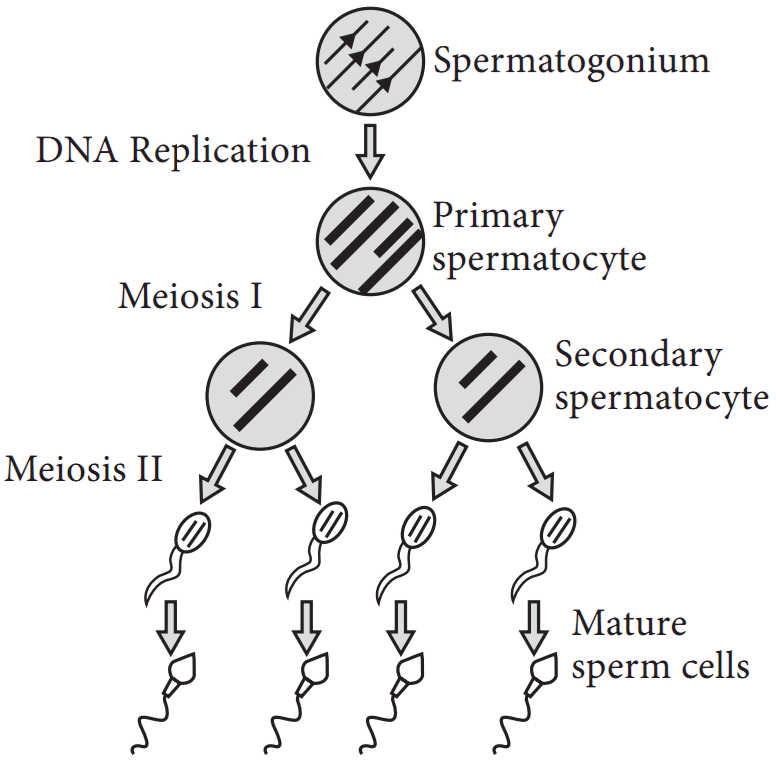
  1. The search for pluripotent stem cells is intense. The spennatogonium is the diploid precursor of haploid sperm in the development pathway of mouse gametes as shown below.


Scientists were interested to find out which stages of sperm development have stem cell capacity. Two experiments were carried out using sterile host males with testes that lacked germ cells. The results are shown in the table.
  Type of cells used Result
Experiment 1 Secondary spermatocytes were injected Fertility was not restored
Experiment 2 Spermatogonia were injected Fertility was restored for the rest of the mouse's life
What property of a stem cell is missing in the secondary spermatocytes?
  1. Specialisation.
  2. Self-renewal.
  3. Commitment.
  4. A proper stem-cell niche.
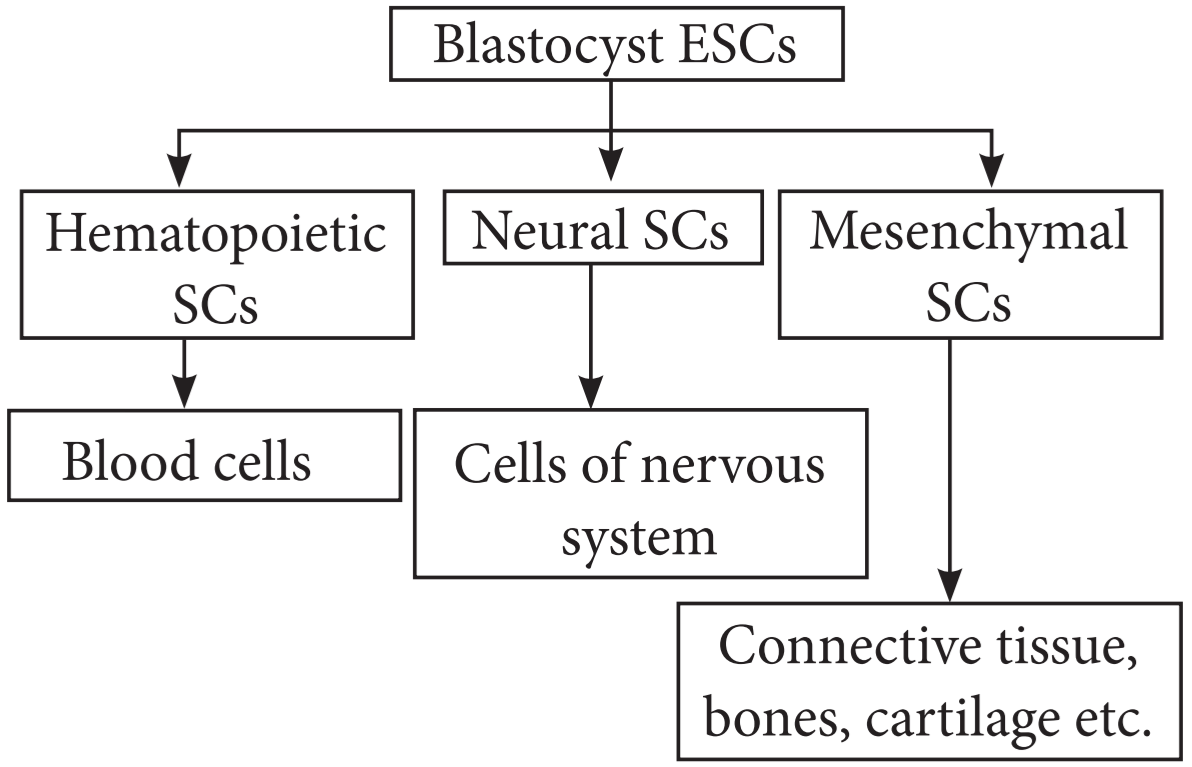
  1. Which feature of embryonic stem cells (ESCs) is illustrated below?
  1. ESCs are capable of dividing.
  2. ESCs are multipotent.
  3. ESCs are pluripotent.
  4. ES Cs show plasticity.
Write two differences between spermatogenesis and oogenesis.