Question
Explain threshold frequency and stopping potential.###Define the following with respect to photoelectric effect :
(i) Work function (ii) Stopping potential

Answer

Threshold frequency : The minimum frequency below which photon is not capable of emitting an electron is called the threshold frequency. This is represented by $v_0$.
Stopping potential : The negative potential of plate C relative to P at which the photoelectric current becomes zero is called "stopping potential" or "cut off potential".
Work function : The minimum energy required for the emission of photoelectron from a metal is called the 'Work function' of that metal. Generally it represented by W or $\phi_0$. It is expressed in Joule and electron Volt.

Need a full question paper?

Generate a complete, print-ready paper with questions like this in minutes — across 16+ boards, with answer keys.
Start Generating Free

Similar questions

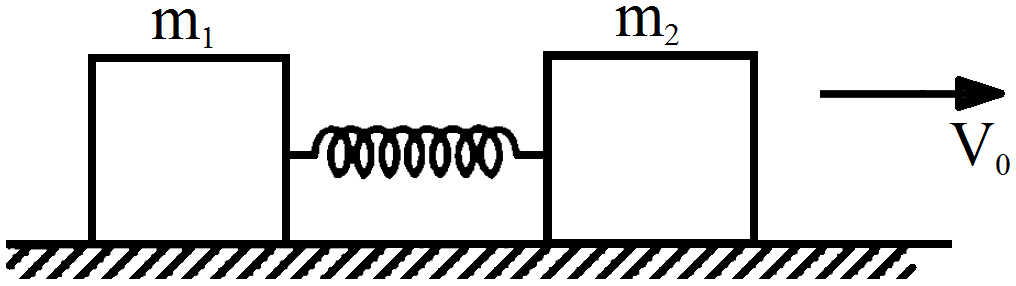
Two blocks of masses $m_1$ and $m_2$ are connected by a spring of spring constant k. The block of mass $m_2$ is given a sharp impulse so that it acquires a velocity $v_0$ towards right. Find
  1. The velocity of the centre of mass.
  2. The maximum elongation that the spring will suffer.
An inductor-coil, a capacitor and an AC source of rms voltage 24V are connected in series. When the frequency of the source is varied, a maximum rms current of 6.0A is observed. If this inductor coil is connected to a battery of emf 12V and internal resistance $4.0\Omega,$ what will be the current?
A body of mass 2kg suspended through a vertical spring executes simple harmonic motion of period 4s. If the oscillations are stopped and the body hangs in equilibrium, find the potential energy stored in the spring.
Two identical coherent waves, each of intensity I, are producing an interference pattern. Find the value of the resultant intensity at a point of:
  1. Constructive interference.
  2. Destructive interference.
What is the energy of a hydrogen atom in the first excited state if the potential energy is taken to be zero in the ground state?
Consider a uniform electric field $E = 3 \times 10^3$ î N/C.
  1. What is the flux of this field through a square of 10 cm on a side whose plane is parallel to the yz plane?
  2. What is the flux through the same square if the normal to its plane makes a 60° angle with the x-axis?
The band gap for silicon is 1.1eV.
  1. Find the ratio of the band gap to kT for silicon at room temperature 300K.
  2. At what temperature does this ratio become one tenth of the value at 300K?
(Silicon will not retain its structure at these high temperatures.)
A circular copper-ring of radius r translates in its plane with a constant velocity v. A uniform magnetic field B exists in the space in a direction perpendicular to the plane of the ring. Consider different pairs of diametrically opposite points on the ring.
  1. Between which pair of points is the emf maximum? What is the value of this maximum emf?
  2. Between which pair of points is the emf minimum? What is the value of this minimum emf?
0.5 A of current is flowing through a coil of 25 turns and area $200 cm^2$. What is the pole strength of 10 cm length of bar magnet whose magnetic moment is equal to magnetic moment of the coil?
Why is the mass of a nucleus always less than the sum of the masses of its constituents, neutrons and protons?If the total number of neutrons and protons in a nuclear reaction is conserved, how then is the energy absorbed or evolved in the reaction? Explain.